
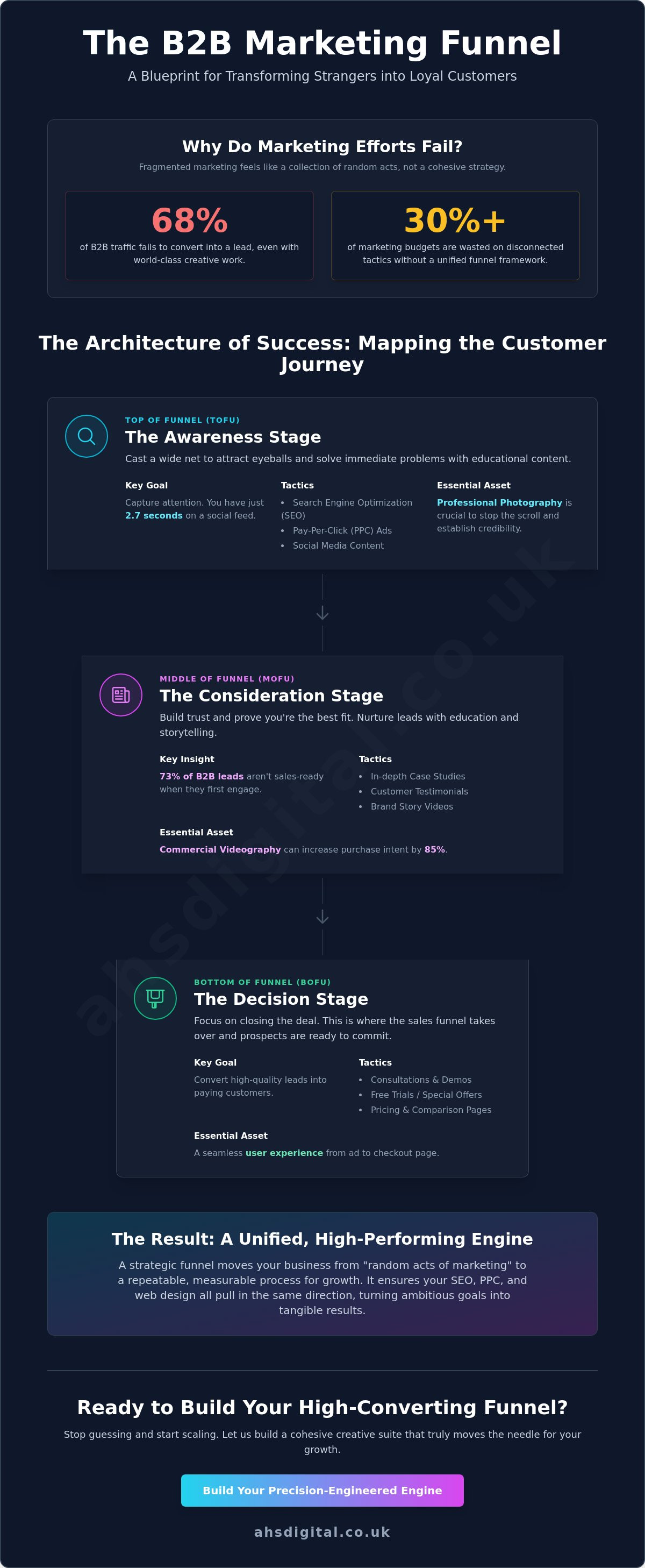
Why does 68% of B2B traffic fail to convert into a lead, even when the creative work looks world-class? You’re likely tired of fragmented marketing efforts that feel more like a collection of random acts than a cohesive digital marketing strategy. It’s frustrating to see healthy traffic numbers in your analytics while your conversion rates remain low, especially when you can’t clearly measure the ROI of your latest campaign assets.
We believe your marketing should be a precision engineered engine, not a series of disconnected gambles. In this guide, we’ll show you how to create a marketing funnel that bridges the gap between a first impression and a final sale. You’ll discover how to build a high converting system that transforms strangers into loyal customers and moves the needle for your business growth. We’re outlining a clear roadmap for customer acquisition that ensures your brand message remains unified across every single touchpoint, giving you the predictable growth your ambition deserves.
Key Takeaways
- Understand why a strategic funnel is the essential backbone of your digital marketing and how it visualises the journey from curiosity to conversion.
- Discover the step-by-step process of how to create a marketing funnel that targets specific pain points and captures high-quality leads for your business.
- Learn to avoid the “one-size-fits-all” content trap by mapping a bespoke customer journey that resonates with your unique UK audience.
- Identify and fix the common “leakage points” in your sales process where poor web design or fragmented branding might be draining your potential ROI.
- Realise the power of a cohesive creative suite and unified identity to build a high-performing engine that truly moves the needle for your growth.
From Curiosity to Conversion: What is a Marketing Funnel?
A marketing funnel isn’t just a corporate buzzword; it’s the visual architecture of your customer’s journey from a total stranger to a loyal advocate. Think of it as a strategic map that tracks every interaction a prospect has with your brand. For any ambitious UK business, understanding the purchase funnel is the first step toward predictable growth. It’s the backbone of every successful digital marketing campaign we build, ensuring that no lead is left behind in a crowded marketplace.
The core purpose is simple: turning cold traffic into hot leads and, eventually, repeat buyers. Without this structure, you’re essentially throwing money away. A well-designed funnel provides total clarity on your ROI, showing you exactly where your marketing spend is working and where it’s leaking. When you master 2. how to create a marketing funnel, you stop guessing and start scaling. Our 100% U.K. Based team sees this as the difference between a hobby and a high-growth enterprise.
To better understand this concept, watch this helpful video:
The Difference Between Marketing and Sales Funnels
Marketing funnels focus on the top and middle sections, generating awareness and nurturing interest through education. Sales funnels take over when the prospect is ready to commit, focusing purely on closing the deal. These two systems must work in perfect harmony to be effective. If there’s a gap between your social media ads and your checkout page, you’ll experience “dropped” customers who were interested but didn’t feel confident enough to buy. We focus on creating a seamless transition from your brand story to the final purchase. This involves aligning your messaging so the customer feels supported at every touchpoint, from the first click to the final “thank you” page.
Why Ambitious Businesses Need a Unified Strategy
The danger of “random acts of marketing” is real for many growing firms. Without a funnel framework, you’re likely wasting 30% or more of your budget on disconnected tactics. A funnel helps you scale your business from the ground up by providing a repeatable, measurable process. It allows you to see that for every £1 spent, you’re generating a specific return. The value of having all your marketing needs in one place cannot be overstated. It ensures your SEO, PPC, and web design all pull in the same direction. We love a challenge, and building a cohesive creative suite is how we move the needle for our clients, turning ambitious goals into tangible results.
The Architecture of Success: Mapping the Customer Journey
Building a funnel isn’t just a marketing task; it’s an architectural project for your brand. If you’re wondering 2. how to create a marketing funnel that actually converts, you have to stop treating every lead like they’re ready to buy immediately. Current market data suggests that 73% of B2B leads aren’t sales-ready when they first engage with a brand. This makes an effective marketing funnel a vital framework for nurturing relationships rather than just shouting into the void. You need a strategy that aligns your business goals with the specific, evolving needs of your audience.
A “one-size-fits-all” approach to content is the quickest way to waste your budget in 2026. Ambitious UK businesses succeed when they deliver the right message at the right time. High-quality creative assets aren’t just “nice to have” anymore; they’re the foundation of trust. Without a cohesive visual identity, your funnel will leak at every stage. We focus on creating a journey that moves the needle by prioritising clarity, engagement, and scalability.
TOFU: The Awareness Stage (Attracting Eyeballs)
This is where you cast a wide net using SEO, social media, and PPC. At the Top of Funnel (TOFU), your goal is to solve immediate problems with educational content. You only have about 2.7 seconds to capture attention on a social feed. Using professional photography is essential to stop the scroll. Authentic, high-end imagery establishes immediate credibility, making potential customers stop and listen to what you have to say before they even read a word of copy. It’s about being seen in a crowded marketplace.
MOFU: The Consideration Stage (Building Trust)
Once you have their attention, you must prove you’re the best fit. The Middle of Funnel (MOFU) is about education and storytelling. This is where the power of commercial videography comes into play. A well-produced brand story or a detailed product demonstration can increase purchase intent by 85% compared to text alone. By using case studies and testimonials, you can cultivate digital growth and show prospects exactly how you’ve solved similar challenges for other businesses. Trust is earned through transparency and proof.
BOFU: The Decision and Loyalty Stages (Closing the Loop)
The Bottom of Funnel (BOFU) is where the transformation happens. You’ve built the trust; now you must remove the friction. This requires responsive, lightning-fast web design that works perfectly on mobile. If a page takes longer than three seconds to load, conversion rates drop significantly. Craft compelling calls to action that encourage immediate conversion, then turn those one-time buyers into brand advocates through proactive post-purchase engagement. If you’re ready to scale your results, get in touch to discuss your strategy.
Constructing Your Engine: A Step-by-Step Guide to Creating a Marketing Funnel
Building a lead-generation machine isn’t about guesswork; it’s about engineering. Understanding 2. how to create a marketing funnel requires a blueprint that moves the needle for your specific UK audience. You aren’t just looking for clicks; you’re looking for a scalable system that transforms strangers into loyal advocates.
Defining Your Audience and Objectives
You cannot build a funnel if you don’t know who you’re talking to. In the UK, 61% of marketers identify lead generation as their primary struggle, often because they target too broadly. Setting SMART goals, such as achieving a 20% increase in Marketing Qualified Leads by December 2024, provides the clarity your campaign needs. Researching the UK market landscape for your specific industry ensures your messaging resonates with local pain points and cultural nuances.
Building the Technical Infrastructure
Your tech stack is the chassis of your marketing engine. For ambitious ecommerce brands, platforms like Magento 2 provide the scalability needed to handle rapid growth and complex inventories. Integrating your digital marketing strategies, such as SEO and PPC, ensures maximum visibility from day one. Speed is vital; data shows that a site taking over three seconds to load loses 40% of its visitors. This step-by-step guide to creating a marketing funnel emphasises that your infrastructure must be responsive, lightening-fast, and ready to convert on any device.
To keep your engine running smoothly, follow these five essential steps:
- Step 1: Identify your target audience and their core pain points to ensure your solution is the obvious choice.
- Step 2: Create a lead magnet or “hook,” such as a bespoke industry report or a limited-time discount, to capture interest.
- Step 3: Design high-converting landing pages that look great on mobile and remove all friction from the user journey.
- Step 4: Set up automated nurture sequences using CRM tools to stay top-of-mind without manual intervention.
- Step 5: Measure, test, and optimise your funnel stages to improve your conversion rates based on real-time user data.
The Nurture Process: Keeping the Conversation Going
Lead nurturing is the process of building relationships with prospects who are not yet ready to buy. Use email marketing and social retargeting to guide users down the funnel with helpful, relevant content. Personalising the experience based on user behaviour is essential; 80% of shoppers are more likely to buy from brands that offer tailored interactions. When you master 2. how to create a marketing funnel, you stop shouting into the void and start building a cohesive creative suite that delivers consistent ROI.
Why Most Funnels Leak: Avoiding the Pitfalls that Drain ROI
Ambitious UK businesses often watch their hard-earned ROI vanish because they’ve built a strategy full of holes. Identifying these leakage points is the first step toward a digital presence that actually moves the needle. A 2023 study found that only 22% of businesses are satisfied with their conversion rates, a statistic that usually stems from relying on “gut feeling” rather than hard data. Mastering the technical side of 2. how to create a marketing funnel is only half the battle, the other half is constant, data-driven refinement.
Generic, boring visuals are the silent killers of modern marketing. If your brand uses the same tired stock photos of people shaking hands as your competitors, you’ve already lost the trust of your audience. High-impact, unique creative assets aren’t just a luxury, they’re a fundamental requirement for keeping people engaged. When you ignore the data and refuse to evolve your aesthetic, you’re essentially leaving money on the table for more agile competitors to scoop up.
The Content-Offer Mismatch
Sending top-of-funnel traffic directly to a “Buy Now” page is a recipe for a high bounce rate. It’s the digital equivalent of asking for a marriage proposal on a first date. You’ve got to ensure your creative assets match the intent of the searcher. If a user is looking for information, provide value that establishes your authority. Aligning your brand voice with the emotional state of the customer, whether they’re curious, frustrated, or ready to commit, is vital for a seamless transition through the stages of 2. how to create a marketing funnel.
Slow Load Times and Poor Mobile Experience
A slow website kills your SEO and frustrates your users before they even see your offer. Google’s data indicates that a one-second delay in mobile load times can decrease conversion rates by up to 20%. This is where professional web design becomes your greatest competitive advantage. Lightening-fast performance is a business necessity, not just a technical buzzword. Your UX and UI must be prioritised to keep people moving through the funnel without friction, especially for the 60% of UK users who now browse primarily on mobile devices.
- Data over intuition: Stop guessing what your customers want and start using heatmaps and A/B testing.
- Visual storytelling: Swap generic imagery for “off the wall” visuals that capture attention instantly.
- Mobile-first mindset: If it doesn’t work perfectly on a smartphone, it doesn’t work at all.
Ready to plug the leaks and scale your business? Contact our 100% UK-based team today to start your transformation.
Moving the Needle: How a Cohesive Creative Suite Fuels Growth
Hiring five different freelancers to build your digital presence often leads to a fragmented, leaky funnel. When one person handles your copy, another designs your logo, and a third manages your social media, the brand message inevitably gets diluted. This lack of alignment can cause a 60% drop in lead retention as potential customers feel a disconnect between your various platforms. Understanding 2. how to create a marketing funnel requires more than just technical setup; it demands a unified creative strategy that guides a prospect seamlessly from initial awareness to the final conversion.
A 100% UK-based team offers a distinct advantage by understanding local market nuances and specific consumer behaviours. Instead of managing a disjointed group of contractors, working with a strategic partner provides a cohesive creative suite. This integration ensures that every piece of content, from a search ad to a landing page, speaks with the same authoritative voice and drives measurable ROI. It is about building a transformation that scales with your ambition.
Branding: The Glue That Holds Your Funnel Together
Trust is the foundation of every digital transaction. A professional branding agency builds this trust from the ground up by crafting a consistent visual story. When your brand looks and feels the same across all platforms, you eliminate the friction that stops people from clicking “buy.” Data from a 2021 Lucidpress study shows that brand consistency can increase revenue by 33%, proving that a unified identity is a financial asset, not just a design choice.
Investing in comprehensive branding packages increases your perceived value instantly. It transforms your business from a simple service provider into a premium brand that people actually want to engage with. By aligning your visual identity with your long term goals, you create a brand that resonates with ambitious UK audiences and stands out in a crowded marketplace.
Taking Your Marketing to the Next Level
Premium brands aren’t built on generic stock photos or shaky phone footage. Integrated photography and videography create an authentic, high-end feel that DIY visuals simply cannot match. This level of quality is essential when you are refining 2. how to create a marketing funnel that targets high-value clients. AHS Digital helps ambitious businesses cultivate digital growth by providing all the tools needed to scale effectively under one roof, ensuring your message never misses the mark.
We love a challenge and specialise in transformations that move the needle for our clients. By combining strategy, design, and technical expertise, we ensure your marketing engine runs at peak performance. Ready to build your engine? Get in touch with our expert team and let’s start scaling your business today.
Fuel Your Growth with a High-Performance Engine
Building a high-performing engine requires more than just a few ads. It’s about understanding the architecture of success. You’ve seen how mapping the customer journey and plugging leaks can significantly impact your bottom line. Research from the Content Marketing Institute shows that 78% of successful marketers use a documented strategy to drive results. Mastering 2. how to create a marketing funnel that actually converts is what separates the market leaders from the rest. Don’t let your hard-earned traffic go to waste through a leaky system.
At AHS Digital, we don’t just offer services; we deliver a cohesive creative suite that covers everything from branding to lightening-fast web design. Our 100% U.K. based team focuses on a results-oriented approach that prioritises your ROI and long-term scalability. Whether you’re looking to refine your web design or overhaul your entire digital presence, we’re here to help you move the needle. We love a challenge and we’re ready to help you scale.
Stop letting potential customers slip through the cracks. It’s time to transform your digital presence into a scalable growth machine. Ready to move the needle? Let’s build your high-converting marketing funnel today.
Frequently Asked Questions
What is the most important stage of a marketing funnel?
The awareness stage is the most critical part of your funnel because it acts as the entry point for every potential customer. Without a consistent flow of new eyes on your brand, your sales pipeline will eventually run dry. Industry data from 2023 shows that 68% of B2B organisations prioritise lead generation at the top of the funnel to ensure long-term scalability and growth.
Focusing on this initial touchpoint allows you to build trust before asking for a sale. It’s about casting a wide net with high-quality content that addresses specific pain points for your UK audience.
How long does it take to create a marketing funnel that works?
You can expect a fully functional marketing funnel to take between 30 and 90 days to show meaningful results. This timeframe allows for the initial build, a 30-day testing period, and subsequent optimisations based on real-world user data. When you are learning how to create a marketing funnel, it’s vital to remember that the first iteration is rarely the final one.
We recommend running traffic for at least 4 weeks before making major changes. This ensures your decisions are based on statistically significant numbers rather than gut feelings or short-term fluctuations in the UK market.
Do I need a large budget to build an effective marketing funnel?
You don’t need a massive corporate budget to see success; many UK SMEs launch effective funnels with an initial ad spend of just £500 per month. The key is to start small, prove the concept, and reinvest your profits to scale. Using organic channels like SEO and social media can also lower your initial costs significantly.
Focusing on high-intent keywords ensures your budget isn’t wasted on disinterested users. Effective resource allocation is more important than the total amount of cash you throw at the project.
How do I measure the success of my marketing funnel?
Success is measured by tracking the conversion rate between each stage and monitoring your Customer Acquisition Cost (CAC). You should aim for a 3:1 ratio between the lifetime value of a customer and the cost to acquire them. If you’re spending £50 to get a customer who spends £150, your funnel is performing well.
Other vital metrics include your click-through rate (CTR) and the time it takes for a lead to move from awareness to purchase. You can find more detail on tracking these metrics on our lead generation strategy guide.
Can a marketing funnel work for a service-based business in the UK?
Marketing funnels are incredibly effective for service-based businesses because they automate the process of building professional authority. Instead of cold calling, you use lead magnets like whitepapers or free consultations to attract high-value prospects. In the UK service sector, funnels often reduce the sales cycle by 25% by pre-qualifying leads before they ever speak to a human.
This approach works for everything from accounting firms to creative agencies. If you want to see how this fits your specific model, feel free to contact us for a strategic chat.
What is the difference between a lead and a customer in a funnel?
A lead is an individual who has expressed interest by sharing their contact details, whereas a customer is someone who has completed a financial transaction. Leads sit in the middle of the funnel, requiring further nurturing and education before they’re ready to buy. A customer has reached the bottom of the funnel and requires post-purchase engagement to encourage repeat business.
Converting a lead into a customer is the primary goal of the “desire” and “action” stages. This transition usually involves targeted emails, limited-time offers, or direct sales outreach.
How often should I update or optimise my marketing funnel?
You should review your funnel analytics every 30 days and perform a comprehensive strategic audit every quarter. Small tweaks to headline copy or call-to-action buttons can increase conversion rates by as much as 232% according to recent VWO industry studies. Digital markets move fast, so staying stagnant for more than 6 months often leads to declining ROI.
Regular testing ensures your messaging remains relevant to your audience’s evolving needs. We love a challenge, and constant optimisation is where the real growth happens for our clients.
Why is branding important for my marketing funnel conversion rates?
Strong branding reduces friction by establishing trust instantly, which is essential for moving people through the funnel stages. If your brand looks inconsistent or unprofessional, prospects will drop out before they reach the checkout. Understanding how to create a marketing funnel requires a holistic approach where your visual identity and tone of voice align with your value proposition.
Consistent branding across all touchpoints can increase revenue by up to 33% by fostering brand loyalty. It’s the “glue” that holds your digital strategy together and ensures your business stands out in a crowded UK marketplace.