

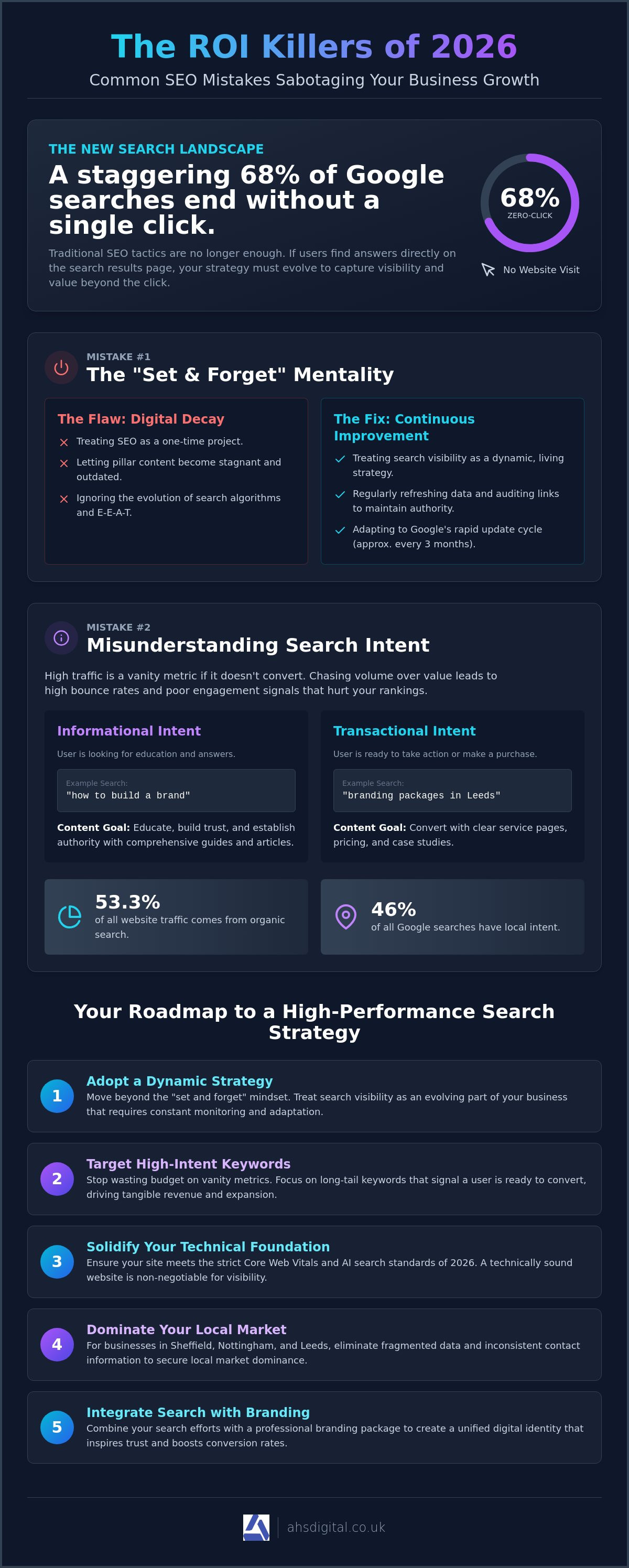
Did you know that 68% of Google searches in early 2026 ended without a single click? This staggering statistic highlights a massive shift in how users interact with search engines, proving that traditional tactics no longer deliver the results they once did. If you’ve watched your marketing budget disappear into a void of fluctuating rankings and complex jargon, you’re likely falling victim to common seo mistakes to avoid. We understand how exhausting it is to produce regular content only to see your visibility stall while competitors thrive.
You deserve a search strategy that delivers a measurable return on investment, not just a list of technical excuses. We’re ready to help you transform your online presence into a high-performance engine that drives real business expansion. This guide reveals the critical errors sabotaging your ROI and provides a clear roadmap to fix your visibility for good. We’ll preview the essential shifts in AI-driven search and show you how to integrate your digital marketing campaigns into a unified strategy that converts browsers into loyal partners.
Key Takeaways
- Move beyond the “set and forget” mentality by treating search visibility as a dynamic, living strategy that evolves with your organisation.
- Stop wasting marketing budget on vanity metrics and start targeting high-intent keywords that drive tangible revenue and business expansion.
- Identify common seo mistakes to avoid within your technical foundation, ensuring your site meets the strict Core Web Vitals and AI search standards of 2026.
- Secure your local market dominance in Sheffield, Nottingham, and Leeds by eliminating fragmented data and inconsistent contact information.
- Learn how to integrate search efforts with a professional branding package to create a unified digital identity that inspires trust and conversion.
Why the “Set and Forget” Mentality is Killing Your Rankings
Treating your search presence like a one-off home renovation is one of the most common seo mistakes to avoid. Many organisations believe that once a site is launched and the initial search engine optimization (SEO) is complete, the work is done. This static approach is a recipe for digital decay. In 2026, search engines prioritise active, evolving entities over dormant ones. If you aren’t iterating your strategy, you’re essentially handing market share to competitors who are constantly refining their approach.
To better understand why a proactive approach is essential, watch this helpful video regarding the pitfalls of a passive strategy:
Google now rolls out core updates approximately every three months, which is a significantly faster pace than in previous years. This rapid cadence means a site that was perfectly optimised in January could be technically obsolete by April. A high-performance digital marketing campaign requires constant monitoring, testing, and adjustment to remain competitive. Ambitious brands don’t just “do SEO”; they build a culture of continuous digital improvement.
The High Price of Stagnant Content
Freshness signals have become a dominant ranking factor. Search engines look for signs of life, such as updated statistics, new internal links, and evolving user interactions. When you leave high-performing pillar pages to gather dust, you’re telling algorithms that your information might be outdated. Even “evergreen” content requires regular data refreshes and link audits to maintain its authority. Stagnant content leads to a slow slide down the rankings as newer, more relevant sources emerge to capture the attention of your audience.
Ignoring the Evolution of Search Algorithms
The core updates of early 2026 shifted the focus heavily toward real-world user engagement and original insight. Relying on outdated “grey hat” tactics or high-volume, low-value content is no longer just ineffective; it’s a risk to your entire domain. Modern search rewards E-E-A-T (Experience, Expertise, Authoritativeness, and Trustworthiness). This requires a holistic approach where your content proves its value to humans, not just bots. Failing to adapt your strategy to these qualitative requirements is another one of those common seo mistakes to avoid if you want to protect your long-term ROI.
Misunderstanding Search Intent: Content That Clicks but Never Converts
High traffic figures look fantastic on a monthly report. They suggest growth and reach. However, if those thousands of visitors exit your site without taking action, your strategy is fundamentally flawed. Chasing raw volume while ignoring the user’s actual goal is one of the most common seo mistakes to avoid. In 2026, search engines are sophisticated enough to recognise when a page fails to satisfy a query, leading to poor engagement signals that eventually tank your rankings.
Successful digital performance requires a deep understanding of what your audience needs at specific moments. Research shows that 53.3% of all website traffic comes from organic search, but not all that traffic is ready to buy. A user in Leeds searching for “how to build a brand” has an informational intent. They are looking for education. Conversely, someone searching for “branding packages in Leeds” has a transactional intent. If you target the former with a hard sales pitch, they will bounce. If you target the latter with a 3,000-word history of logos, they will find a competitor who gets straight to the point.
Aligning your content with Google’s SEO best practices means mapping every piece of content to a stage in the buyer’s journey. This is especially vital for regional businesses in Manchester or Leeds, where local intent is high. Approximately 46% of all Google searches have local intent, meaning your content must speak directly to the community’s specific geographical and commercial needs to drive real-world results.
Ranking for the Wrong Keywords
Targeting broad, high-volume terms often leads to “empty” traffic. These keywords are highly competitive and rarely result in direct sales. Instead, focus on high-intent long-tail queries. These specific phrases might have lower search volumes, but the conversion potential is significantly higher. Auditing your current keyword list to ensure a healthy balance of informational and transactional terms is essential for building a strategy that actually impacts your bottom line.
Neglecting the User Journey and CRO
SEO gets people to your site; Conversion Rate Optimisation (CRO) keeps them there and turns them into clients. A common error is leaving high-traffic pages without a clear call to action. Whether it’s a “contact us” prompt or a link to a service page, every piece of content must guide the visitor toward the next step. If you’re unsure where your funnel is leaking, our team can help you refine your digital marketing campaigns to ensure every click counts toward your ROI.
Technical SEO Blunders: From Slow Speeds to AI Search Blind Spots
Your technical infrastructure is the silent engine of your digital performance. If it’s stalling, your search visibility will vanish regardless of your content quality. One of the most common SEO mistakes is treating technical health as a one-time setup rather than a continuous performance audit. Search engines in 2026 are ruthless with sites that present “invisible” hurdles, such as broken redirects or bloated sitemaps that confuse crawlers and waste your crawl budget. A logical, flat site architecture is essential for ensuring every high-value page is indexed and accessible to the bots that determine your rank.
Core Web Vitals and the Mobile Experience
With mobile devices accounting for 51.04% of global platform market share as of May 2026, your web design must be exceptionally fast and responsive. Google’s thresholds for “Good” performance are non-negotiable: Largest Contentful Paint (LCP) must be under 2.5 seconds, Interaction to Next Paint (INP) under 200 milliseconds, and Cumulative Layout Shift (CLS) under 0.1. Failing to meet these metrics is among the common seo mistakes to avoid, as poor technical performance directly correlates with lower rankings and eroded user trust. If your site jumps around while loading or takes too long to respond to a tap, your visitors will quickly find a competitor who prioritises their experience.
Failing to Optimise for AI-Driven Search Results
The search landscape has fundamentally changed with the rise of generative answer engines. AI Search Optimisation (AISO) is now a critical component of any growth strategy, yet many businesses are still operating with a 2023 mindset. Statistics from 2026 show that 43% of local searches now trigger AI Overviews. If your site lacks clear, structured data and Schema markup, AI crawlers will struggle to extract the context they need to feature your brand in these high-value summaries. This lack of technical clarity makes your business invisible to a massive segment of the market.
To stay visible, you must provide concise, authoritative data points that AI engines can easily digest and cite. This is about more than just text; it’s about ensuring your technical backend communicates clearly with the latest search algorithms. Ignoring this shift is a fatal error for ambitious organisations. By ensuring your technical foundation is robust and AI-ready, you position your brand as a forward-thinking leader ready for the next phase of digital evolution. Don’t let your competitors capture the zero-click market while you’re still fixing errors from last year.
Local SEO Errors: Missing the Mark in Your Own Community
Search isn’t just a global race; it’s a hyper-local battle for regional dominance. For businesses operating in Sheffield, Nottingham, or Leeds, being invisible in your own city is a catastrophic failure. Research shows that 46% of all Google searches have local intent. This means nearly half your potential customers are looking for services right on their doorstep. If you aren’t appearing in the “Local Pack” or modern AI-generated summaries, you’re handing leads to the competitor across the street. Neglecting these regional nuances is one of the most common seo mistakes to avoid if you want to dominate your local market.
Trust is the primary currency of local search. When search engines find conflicting contact details across the web, they lose confidence in your business’s legitimacy. Inconsistent NAP (Name, Address, Phone) data acts like a broken compass for both algorithms and customers. A single digit wrong in a phone number or a slight variation in an address can tank your local authority and confuse the 58% of people who use voice search to find local businesses. High-performance organisations ensure their data is crystalline and consistent across every platform.
Inconsistent NAP Data Across UK Directories
Conflicting information across digital platforms is a silent killer of local rankings. You must ensure that your details on every UK directory are identical to your website and Google Business Profile. Auditing your presence on Yell, Thomson Local, and niche UK directories ensures a unified brand image. Streamlining these citations creates a solid foundation for your digital marketing campaigns, allowing you to focus on organisational transformation rather than fixing basic data errors.
Neglecting Localised Content and Reviews
Using generic content for multiple location pages is a lazy tactic that search engines easily spot. Your Leeds page shouldn’t just be a “find and replace” version of your Sheffield page. It needs to reflect the local community and address specific regional needs. Don’t underestimate the power of customer feedback; reviews are the most potent local ranking signal available. Ambitious organisations actively encourage authentic feedback to build regional trust. This creates a sense of momentum that outshines competitors who ignore their community’s voice. Understanding these common seo mistakes to avoid ensures your brand remains the first choice for local customers.
Ready to secure your spot at the top of the local map? You can get in touch with our team to clean up your citations and build a strategy that resonates with your neighbours.
The Cost of Fragmented Marketing: Why Siloed SEO Fails
SEO doesn’t happen in a vacuum. It’s a single thread in a larger tapestry of digital growth. One of the most damaging common seo mistakes to avoid is treating search as a technical silo, completely detached from your creative and strategic departments. When your SEO team works in isolation from your web designers or brand strategists, you create a disjointed user experience that frustrates customers and confuses search algorithms. High performance requires a unified front where every digital asset pulls in the same direction.
Integrating videography into your search strategy is a prime example of this unified approach. Video content dramatically increases dwell time, which sends powerful engagement signals to search engines. If your marketing is fragmented, you might have great videos that aren’t optimised for search, or an SEO strategy that lacks the engaging visual content needed to convert visitors. Bridging this gap is essential for a modern, high-velocity strategy that captures attention and holds it.
When Branding and SEO Do Not Align
Your branding and your search strategy must tell the same story. A common error is prioritising “cool” or abstract design at the expense of search accessibility. If your visual identity makes it difficult for crawlers to understand your site’s hierarchy, your rankings will suffer. Inconsistent brand messaging also erodes trust. Users who find you through a specific search query expect a seamless transition to a brand experience that matches their intent. If the design feels disconnected from the search snippet, they’ll bounce almost immediately.
Building a Unified Strategy for Measurable ROI
Moving away from fragmented agencies is the first step toward organisational transformation. Managing multiple points of contact often leads to misaligned goals and wasted marketing spend. A holistic digital marketing approach ensures that your technical SEO, content creation, and visual assets are all working toward the same KPIs. This synergy doesn’t just improve your rankings; it improves your conversion rates and overall investment returns.
Auditing your current strategy for these common seo mistakes to avoid is the final step in preparing for a successful 2026. Look for gaps where your departments aren’t communicating. Ensure your branding supports your organic growth rather than hindering it. By building a search-first foundation into every aspect of your marketing, you create a resilient digital presence that’s ready to tackle complex problems and achieve ambitious growth. Don’t let siloes stand in the way of your organisation’s potential.
Secure Your Digital Future Today
The search landscape of 2026 demands more than a simple technical checklist; it requires a unified brand experience that prioritises user intent and technical precision. By eliminating the common seo mistakes to avoid discussed in this guide, you position your organisation for meaningful, measurable growth. Success now depends on your ability to adapt to rapid algorithm shifts and the rise of AI-driven search while maintaining a rock-solid foundation of Core Web Vitals and high-performance design.
At AHS Digital, we specialise in turning these complex challenges into opportunities for business transformation. With a proven track record in Sheffield and across the UK, we bring deep expertise in high-conversion web design and platforms like Magento 2. We don’t just chase rankings; we build integrated strategies that drive tangible ROI. It’s time to stop letting fragmented marketing hold your brand back and start building a digital presence that truly performs.
Ready to dominate the search results? Stop making mistakes and start growing, contact AHS Digital today. We are ready to help you lead your industry with confidence.
Frequently Asked Questions
What is the most common SEO mistake for small UK businesses?
The most frequent error for small UK firms is ignoring local search intent and maintaining inconsistent contact details across the web. With 46% of searches having local intent, failing to align your business name, address, and phone number across directories like Yell confuses both users and algorithms. This lack of clarity is one of the common seo mistakes to avoid if you want to capture regional market share in cities like Sheffield or Leeds.
How long does it take to fix major SEO errors and see results?
Fixing major errors usually yields measurable results within three to six months, though technical improvements can trigger faster recoveries in search visibility. Search engines need time to recrawl your site and re-evaluate your authority following significant updates to your architecture or content. Continuous monitoring is essential, as the 2026 algorithm cadence involves core updates approximately every three months, requiring a proactive and agile strategy.
Can bad web design actually hurt my SEO rankings?
Poor web design is a primary driver of high bounce rates and significant ranking drops in modern search. If your site doesn’t meet the 2026 Core Web Vitals thresholds, such as an LCP under 2.5 seconds, search engines will prioritise faster, more stable competitors. A mobile-first approach is mandatory, as mobile devices now account for over 51% of global platform market share, making responsive performance a critical ranking factor.
Is keyword stuffing still a mistake in 2026?
Keyword stuffing remains a critical error that triggers Google’s 2026 spam updates and erodes user trust. Modern algorithms prioritise helpful, people-first content over text forced with repetitive phrases designed for bots. Using high-energy verbs and clear, direct language is far more effective for both ranking and conversion than trying to manipulate search engines with redundant, low-value keywords that frustrate your audience.
Why is my business not appearing in local search results?
Your business might be missing from local results due to an unoptimised Google Business Profile or a lack of authentic regional reviews. Since 58% of people use voice search for local information, your profile must be complete, accurate, and regularly updated with fresh content. Authentic feedback and localised content are the most powerful signals for building trust and ensuring you appear in the “Local Pack” for your community.
How does AI search change the way I should avoid SEO mistakes?
AI-driven search requires a shift toward providing clear, structured data that generative engines can easily digest and cite in their summaries. With 43% of local searches now triggering AI Overviews, you must avoid the mistake of leaving your technical backend unoptimised for AI crawlers. Providing authoritative, concise answers through Schema markup helps your brand appear in these high-value boxes, capturing traffic in a zero-click environment.
Is it worth hiring an agency to fix my SEO mistakes?
Partnering with a professional team is the fastest way to achieve organisational transformation and a tangible return on investment. An integrated digital marketing campaign ensures your search strategy, branding, and technical health work as a unified force. This holistic approach eliminates the friction of fragmented marketing, allowing you to focus on business expansion while experts manage the complexities of modern search algorithms.
What happens if I have duplicate content on my website?
Duplicate content wastes your crawl budget and dilutes the ranking power of your pages by confusing search engine crawlers. Algorithms struggle to decide which version of a page is the original, often leading to lower visibility for all involved URLs. Auditing your site for these common seo mistakes to avoid ensures that your unique, high-value content receives the attention it deserves, protecting your authority and improving your overall performance.