

You’re investing pounds into PPC, SEO, and social media, but when stakeholders ask for the bottom-line impact, do you have a clear, confident answer? It’s a common challenge for ambitious UK businesses. Without a clear way to measure financial impact, every marketing decision can feel like a gamble. This uncertainty ends now. We’ve developed a straightforward digital marketing roi calculator to cut through the complexity and give you an instant, clear picture of your profitability.
But getting your number is just the first step. This guide goes further, empowering you to understand what that figure truly means for your business. We’ll demystify the formula, explore industry benchmarks, and most importantly, show you how to use these insights to refine your strategy. It’s time to stop guessing, justify your budget with confidence, and start making decisions that move the needle and drive tangible growth for your brand.
Key Takeaways
- Use our straightforward digital marketing roi calculator to get an instant, high-level view of your current performance and establish a clear baseline for growth.
- Calculate your true marketing investment by accounting for all costs-not just ad spend-to ensure your ROI calculations are accurate and insightful.
- Pinpoint your most profitable channels by calculating ROI for individual activities, allowing you to double down on what works and cut what doesn’t.
- Learn which key metrics predict future success, giving you the power to make proactive, data-driven decisions that move the needle.
The Simple Digital Marketing ROI Calculator
Stop guessing and start measuring. Effective marketing isn’t just about creative campaigns; it’s about delivering tangible growth and proving its value to the bottom line. Use our simple digital marketing roi calculator below to get an instant, high-level snapshot of your campaign performance.
Your ROI is: –%
Your Ratio is: –:1
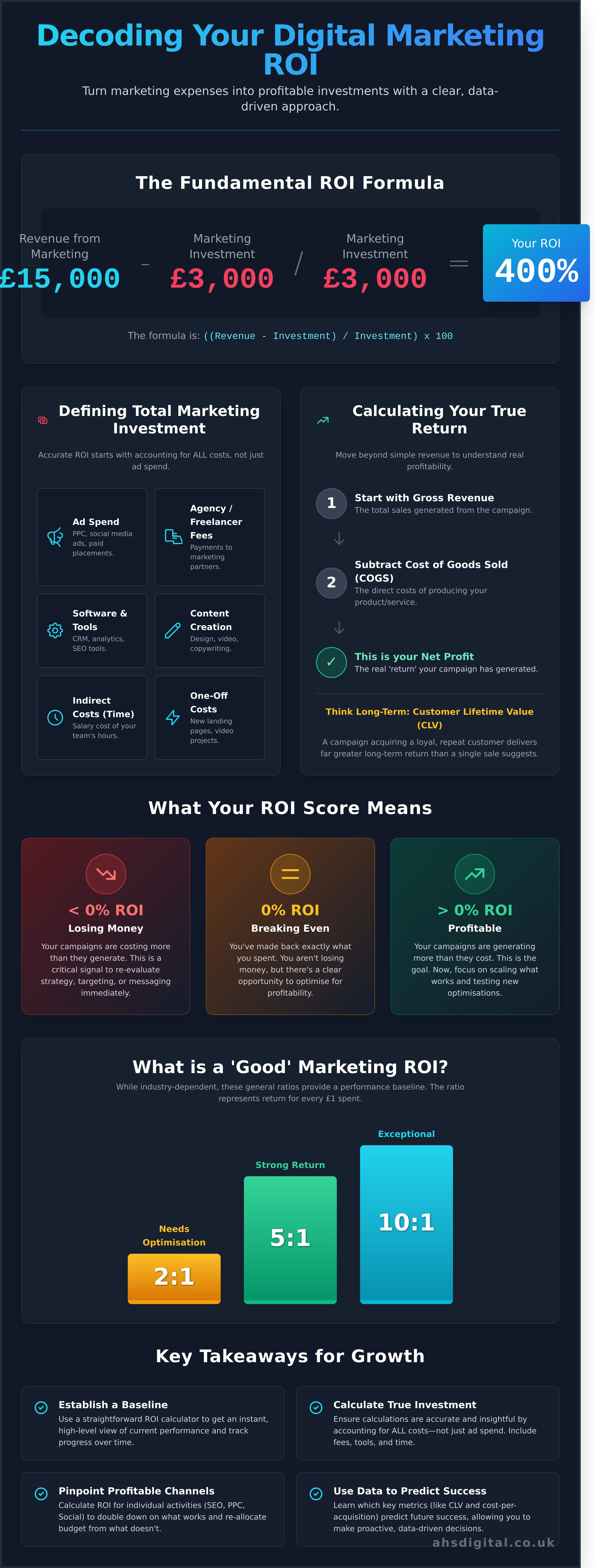
This tool calculates your Return on Marketing Investment (ROMI), a crucial metric for any business looking to scale. The formula is straightforward: (Net Profit / Total Investment) x 100. While this provides an essential top-level view, the rest of this guide will help you dig deeper into channel-specific ROI and other factors that add crucial context to this number.
How to Use The Calculator
To get a meaningful result, you need accurate inputs. Your ‘Total Revenue Generated’ can be found in your CRM, e-commerce platform (like Shopify or WooCommerce), or sales reports. For ‘Total Marketing Investment’, be sure to include all associated costs for a true picture:
- Ad Spend: Costs for PPC, social media ads, and other paid placements.
- Agency or Freelancer Fees: Payments to your marketing partners.
- Software & Tools: Subscriptions for analytics, email marketing, or SEO tools.
- Content Creation: Costs for graphic design, video production, or copywriting.
Example: If your campaign generated £15,000 in sales from a £3,000 total investment, your net profit is £12,000. Your ROI is 400%, or a 5:1 ratio (£15,000 revenue for every £3,000 spent).
What Your ROI Score Means
Your ROI percentage tells a clear story about your marketing’s financial performance. Here’s how to interpret it:
- Positive ROI (>0%): Your campaigns are profitable. For every pound you invest, you are generating more than a pound in return. This is the goal.
- Break-even ROI (0%): You’ve made back exactly what you spent. You aren’t losing money, but there’s a clear opportunity to optimise for profitability.
- Negative ROI (<0%): Your campaigns are currently costing more than they generate. This is a critical signal to re-evaluate your strategy, targeting, or messaging to move the needle.
Deconstructing the ROI Formula: What to Actually Measure
The basic formula for ROI-(Net Profit / Total Investment) x 100-is a powerful starting point. However, its accuracy hinges entirely on the quality of the data you use. To get a true measure of your campaign’s value and make the most of any digital marketing roi calculator, you must look beyond surface-level numbers. This requires adopting a comprehensive digital marketing framework for ROI that accounts for all relevant costs and returns, not just the obvious ones.
Defining Your ‘Total Marketing Investment’
One of the most common mistakes is only counting direct ad spend. A precise calculation of your investment must be all-encompassing to provide a clear picture. Be sure to include:
- Direct Costs: This covers your ad spend on platforms like Google Ads and Meta, agency fees, and subscriptions for marketing software like CRMs or analytics tools.
- Indirect Costs: Factor in the cost of your team’s time. If your marketing manager spends 10 hours a week on a campaign, that salary cost is part of the investment. This also includes content creation time.
- One-Off Costs: Did you build a new landing page or invest in a professional video for this campaign? These project-based expenses must be included.
Calculating Your ‘Return’ (Net Profit)
Simply tracking revenue can be misleading. To understand true profitability, you must calculate the Net Profit attributed to your marketing. Start with the Gross Revenue from campaign sales, then subtract the Cost of Goods Sold (COGS). From that Gross Profit figure, subtract your Total Marketing Investment. The result is your Net Profit-the real ‘return’ your campaign has generated. For a more forward-thinking approach, consider Customer Lifetime Value (CLV). A campaign that acquires a customer who makes repeat purchases for years delivers a far greater return than a single sale might suggest.
What is a ‘Good’ Marketing ROI?
There is no universal benchmark for a “good” ROI, as it depends heavily on your industry, profit margins, and overall business goals. However, some general ratios can help you gauge performance:
- A 5:1 ratio (£5 return for every £1 spent) is widely considered a strong and healthy return.
- A 2:1 ratio might be profitable for businesses with very high-profit margins but could be a loss for others.
- A 10:1 ratio or higher is exceptional and indicates a highly efficient and scalable marketing engine.
How to Calculate ROI for Different Marketing Channels
While a blended ROI for your entire marketing function provides a useful top-level metric, the real power lies in breaking it down. Calculating ROI for individual channels is what allows you to make strategic decisions, reallocate budgets, and truly optimise your marketing spend. It’s the difference between knowing if your marketing is working and knowing what parts are moving the needle.
The inputs for ‘Investment’ and ‘Return’ shift depending on the channel. Understanding these nuances is the key to using a digital marketing roi calculator effectively and identifying your most (and least) profitable activities.
Measuring PPC and Paid Social ROI
Pay-per-click and paid social advertising offer the most direct path to calculating ROI, thanks to robust tracking capabilities. The cause-and-effect relationship is clear and almost immediate.
- Investment: This includes your total ad spend, any agency or freelance management fees, the cost of creating ad visuals, and time or money spent developing dedicated landing pages.
- Return: Revenue generated directly from conversions, which are tracked precisely using tools like the Meta Pixel or Google Ads conversion tracking.
Tracking SEO and Content Marketing ROI
Calculating the ROI for Search Engine Optimisation is a longer-term exercise. Its impact is cumulative and often felt across the entire customer journey, making direct attribution more complex but no less crucial.
- Investment: Costs here cover agency retainers, salaries for in-house staff, content creation expenses (writers, designers), link building campaigns, and subscriptions for SEO tools like Ahrefs or Semrush.
- Return: This is measured through the value of increased organic traffic, direct conversions from organic search, and the lifetime value of leads generated from content downloads or newsletter sign-ups. Our digital marketing services prioritise transparent reporting to connect our SEO efforts to your bottom-line growth.
Calculating Email Marketing ROI
Email marketing consistently delivers one of the highest returns of any digital channel, often cited as generating over £35 for every £1 spent. It leverages an asset you own-your subscriber list-to drive repeat business and nurture leads.
- Investment: The primary costs are your email marketing platform subscription (e.g., Mailchimp, Klaviyo) and the time invested in strategy, copywriting, and design for each campaign.
- Return: Revenue generated from users who click through a campaign email and make a purchase. This is easily tracked by using UTM parameters in your email links.
Beyond ROI: Key Metrics That Drive Profitability
While a digital marketing roi calculator provides a vital snapshot of past performance, Return on Investment is ultimately a lagging indicator. It tells you what has already happened. To truly drive growth, you must focus on the leading indicators-the operational metrics that predict and influence your future ROI.
A proactive marketing strategy doesn’t just measure the end result; it meticulously optimises the inputs. By focusing on the following key metrics, you can directly control the levers that boost profitability and ensure your campaigns deliver sustainable success.
Customer Acquisition Cost (CAC)
CAC is the total cost your business incurs to acquire a single new customer. This is a critical efficiency metric. To calculate it, you simply divide your total marketing and sales spend over a specific period by the number of new customers gained in that same period. For example, if you spend £2,000 on a campaign that brings in 20 new customers, your CAC is £100. Lowering this figure directly increases the profitability of every conversion and elevates your overall ROI.
Customer Lifetime Value (CLV)
CLV represents the total net profit a business can expect to make from any given customer throughout their entire relationship with your brand. This metric is especially powerful for businesses with repeat purchase models, such as e-commerce stores or subscription services. A high CLV demonstrates customer loyalty and retention. The goal is to maintain a high CLV to CAC ratio (ideally 3:1 or higher), as this is a powerful indicator of a profitable and scalable business model.
Conversion Rate Optimisation (CRO)
Conversion rate is the percentage of visitors to your website who complete a desired action, such as making a purchase or filling out a contact form. CRO is the systematic process of increasing that percentage. Improving your conversion rate is one of the most efficient ways to grow revenue, as it allows you to generate more value from the traffic you already have. This is where user experience and intelligent site structure are critical. Effective web design is fundamental to high conversion rates, turning casual browsers into committed customers.
By shifting your focus from simply calculating ROI to actively improving CAC, CLV, and conversion rates, you transform your marketing from a reactive expense into a proactive growth engine. Understanding these metrics is the first step; the next is building a strategy to optimise them. At AHS Digital, we build holistic campaigns that move the needle on the metrics that matter.
Your ROI is Low. Now What? Actionable Steps to Improve It
Discovering a low return on investment isn’t a failure; it’s a valuable insight. The data you’ve gathered using a digital marketing roi calculator is the starting point for strategic optimisation. It provides the clarity needed to stop wasting your budget and start making decisions that deliver tangible growth. Here is your clear path forward to turn those numbers into meaningful results.
Step 1: Conduct a Full Marketing Audit
Before you can improve, you need to understand precisely what’s working and what isn’t. A comprehensive audit moves beyond a single ROI figure and drills down into the performance of each component of your strategy. This is where you find the opportunities to move the needle.
- Analyse Channel-Specific ROI: Is your PPC spend converting better than your social media campaigns? We identify your high-performing channels and pinpoint the underachievers draining your budget.
- Reallocate Your Budget: Double down on what works. By strategically shifting funds from low-ROI activities to your most profitable channels, you can immediately elevate your overall return.
- Review Audience Targeting: Reaching the wrong people is expensive. We ensure your messaging is connecting with a high-intent audience, maximising the impact of every pound spent.
Step 2: Invest in a High-Performance Website
You can have the best marketing in the world, but if it leads to a slow, confusing, or broken website, your ROI will always suffer. Your website is your primary conversion tool. A poor user experience (UX) creates friction, causing potential customers to leave before they ever take action. At AHS Digital, we build responsive, lightning-fast websites designed with a clear customer journey, ensuring your site is an asset that converts traffic, not a liability that leaks revenue.
Step 3: Partner with a Results-Driven Agency
Stop juggling multiple freelancers and hoping for a cohesive strategy. A low ROI is often a symptom of fragmented marketing efforts that lack a central, guiding vision. An expert agency provides the integrated approach needed to build momentum and achieve scalable growth. The AHS Digital team acts as your strategic partner, identifying growth opportunities you might miss and executing a unified plan focused on one thing: delivering measurable results.
Ready to transform your marketing performance? Let’s talk about a strategy that grows your bottom line.
Master Your ROI: From Calculation to Tangible Growth
Understanding your digital marketing ROI is more than just plugging numbers into a formula. It’s about identifying the right metrics for each channel, looking beyond the bottom line to see the full picture of your profitability, and using that data to make strategic, needle-moving decisions. A low ROI isn’t a dead end-it’s a clear signpost pointing towards powerful opportunities for growth.
While a digital marketing roi calculator provides the initial snapshot, true growth comes from the strategy you build around those numbers. Turning insights into action is where real transformation happens. As a 100% U.K. based team with a proven track record of client growth, AHS Digital offers the cohesive creative suite you need to elevate your entire marketing effort. We don’t just measure ROI; we actively improve it.
Ready to move beyond the calculator and achieve a genuine return on your investment? Contact our team for a free strategy session and let’s start cultivating your digital growth.
Frequently Asked Questions
What’s the difference between ROI and ROAS (Return on Ad Spend)?
Think of ROAS as a tactical metric, while ROI is the strategic measure of profitability. ROAS (Return on Ad Spend) measures the gross revenue generated for every pound spent on advertising, making it ideal for optimising specific campaigns. ROI (Return on Investment) is the bigger picture; it calculates net profit by accounting for all costs, including ad spend, agency fees, and software, to reveal the true bottom-line impact of your marketing efforts.
How can I calculate marketing ROI for a business with a long sales cycle?
Calculating ROI with a long sales cycle requires a strategic, long-term view. The key is to track the entire customer journey using multi-touch attribution models within your CRM. This connects initial touchpoints, like an SEO-driven blog visit, to the final sale months later. We also measure leading indicators like demo requests and content downloads, which demonstrate value and momentum long before the final invoice is paid. It’s about mapping the path to conversion.
Is it possible to measure the ROI of branding or top-of-funnel campaigns?
Absolutely. Measuring branding ROI means shifting focus from direct sales to powerful leading indicators of growth. We track metrics like increases in branded search volume, direct website traffic, and social media share of voice. While not a direct sale, a significant uplift in people searching for your brand name after a campaign is a clear sign of success. These activities build the qualified audience that fuels your sales pipeline, making them a crucial long-term investment.
How often should I be calculating my digital marketing ROI?
The ideal frequency depends on your sales cycle and channels. For fast-moving campaigns like PPC, a monthly or even weekly review is essential to optimise performance. For longer-term strategies like SEO and content marketing, a quarterly analysis provides a more meaningful picture of growth. Using a comprehensive digital marketing roi calculator at these intervals ensures you are making informed, data-driven decisions based on a complete picture, not short-term fluctuations.
What tools can help me track my marketing performance and ROI more accurately?
Accurate ROI tracking relies on an integrated toolset. We build client reporting on a foundation of Google Analytics 4 for web behaviour and a robust CRM like HubSpot to track leads to revenue. Native platforms like Google Ads and Meta Ads provide direct ROAS data. We then centralise this data in a dashboard like Google Looker Studio. This setup acts as a powerful, real-time digital marketing roi calculator, providing clarity on what’s moving the needle for your business.