

Is your marketing budget seen as a line-item expense instead of a strategic investment? It’s a common frustration for ambitious marketers. You know your plan can move the needle, but learning how to get buy-in for a new marketing budget feels like an uphill battle against a wall of financial scrutiny. You’re asked for ROI you can’t prove and forced to speak a language that isn’t your own, leaving your best ideas underfunded and your department viewed as a cost centre.
Crafting this kind of comprehensive business case is a specialized skill. For organizations looking to strengthen their strategic planning, expert firms such as Business Analysis & Solutions provide the digital strategy and analysis needed to build these compelling proposals.
This guide is your new playbook. We will equip you with a strategic framework to transform your budget proposal from a list of expenses into a compelling business case for growth. You will learn to forecast ROI, align your goals with executive priorities, and present your plan with the confidence that earns trust and secures the investment your team deserves. It’s time to stop defending your budget and start demonstrating its power to drive the business forward.
Key Takeaways
- Shift your perspective from marketer to CFO by framing your budget request as a strategic investment that drives tangible business growth.
- Master the art of forecasting ROI by translating marketing metrics into the financial impact leadership cares about, effectively overcoming objections before they arise.
- Discover how to get buy-in for a new marketing budget by building a bulletproof, data-backed proposal and presenting it as a compelling business narrative.
- Securing the budget is just the beginning; establish a clear reporting framework immediately to prove value and set the stage for future investment.
The Mindset Shift: Stop Thinking Like a Marketer, Start Thinking Like a CFO
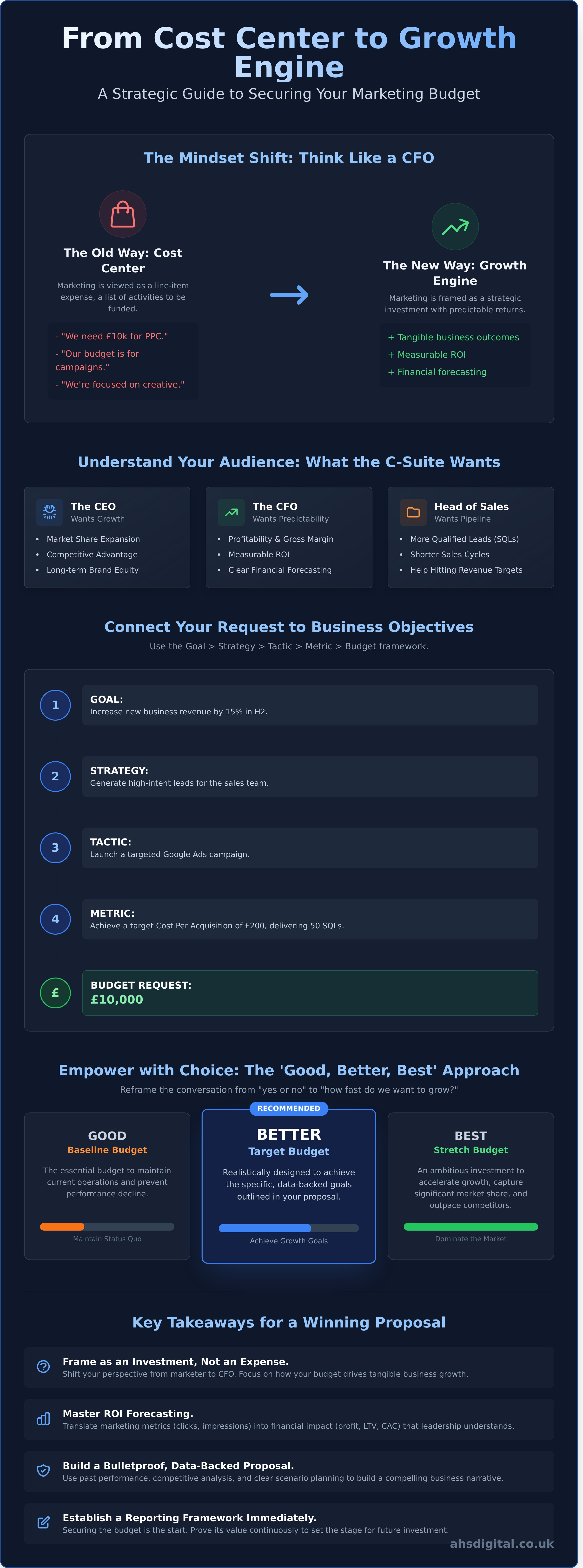
The single most critical step in winning a new budget is to stop presenting it as a departmental expense. Instead, you must frame it as a strategic business investment. Your leadership team doesn’t fund activities; they invest in outcomes. The secret to how to get buy-in for a new marketing budget lies in shifting the entire conversation from ‘cost’ to ‘return on investment’. While traditional marketing spending is often categorised as a line item, your job is to present it as a growth engine. Learn to speak the language of financial forecasting, risk mitigation, and predictable growth, and you’ll find the boardroom doors open much wider.
Understanding Your Audience: What Does the C-Suite Really Want?
Your proposal is not a one-size-fits-all document. To be effective, you must speak directly to the core priorities of each key stakeholder. They are all on the same team, but they measure success through different lenses.
- The CEO wants growth. Frame your budget in terms of market share, competitive advantage, and long-term brand equity.
- The CFO wants predictability. Focus on profitability, measurable ROI, and clear financial forecasting. Show them the numbers.
- The Head of Sales wants pipeline. Highlight how your plan will generate more qualified leads, shorten the sales cycle, and help them hit their targets.
Connecting Marketing Activities to Core Business Objectives
Never present a tactic without tying it directly to a top-level company goal. This builds an undeniable link between your requested budget and the results the business cares about. Use a simple, powerful framework to structure your request: Goal > Strategy > Tactic > Metric > Budget.
For example, instead of just asking for “£10k for PPC,” present it like this:
- Goal: Increase new business revenue by 15% in H2.
- Strategy: Generate high-intent leads for the sales team.
- Tactic: Launch a targeted Google Ads campaign.
- Metric: Achieve a target Cost Per Acquisition of £200, delivering 50 sales-qualified leads.
- Budget Request: £10,000.
This approach transforms your budget from a list of expenses into a clear, actionable plan to move the needle on core business metrics.
Building Your Bulletproof Budget Proposal: The Key Components
An effective budget proposal is more than a spreadsheet; it’s a strategic narrative. It tells the story of where you’ve been, where you’re going, and exactly what you need to get there. To truly move the needle, you must connect every requested pound to a tangible business outcome. This data-first approach is fundamental to understanding how to get buy-in for a new marketing budget from a results-focused leadership team.
Data-Driven Justification: Past Performance and Competitive Analysis
Begin by grounding your request in reality. Conduct a transparent audit of the previous period’s performance, showcasing what worked and, more importantly, what didn’t and why. Present clear metrics like Customer Acquisition Cost (CAC) and Lifetime Value (LTV) by channel to illustrate your successes and limitations. Comparing your spend against industry Marketing Budget benchmarks and competitor activity can powerfully demonstrate where a limited budget is creating a competitive disadvantage.
The Core Proposal: Channels, Tactics, and Costs
Now, build your case. Break down your requested budget into logical categories: paid advertising, content creation, SEO, software subscriptions, and personnel. For each line item, provide a clear justification tied directly to your overarching goals-for instance, “£15,000 for SEO to increase organic lead generation by 40%.” This is where demonstrating synergy is crucial; a fragmented approach wastes money. Investing in cohesive digital marketing services ensures your channels work together, amplifying ROI. Always include quotes from vendors or agencies to validate external costs.
Scenario Planning: The ‘Good, Better, Best’ Approach
Never present a single, all-or-nothing number. Instead, empower your executive team with choice by using a ‘Good, Better, Best’ framework. This strategic approach reframes the conversation from “yes or no” to “how fast do we want to grow?”
- Good (Baseline): The essential budget to maintain current operations and prevent decline.
- Better (Target): The recommended budget, realistically designed to achieve the specific goals outlined in your proposal.
- Best (Stretch): An ambitious investment to accelerate growth, capture significant market share, and outpace competitors.
This positions you as a strategic thinker and often makes your target budget appear as the most reasonable and compelling option.
Forecasting ROI: Turning Marketing Metrics into Business Impact
This is where you move from concepts to cash flow. To overcome financial objections, you must translate marketing activities into tangible business outcomes. The core of how to get buy-in for a new marketing budget is demonstrating a clear, credible path from investment to profit. Forget vanity metrics; the C-suite speaks the language of Gross Margin, Net Profit, and Return on Investment (ROI).
Develop realistic forecasts using your own historical data as a baseline and supplement it with UK industry benchmarks where necessary. Create a simple model that shows exactly how your proposed spend will move the needle on revenue. Crucially, be conservative in your estimates. It is always better to build trust by under-promising and over-delivering.
Modeling for Different Channels
Your financial model should break down the expected return for each major initiative. This shows you’ve done your homework and understand the unique contribution of each channel:
- PPC: Model your projected spend, estimated cost-per-click (CPC), click-through rate, and on-site conversion rate to forecast cost-per-lead. Apply your sales team’s close rate to calculate a final customer acquisition cost (CAC) and projected revenue.
- SEO: Project organic traffic growth based on target keyword volume and ranking goals. Assign a value to each organic lead and showcase SEO’s long-term value as a compounding digital asset that reduces future reliance on paid channels.
- New Website: Frame a new site not as a cost, but as a conversion asset. Model how a 0.5% increase in conversion rate, driven by professional web design and improved user experience, will boost revenue from all traffic sources.
Calculating Customer Lifetime Value (CLV)
Focusing only on the first transaction is short-sighted. Introduce Customer Lifetime Value (CLV) to provide a more accurate picture of a customer’s total worth. Explain how your marketing plan-through email marketing, content, and community building-will increase customer retention and repeat purchases. A higher CLV justifies a higher upfront CAC, transforming a seemingly expensive lead into a highly profitable long-term relationship.
Presenting Your Financial Projections
Present your numbers with clarity and confidence. Use simple charts and graphs to visualise the expected ROI and show a clear timeline for when the business can expect to see a return. Including a break-even analysis for significant investments like a new website or a major campaign demonstrates financial diligence. Be prepared to defend every assumption in your model with data and logic; this transparency is key to building the trust you need to secure your budget.
Presenting Your Case: How to Win the Room and Handle Objections
You’ve meticulously researched the data, forecasted the ROI, and built a strategic budget. Now comes the final, critical step: the presentation. Your ability to communicate your vision with confidence and clarity is just as important as the numbers in your deck. This is where your proposal transforms from a spreadsheet into a compelling roadmap for business growth.
The secret to how to get buy-in for a new marketing budget lies in storytelling, preparation, and professional delivery. You aren’t just asking for funds; you are inspiring belief in a more profitable future.
Crafting a Compelling Narrative
Frame your pitch as a clear, compelling story. Start with the ‘why’-the urgent business problem you need to solve or the untapped market opportunity you’ve identified. Position your marketing plan as the definitive solution to that challenge. Use case studies and tangible examples to illustrate your points, then conclude with a powerful vision of what success looks like: increased revenue, stronger brand equity, and a decisive competitive advantage.
Anticipating and Overcoming Objections
Executives will always challenge a budget proposal; it’s their job. Your job is to be ready with calm, data-backed answers. Prepare for the most common objections:
- “It costs too much.” Reframe the discussion from cost to investment. Focus on the projected ROI and the significant cost of inaction. For instance, “This £30,000 investment is projected to deliver £150,000 in new business. By not acting, we risk losing ground to competitors who are already investing here.”
- “How do we know it will work?” Refer to your forecasts, industry benchmarks, or pilot programme results. Detail your risk mitigation strategies and how you’ll use KPIs to monitor performance and pivot when necessary.
- “We can’t do it all now.” This is the perfect moment to introduce your tiered budget scenarios. Present your core “must-have” plan first, followed by the ambitious growth plan as a phased second step.
Using Visuals to Your Advantage
A clean, professional presentation deck is non-negotiable. Your visuals should reflect the quality and ambition of your plan. Use high-quality imagery and concise data visualisations to make your vision feel real and achievable. For example, including examples of professional brand photography can powerfully demonstrate the calibre of creative work you intend to produce. Remember, your slides should support you, not replace you. Keep them simple, impactful, and focused on moving your story forward.
After Approval: Setting the Stage for Success and the Next Budget
Congratulations, you’ve secured your funding. But getting buy-in is the starting line, not the finish line. The actions you take now are crucial for delivering results, validating the executive team’s decision, and making your next budget request a formality rather than a fight. This is where you prove the value of your strategy and build a foundation of trust.
Your performance over the coming months is the most powerful evidence you can gather for how to get buy-in for a new marketing budget in the future. It’s time to execute with precision and communicate with clarity.
Executing and Reporting: Delivering on Your Promises
Transparency is your greatest asset. Immediately establish a clear framework for tracking progress against the goals you outlined in your proposal. Set up a live dashboard using tools like Google Data Studio to monitor your core KPIs in real-time. Schedule monthly or quarterly performance reviews with stakeholders to discuss what’s working, what isn’t, and how you’re optimising your approach. This proactive reporting demonstrates accountability and keeps marketing’s impact front-and-centre.
Building a Culture of Marketing Accountability
Turn your budget approval into a long-term strategic partnership. You can achieve this by fostering a culture where marketing’s value is understood and celebrated across the business. Share key milestones and wins in company-wide updates, always giving credit to your team. Most importantly, translate marketing metrics into business outcomes. Instead of just reporting on click-through rates, report on how those clicks generated qualified leads that contributed £X to the sales pipeline. This builds unshakeable trust.
By consistently delivering and effectively communicating ROI, you transform the entire dynamic. The next conversation won’t be about justifying costs; it will be about allocating resources to drive further growth. This is the ultimate goal.
Turning complex data into a compelling growth narrative is what we do best. If you need a strategic partner to help you deliver and report on your new marketing initiatives, get in touch with the AHS Digital team.
Turn Your Budget Request into a Business Asset
Securing the investment you need hinges on a crucial mindset shift. It’s about moving beyond campaign metrics and presenting a compelling business case, grounded in solid data and clear ROI projections. By framing your request in the language of the boardroom-forecasting growth and demonstrating tangible financial impact-your budget proposal transforms from a departmental expense into a vital strategic investment for the company’s future.
Ultimately, mastering how to get buy-in for a new marketing budget is about building trust and proving that your plan will move the needle. But you don’t have to build that case alone. As your strategic partner, AHS Digital excels at turning marketing strategy into measurable growth. Our results-driven, 100% U.K. based team provides a cohesive creative suite, ensuring every pound of your hard-won budget works efficiently to build a unified, powerful brand that converts.
Your next budget approval is within reach. Go forward with confidence and secure the resources you need to drive real transformation.
Ready to build a marketing strategy that gets results? Let’s talk.
Frequently Asked Questions
What is a realistic marketing budget for a small or medium-sized business?
For UK SMEs, a common benchmark is 5-12% of total revenue. However, this isn’t a rigid rule. A business in a high-growth phase might invest 15-20% to aggressively capture market share, while a more established company might allocate a lower percentage for maintenance and steady growth. The key is to align the budget with specific business objectives, not just an arbitrary percentage. Focus on what you need to achieve, then calculate the required investment.
How can I build a marketing budget proposal if I have no historical data?
Without past data, build your budget from the ground up based on your goals. Start with your desired outcomes (e.g., “generate 500 qualified leads”). Research the costs to achieve this, such as typical Cost Per Click (CPC) in your UK market or quotes for content creation. Analyse competitor activity to benchmark potential spending. This objective-based approach demonstrates strategic thinking and provides a solid, data-driven foundation for your request, even without internal history.
What is the difference between a marketing plan and a marketing budget?
Think of the marketing plan as the “what and why”-it outlines your strategy, goals, target audience, and the tactics you’ll use to achieve success. The marketing budget is the “how much.” It’s the financial document that allocates specific funds to each part of your plan, from ad spend and agency fees to software subscriptions. Your budget is the resource that brings your strategic plan to life; one cannot be effective without the other.
How should I react if my budget request is rejected or severely cut?
Stay professional and view it as a conversation, not a defeat. Ask for specific feedback to understand the executives’ primary concerns-is it the total amount, the channel mix, or the projected ROI? Use this insight to refine your proposal. You could suggest a smaller, 3-month pilot project to prove the concept and demonstrate a return on investment. This builds trust and provides the data needed to secure a larger budget in the next cycle.
Should I include salaries, agency fees, and overheads in my marketing budget?
Yes, absolutely. To present a true picture of the total investment and calculate an accurate ROI, your budget must be comprehensive. This includes “people costs” like internal salaries and external agency or freelancer fees. It should also cover “platform costs” for essential software like your CRM, analytics tools, and scheduling platforms. A complete budget prevents unexpected expenses and shows that you have a firm grasp on all financial aspects of your marketing operation.
What are the most common mistakes to avoid when presenting a marketing budget?
The biggest mistake is failing to connect your requested budget directly to business revenue and growth goals. Don’t just present a list of costs; tell a story about the investment and the expected return. Another common error is using vague metrics instead of clear KPIs. A crucial part of learning how to get buy-in for a new marketing budget is to anticipate questions and present a clear, confident, and data-supported case that speaks the language of the C-suite: results.
How long should my budget proposal document or presentation be?
Keep the core presentation concise and impactful. Aim for 10-15 slides that focus on the high-level story: the market opportunity, your strategic plan, the required investment, and the projected business outcomes (ROI). Lead with a one-page executive summary that covers the most critical points. Have detailed spreadsheets and channel-specific data ready in an appendix to answer deeper questions, but don’t lead with them. Respect the executives’ time by being direct and focused.