

Rankings are a vanity metric if they don’t move the needle on your bottom line. You might see your website climbing the search results, but if those clicks aren’t turning into cold, hard cash, your strategy is failing. Many ambitious organisations find themselves trapped in a cycle of unclear reporting and confusing data, struggling to understand how to measure seo roi with any real precision. It’s frustrating to feel like you’re throwing money into a digital black hole without a clear picture of the return on your investment.
We’re here to change that narrative and empower your business with total financial clarity. You’ll master the exact formulas and tracking methods needed to bridge the gap between organic traffic and actual revenue. From calculating lead value to navigating the complexities of multi-channel attribution, this guide provides a roadmap to prove the tangible impact of your digital marketing campaigns. We’ll move beyond surface-level stats and dive into the rigorous, results-driven framework that defines a successful search engine optimisation strategy, ensuring you have the tools to transform search visibility into a high-performing financial asset.
Key Takeaways
- Shift your focus from vanity metrics like keyword rankings to tangible profit, ensuring your search strategy aligns with your bottom line.
- Master the calculation framework for assigning monetary value to every conversion, from direct ecommerce sales to lead form submissions.
- Discover exactly how to measure seo roi using advanced tracking methods that bridge the gap between organic traffic and actual revenue.
- Uncover the power of assisted conversions to see how organic search builds brand equity and influences customers long before the final click.
- Learn why a unified digital strategy, incorporating high-quality videography and technical performance, is the key to maximising your long-term returns.
Defining SEO ROI: Why Measuring Your Search Investment Matters
SEO ROI isn’t just a marketing metric; it’s the financial pulse of your search strategy. At its heart, it measures the profit generated by your search engine optimisation relative to every pound spent. While many agencies boast about keyword rankings, these figures are often smoke and mirrors that hide the true financial picture. A number one spot for a low-intent term is a vanity project, not a business victory. Understanding how to measure seo roi allows you to cut through the noise and treat your website as a growing digital asset rather than a monthly expense.
Establishing a clear measurement framework does more than just justify a budget. It inspires absolute confidence in your broader digital marketing campaigns. When you can see exactly how search visibility translates into revenue, you stop guessing and start scaling. This clarity transforms SEO from a technical dark art into a predictable engine for business expansion.
The Core SEO ROI Formula
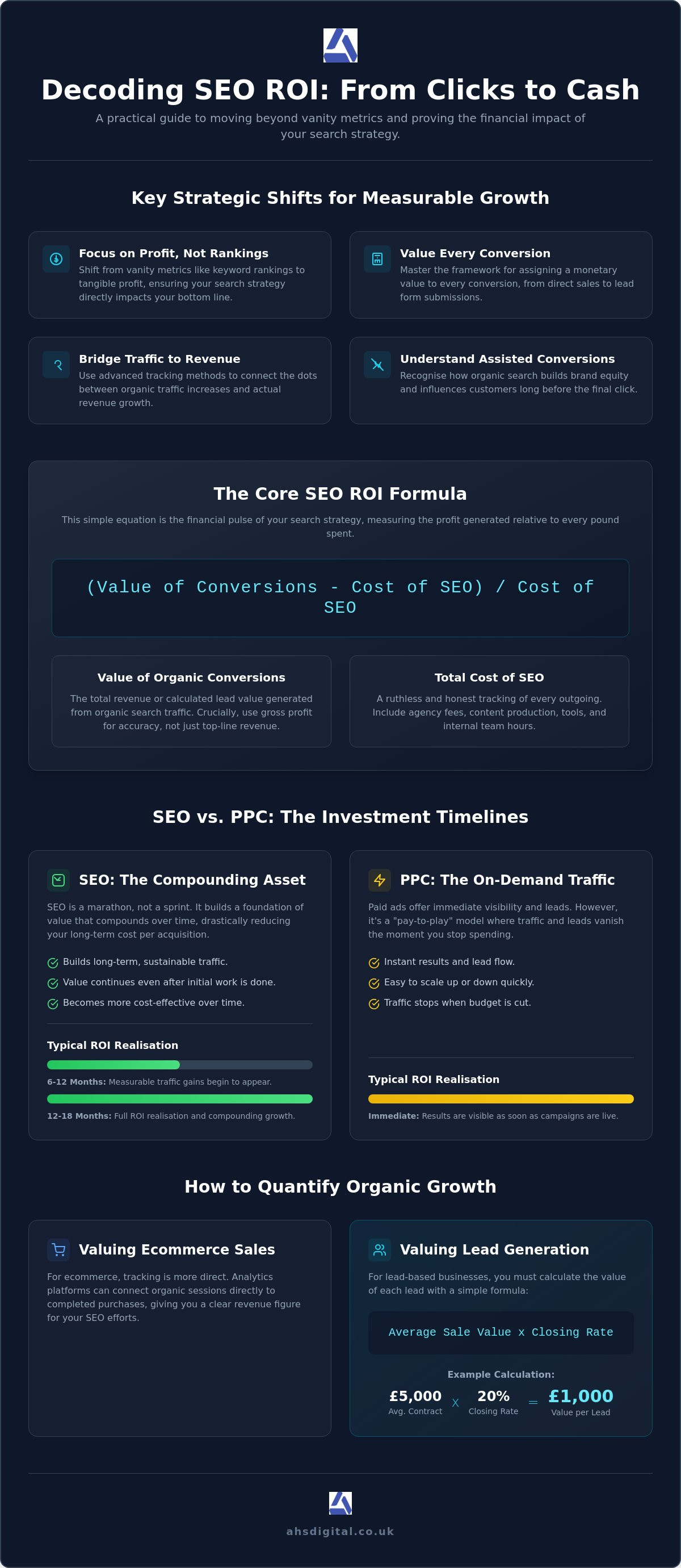
To calculate your success, use this simple equation: (Value of Organic Conversions – Cost of SEO) divided by the Cost of SEO. This fundamental principle of Return on Investment (ROI) ensures you’re looking at the actual efficiency of your spend. It’s vital to distinguish between top-line revenue and gross profit here. If you sell a product for £100 but your margin is only £20, using the full £100 in your ROI calculation will lead to a dangerously inflated sense of success.
Be ruthless with your cost tracking. You must include agency fees, content production costs, and even the internal resource time your team spends on SEO tasks. Only by including every outgoing can you find the honest truth of your performance. Ambitious organisations prioritise this level of detail because it provides the data needed to make high-stakes investment decisions with total certainty.
Why SEO ROI is Different from PPC
Unlike the “pay to play” nature of paid ads, organic search is a compounding engine. With PPC, the moment you stop spending, the leads vanish. SEO is different. It builds a foundation that delivers value long after the initial work is complete. This creates a distinct “lag time” where your initial ROI might look low. Verified industry data indicates that measurable traffic gains typically take 6 to 12 months to appear, with full ROI realisation often taking 12 to 18 months.
Over time, a successful SEO strategy drastically reduces your cost per acquisition (CPA). While your monthly investment might remain steady, the volume of high-value traffic grows, making your search presence one of the most cost-effective channels in your arsenal. It is a marathon, not a sprint, but the finish line represents a level of profitability that paid channels simply cannot match.
The Calculation Framework: How to Quantify Organic Growth
Quantifying growth starts with defining what success looks like for your specific business model. It’s not enough to simply watch traffic climb; you need to pin a pound sign to that movement. Whether you’re chasing ecommerce sales or lead form submissions, every interaction has a financial weight. By establishing these benchmarks early, you gain the ability to accurately track how to measure SEO ROI across your entire digital presence. This framework turns abstract data into a concrete balance sheet that any board of directors will respect.
For non-transactional conversions like newsletter signups or whitepaper downloads, you must assign a proxy value. Look at your historical data to see how many of these “soft” leads eventually become paying customers. If one in ten newsletter subscribers spends £500, then every signup is worth £50. When you factor in the Customer Lifetime Value (CLV), the numbers become even more compelling. A customer isn’t just worth their first purchase; they represent a stream of revenue over years. Ambitious brands use CLV to justify higher initial acquisition costs because they understand the long-term asset value of a loyal client base.
Valuing Ecommerce Sales vs Lead Generation
Ecommerce businesses have it slightly easier for direct revenue tracking. Platforms like Magento or Shopify allow for seamless integration with analytics tools to see exactly which organic sessions led to a sale. Lead generation is more nuanced. To find your lead value, multiply your average sale value by your closing rate. If your average contract is £5,000 and your team closes 20% of leads, each lead is worth £1,000. Don’t ignore assisted conversions, either. Organic search often introduces your brand to a user who might later convert via a direct visit or a social link. Capturing this full journey is essential for a high-performance digital marketing campaign.
Accounting for the Cost of SEO
To get an honest ROI, you must be transparent about your outgoings. This includes agency fees, content production costs, and technical development hours spent on website design and development tasks. There are also hidden costs to consider, such as the time you or your internal team spend on strategy calls and approvals. Distinguish between one-off setup costs, like a technical audit, and your ongoing monthly retainers. By categorising these expenses, you can see how your investment evolves from an initial setup phase into a sustainable growth engine. If you’re ready to stop guessing and start growing, our team can help you build a tracking system that delivers total clarity through a bespoke digital marketing strategy.
Beyond the Basics: Tracking Assisted Conversions and Brand Equity
Relying solely on “Last Click” attribution is a strategic mistake that undervalues your organic efforts. This model gives 100% of the credit to the final touchpoint, completely ignoring the initial discovery phase where SEO does the heavy lifting. Organic search often introduces your brand to a customer at the top of the funnel. It provides the answers they need when they’re still exploring options. If you want to master how to measure seo roi, you must account for these early interactions that prime the user for a future sale. Data doesn’t lie. Without that first touch, the final click simply never happens.
Measuring brand equity is equally vital for ambitious organisations. Visibility breeds trust. Track your branded search volume over time to see if more people are looking for you by name. This growth is a direct result of increased search visibility and professional branding working together. A strong brand identity doesn’t just look good; it actively boosts your organic conversion rates by instilling immediate trust in every visitor who lands on your site. It turns a cold searcher into a warm prospect before they’ve even read your first paragraph.
Understanding Multi-Channel Attribution
SEO is the ultimate assist player in your digital arsenal. It builds the authority that makes your PPC and social media campaigns more effective by providing a credible foundation. Within GA4, you can explore assisted conversion paths to see how many touchpoints a user required before committing. A potential client might find your expert guide via organic search on a Monday, then return through a direct visit on Friday to complete a lead form. Without that initial organic discovery, the conversion would never have happened. Recognising this interplay is essential for a holistic view of your digital performance. It allows you to move beyond fragmented reporting and see your marketing as a unified force.
The Value of Search Visibility
One of the most powerful ways to view your return is by calculating the “media value” of your organic traffic. Compare your organic clicks to what you’d pay for the same volume in a “pay to play” model like Google Ads. This comparison highlights the massive cost savings a successful search strategy provides over time. Search visibility also delivers physical results. For businesses operating in competitive hubs like Sheffield or Leeds, appearing in the “Map Pack” is a primary driver of local footfall and phone enquiries. High-authority content creates a long-term competitive moat. It is an asset that earns for your business 24/7, long after the initial content production costs have been cleared.
A Step-by-Step Guide to Setting Up Your ROI Dashboard
Building a dashboard is about creating a single source of truth for your digital performance. You need to move beyond basic traffic charts and start visualising the actual financial impact of your search presence. By configuring Google Analytics 4 (GA4) with specific event values, you can see exactly how to measure seo roi in real-time. This process involves assigning a monetary weight to every meaningful action, from a simple enquiry to a high-value checkout. It turns your analytics from a passive reporting tool into a strategic command centre.
Success requires a clean foundation. You must audit your web design to ensure that conversion paths are not just clear, but fully trackable. If a user gets lost in a confusing navigation menu, you lose both the sale and the data. Connect Google Search Console to monitor your non-brand organic click growth. This allows you to separate people who already know your name from new prospects who found you through strategic keyword targeting. Ambitious businesses review and adjust their lead values every quarter, ensuring their dashboard reflects the current reality of their sales pipeline.
Essential Tools for ROI Tracking
GA4 is the cornerstone of modern measurement, but it shouldn’t stand alone. To close the loop between clicks and cash, you need a unified tech stack. Call tracking software is essential for attributing phone enquiries back to specific organic sessions. Without it, a huge portion of your offline revenue remains invisible. Integrating your CRM with your analytics platform allows you to track a lead from the first search result all the way to the final invoice. This holistic approach ensures every pound spent on digital marketing campaigns is accounted for and justified by performance.
Common Pitfalls in SEO Measurement
Don’t fall into the trap of obsessing over vanity metrics. High rankings and millions of impressions mean nothing if they don’t contribute to the bottom line. A common error is over-attributing success to brand name searches, which often reflects existing brand awareness rather than new SEO growth. You must also filter out the “noise” by excluding internal traffic and spam bots from your reports. This ensures your data is pure and your ROI calculations are based on real customer behaviour. If you are ready to see the true financial power of your website, contact our team today to build your custom performance dashboard.
Maximising Your Returns: Why a Unified Digital Strategy Wins
SEO works best as a high-performance cog in a much larger machine. When you integrate search strategy with broader digital marketing efforts, the results aren’t just additive; they’re exponential. For instance, incorporating professional videography onto your primary landing pages does more than just look impressive. High-quality video content significantly increases dwell time, which signals to Google that your page is authoritative and valuable. This creative synergy is often the missing piece for businesses wondering how to measure seo roi with greater precision. It turns a static page into an engaging experience that search engines love to reward.
Conversion Rate Optimisation (CRO) is perhaps the most powerful lever you can pull to amplify your success. If your SEO efforts bring in 1,000 visitors and 10 convert, your ROI is tied to that 1% rate. By refining the user experience and messaging to achieve a 2% conversion rate, you effectively double your returns without spending an extra penny on traffic acquisition. This holistic approach builds a sustainable growth engine. It creates a digital presence that remains resilient, even when search engines roll out major algorithm updates. You aren’t just chasing clicks; you’re building a fortified digital moat around your brand.
The AHS Digital Approach to ROI
We’ve seen the limitations of fragmented services first-hand. Working with separate agencies for design, search, and content often leads to disjointed data and diluted results. Our model focuses on being a singular, integrated force. We use real-time data to pivot strategies, shifting focus toward high-value keywords that actually drive revenue rather than just vanity traffic. Ambitious organisations choose this integrated path because it provides a clear, unified narrative of their growth. We’ve helped businesses transform their digital presence from a static brochure into a high-velocity sales tool by focusing on the metrics that truly impact the bottom line.
Ready to Scale Your Business?
Scaling begins with a cold, hard look at the facts. You need a comprehensive audit of your current digital performance to identify the bottlenecks in your conversion funnel. It’s also vital to set realistic expectations from the start. While we focus on rapid momentum, SEO is a long-term play. You should expect to see the first significant shifts in traffic and lead quality within the first 6 to 12 months. If you’re tired of unclear reporting and want to master how to measure seo roi for your own organisation, Contact AHS Digital today to discuss your growth goals. Let’s build a strategy that delivers the tangible financial impact your business deserves.
Transform Your Search Performance into a Financial Powerhouse
Stop treating search engine optimisation as an opaque expense and start viewing it as a measurable growth engine. By mastering how to measure seo roi, you gain the power to justify every pound spent and pivot your strategy toward high value conversions. You’ve seen that success lies in moving beyond simple keyword rankings, focusing instead on lead value, assisted conversions, and the long term appreciation of your digital assets.
AHS Digital acts as your strategic partner in this transformation. As specialists in Magento 2 and high growth ecommerce, we bring a proven track record of increasing ROI for UK businesses. Our integrated creative team combines branding, web design, and digital marketing to build a unified force that captures attention and drives revenue. We don’t just deliver reports; we deliver results that move the needle on your bottom line.
Ready to stop guessing and start scaling? Book your results driven SEO consultation with AHS Digital today. Your future growth starts with data backed decisions and a partner who cares about your profit as much as you do.
Frequently Asked Questions
How long does it take to see a positive ROI from SEO?
Measurable results usually appear within 6 to 12 months, though full ROI realisation often takes 12 to 18 months. This lag time is a fundamental characteristic of organic search compared to paid channels. High-performing organisations understand that search is a marathon. It’s about building a sustainable asset that delivers compounding returns long after the initial work is done. Patience in the early stages is essential for long-term financial success.
What is a good ROI percentage for a UK digital marketing campaign?
A strong benchmark for a UK digital marketing campaign is a 500% return, or a 5:1 ratio. While specific targets vary by industry and margin, achieving this level signifies a highly efficient strategy. Ambitious brands often push for even higher returns by refining their conversion funnels. Your target should always be based on your gross profit margins to ensure the growth is truly profitable for your bottom line.
Can I measure SEO ROI for a local business without an ecommerce shop?
You can absolutely calculate returns for local businesses by assigning monetary values to non-transactional conversions. Even without a shop, you can track lead form submissions, email clicks, and map directions. By determining your average lead-to-sale closing rate, you can accurately understand how to measure seo roi for a service-based organisation. This ensures your local search presence is treated as a serious revenue driver rather than just a digital brochure.
Is it possible to track phone calls back to my SEO efforts?
Dynamic call tracking software allows you to attribute phone enquiries directly to your organic search visitors. The system displays a unique number to users who arrive via Google, allowing you to track exactly which keywords or pages sparked the call. This is vital for closing the loop between digital visibility and offline sales. It provides the missing data needed to prove the total financial impact of your search investment.
Why is my SEO traffic increasing but my revenue staying the same?
Increasing traffic without a revenue boost usually points to a mismatch between your content and user intent. You might be ranking for high-volume keywords that attract information seekers rather than buyers. Alternatively, your website’s user experience might be hindering conversions. Professional digital marketing campaigns focus on high-intent terms and rigorous CRO to ensure every click has the best chance of becoming a sale.
How do I calculate the value of a single lead for my business?
To find your lead value, multiply your average sale value by your closing rate. If your average contract is worth £2,000 and you close one in four leads, each lead is worth £500. This simple formula provides a clear benchmark for your marketing spend. It allows you to set realistic acquisition targets and see exactly how to measure seo roi based on the actual performance of your sales team.
What are the most important tools for measuring organic search ROI?
The cornerstone tools are Google Analytics 4 (GA4), Google Search Console, and a robust CRM. GA4 tracks the user journey and conversion events, while Search Console monitors organic click growth and keyword visibility. Integrating these with your CRM allows you to track a lead from the first click to the final invoice. Adding call tracking software ensures that phone-based enquiries are also included in your total ROI calculations.
Should I stop my SEO investment if the ROI is negative in the first three months?
You should not stop your investment based on the first three months of data. Early SEO performance is almost always negative because the work requires time to build authority and earn rankings. Cutting the budget too early prevents you from reaching the compounding phase where the real profit is generated. Treat the initial months as a setup phase for a long-term financial asset that will eventually outperform paid alternatives.