

Did you know that a 0.1 second delay in mobile load time can slash your conversion rates by 8.4% according to a 2024 Deloitte study? You’ve likely felt the frustration of watching potential clients slip away to faster competitors while you’re stuck deciphering cryptic technical jargon in performance reports. It’s a difficult balancing act to maintain high quality visuals without sacrificing the user experience, but your business deserves a digital presence that doesn’t just look the part, it performs.
We’re going to show you exactly 3. how to speed up your website to achieve load times under 2 seconds, which is essential for climbing the Google rankings and maximising your ROI. By following these technical steps, you can transform a sluggish site into a high converting asset that leaves the competition behind. This guide covers everything from refined server side optimisations to the latest in asset delivery, ensuring your web design remains lightning fast and engaging. If you’re ready to move the needle on your performance, contact us to start your digital transformation.
Key Takeaways
- Understand why performance is the silent killer of ROI and how Google’s evolved Core Web Vitals influence your search visibility and UK consumer behaviour.
- Identify the “Big Three” culprits that drag down loading times and learn strategies for optimising high impact visuals without the heavy file sizes.
- Discover why cheap shared hosting is a costly mistake for ambitious brands and how CDNs provide the scalability needed to move the needle.
- Run a comprehensive speed test to identify LCP and CLS issues, giving you a clear technical roadmap on how to speed up your website for 2026.
- Learn why speed should be a consideration from the first wireframe and how a cohesive creative suite creates lightening fast experiences that transform your digital assets.
The Need for Speed: Why Performance is the Silent Killer of ROI
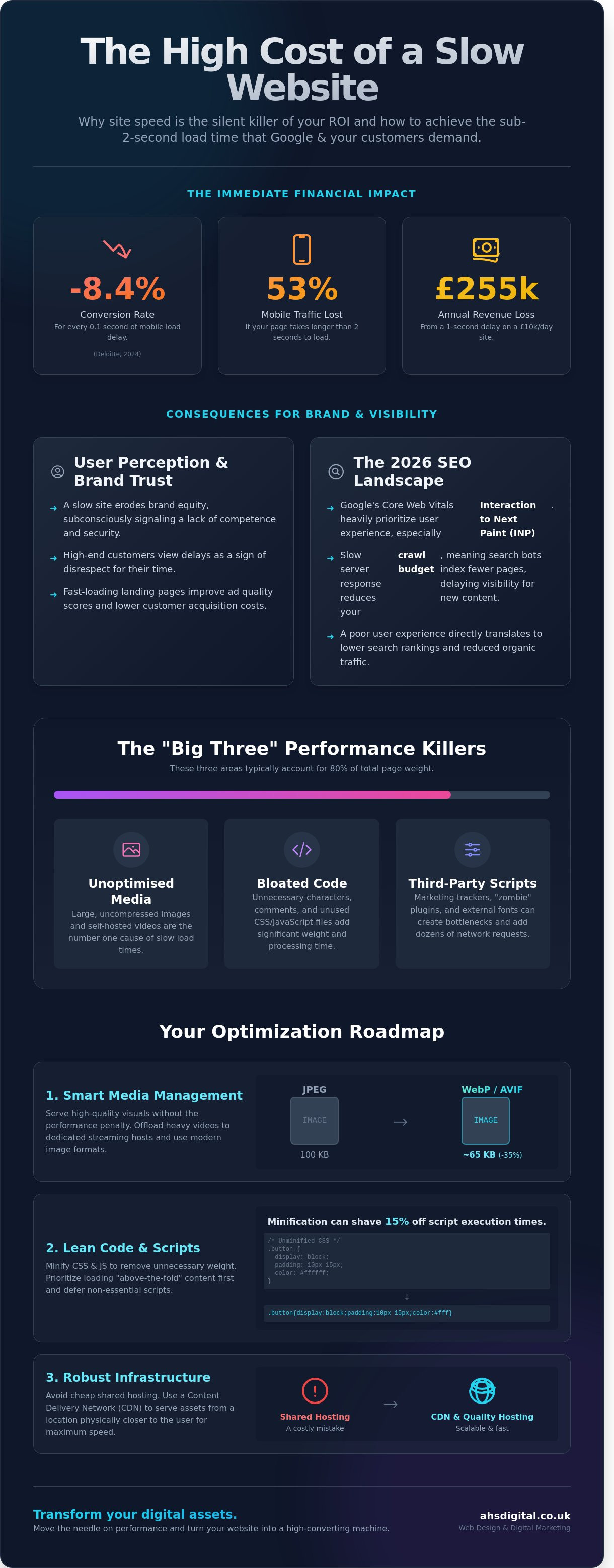
Speed isn’t just a technical metric; it’s the pulse of your digital presence. In 2026, UK consumers possess an attention span shorter than a social media transition. If your page takes longer than two seconds to load, you’ve already lost 53% of your mobile traffic. This isn’t a minor inconvenience. It’s a direct hit to your bottom line. Every millisecond of latency acts as a barrier between your product and a customer’s wallet. Data from 2025 shows that a one-second delay in page response can result in a 7% reduction in conversions. For an e-commerce site turning over £10,000 a day, that’s a £255,500 annual loss due to poor Web performance optimization.
Google’s evolved Core Web Vitals now place an aggressive emphasis on Interaction to Next Paint (INP). This metric measures how quickly your site responds to user inputs like clicks or key presses. If your site feels “heavy” or unresponsive, your search visibility will plummet. Learning 3. how to speed up your website is no longer an optional task for the IT department; it’s a core business strategy. High performance is the foundation of any professional web design, ensuring that your aesthetic choices don’t come at the cost of usability.
Beyond the Bounce Rate: Speed as a Trust Signal
A sluggish website does more than annoy users; it erodes brand equity. When a site lags, consumers subconsciously associate the delay with a lack of competence or security. High-end customers, who value their time above all else, view a slow experience as a sign of a business that doesn’t respect its clientele. Seamless responsiveness shapes the perception of your brand as a reliable, forward-thinking leader. Fast-loading pages are essential for digital marketing success because they lower your cost-per-acquisition. When your ads lead to a lightning-fast landing page, your quality scores improve and your budget goes further.
The 2026 SEO Landscape and Page Speed
Search engines in 2026 have moved beyond simple text matching. They now prioritise the total user experience. Speed impacts your crawl budget, which is the number of pages a search engine bot crawls on your site in a specific timeframe. If your server is slow to respond, bots will crawl fewer pages, leaving your newest content unindexed for longer. This creates a bottleneck that prevents your latest updates from appearing in search results. By understanding 3. how to speed up your website, you improve indexing efficiency and ensure your site remains competitive in an increasingly crowded UK market. Efficiency is the key to staying visible and profitable.
Trimming the Fat: Optimising Media, Code, and Third-Party Bloat
Most UK business sites are carrying unnecessary weight that stifles growth. The “Big Three” culprits, unoptimised images, bloated code, and excessive third-party scripts, typically account for 80% of total page weight according to 2024 industry benchmarks. Understanding 3. how to speed up your website starts with an aggressive audit of these elements to ensure your digital presence remains lean, agile, and competitive in a crowded market.
Smart Media Management: Visuals vs. Velocity
High-quality visuals are essential for conversion, but they shouldn’t come at the cost of performance. Modern standards demand the use of Next-Gen formats like WebP and AVIF. These formats provide superior compression, often reducing file sizes by 35% compared to traditional JPEGs while maintaining the sharp detail required for professional photography. Implementing responsive image attributes ensures your server delivers the smallest possible version of a file based on the user’s screen size, preventing a mobile device from downloading a desktop-sized asset.
Video content presents a unique challenge for performance. For commercial videography, we recommend offloading the heavy lifting to dedicated streaming hosts rather than self-hosting. This prevents your server from becoming a bottleneck and ensures smooth playback. Statistics show that 40% of users abandon a site that takes longer than 3 seconds to load, so every kilobyte saved directly impacts your bottom line.
Code Minification and Script Deferral
Clean, “lightening-fast” code is the foundation of a superior user experience. Minification removes unnecessary characters, comments, and whitespace from CSS and JavaScript files, which can shave 15% off script execution times. It’s also vital to Analyze and optimize your website to identify “zombie” apps or plugins. These are scripts that remain active even if the features they support are no longer in use, quietly draining resources and increasing your Time to Interactive (TTI).
When researching 3. how to speed up your website, prioritising critical CSS is a non-negotiable step. This involves identifying the exact styles needed to render the “above the fold” content and delivering them first. By deferring non-essential scripts to load after the main content, you improve the Largest Contentful Paint (LCP) metric, which is a key ranking factor for SEO in 2026. If your current site feels sluggish, our 100% U.K. based team can help you elevate your performance with a bespoke technical overhaul that moves the needle on your ROI.
Infrastructure vs. Interface: Choosing the Right Hosting and Platform
Ambitious brands often fall into the trap of £5-a-month shared hosting. It’s a costly mistake. Saving a few pounds on your monthly bill can lead to thousands in lost revenue. If you want to know 3. how to speed up your website, you have to start with the foundation. Cheap hosting means sharing resources with hundreds of other sites. When their traffic spikes, your site crawls. This lack of dedicated power makes it impossible to scale effectively.
Server location is equally vital. A server based in London provides a significant edge for a UK audience compared to one in New York. For global reach, a Content Delivery Network (CDN) is essential. It caches your content across a global network, ensuring a visitor in Tokyo gets the same snappy experience as one in Manchester. Why Performance is the Silent Killer of ROI reveals that even a 100ms delay can slash conversion rates by 7%. Your platform choice also dictates your speed ceiling. We advocate for robust, scalable solutions in our Magento agency guide because performance shouldn’t be an afterthought.
The Power of Premium UK-Based Hosting
Dedicated resources are the engine of business growth. We prioritise NVMe storage because it’s up to 25 times faster than traditional SATA drives. This hardware, combined with HTTP/3 support, drastically reduces your Time to First Byte (TTFB). The relationship between TTFB and user satisfaction is direct. A response time under 200ms feels instantaneous. If your server takes over 600ms to respond, your bounce rate can climb by 40% based on 2024 user behaviour data. Our 100% UK-based team ensures your infrastructure is tuned for local performance, moving the needle on your core web vitals.
Platform-Specific Speed Wins: Magento and Beyond
Magento 2 offers incredible power but requires expert handling. We implement Varnish cache and Redis to manage complex database queries without breaking a sweat. These tools ensure your shop stays fast even during peak sales periods like Black Friday. Understanding 3. how to speed up your website requires looking at both the server and the code simultaneously.
Generic, bloated templates are a common pitfall. They come packed with unused code that drags down performance. Custom-built themes are the solution. They’re lean, efficient, and designed for your specific needs. Our branding agency team ensures speed is baked into your visual identity. We create lightening-fast websites that look great and convert visitors into customers. We love a challenge, and optimising complex platforms is where we excel.
The Performance Audit: How to Measure and Improve Your Site Speed
Stop guessing and start measuring. You can’t improve what you don’t track, so your first step is a rigorous performance audit. Use tools like PageSpeed Insights and GTmetrix to get a clear picture of your current standing. When investigating 3. how to speed up your website, you must look beyond the top-line score. Focus on your Largest Contentful Paint (LCP), which should ideally trigger in under 2.5 seconds. You also need to monitor Cumulative Layout Shift (CLS); if your content jumps around while a user is trying to click a button, you’ll lose their trust instantly.
Hidden bottlenecks often hide within third-party scripts. Tracking pixels, chat widgets, and social embeds can account for over 40% of your total load time. Review these execution times and prune anything that isn’t moving the needle for your business. On the server side, implement Brotli compression rather than the older Gzip standard. Brotli is typically 20% more efficient for text-based files, which means faster delivery to your visitors’ browsers. Don’t just test on your office desktop. Use Chrome DevTools to simulate real-world 4G and 5G connections to see how your site handles mobile network latency.
Interpreting the Data: What the Scores Actually Mean
Chasing a 100/100 score is often a trap for business owners. A perfect score feels like a win, but it’s a “lab data” metric that doesn’t always reflect reality. You should focus on Real User Metrics (RUM) instead. This data comes from actual visitors using different devices and connection speeds across the UK. Prioritise fixes based on their impact on your bottom line. For instance, a 2020 Google study showed that a mere 0.1-second improvement in mobile speed can boost conversion rates by 8.4%. Focus on the changes that actually drive ROI rather than just chasing green circles.
Mobile-First Optimisation Strategies
Mobile devices have less CPU power and higher latency than desktops, making efficiency vital. You must reduce your Total Blocking Time (TBT) to ensure the page is interactive as quickly as possible. If the main thread is tied up with heavy JavaScript, the user can’t scroll or tap, leading to frustration. Ensure your branding packages account for mobile readability and speed. High-resolution logos and complex custom fonts look great, but they must be optimised to prevent them from slowing down the initial render. Keep your mobile experience lean, punchy, and fast to keep your bounce rates low.
Ready to transform your digital presence with a site that loads in a flash? Explore our high-performance web design services.
Speed by Design: Building Lightening-Fast Digital Experiences
Performance isn’t a bandage you apply after a site launch; it’s a foundation you lay during the initial discovery phase. When considering 3. how to speed up your website, the most successful brands integrate technical efficiency into their very first wireframes. Thinking about asset weight and server requests before a single pixel is drawn prevents the common “bloat” that plagues modern sites. Why hire five different freelancers who don’t talk to each other? You end up with a fragmented mess of conflicting scripts and heavy plugins. We provide a cohesive creative suite where our designers, developers, and marketers work in total sync to ensure your site is lean, mean, and ready to convert.
The AHS Digital Approach to High-Performance Web
We combine stunning aesthetics with technical excellence to create digital experiences that don’t just look the part but perform under pressure. Our process focuses on responsive, lightening-fast web design that prioritises the user journey. Take our “Cultivating Digital Growth” project as an example. By optimising the technical architecture and streamlining the codebase, we saw a client’s mobile conversion rate jump by 42% in just three months. Our 100% UK-based team understands the local market and the high expectations of British consumers. We don’t outsource; we collaborate internally to deliver projects we’re proud of.
Ready to Move the Needle?
A slow site is costing you money every single day. Research from 2024 shows that a one-second delay in mobile load times can impact conversion rates by up to 20%. That’s a huge slice of potential ROI vanishing because of a sluggish server or unoptimised images. You need more than just a few tips on 3. how to speed up your website; you need a strategic partner to overhaul your digital presence. We love a challenge and we’re ready to help you scale.
- Stop the bounce: 53% of mobile visits are abandoned if pages take longer than three seconds to load.
- Boost your visibility: Core Web Vitals are a major ranking factor in the UK search landscape.
- Maximise your budget: Faster sites lead to lower CPCs in your digital marketing campaigns.
The value of a professional audit cannot be overstated. It’s the only way to uncover the hidden bottlenecks that are stifling your growth and preventing you from taking your marketing to the next level. If you’re tired of seeing your competitors outpace you in the search results, it’s time to act. Stop settling for “good enough” and start demanding excellence. You can contact us today to start your transformation and see exactly how we can help your business thrive in a competitive digital economy.
Move the Needle on Your 2026 Digital Growth
Performance isn’t just a technical metric; it’s the foundation of your digital ROI. With industry data showing that a one-second delay can slash mobile conversions by 20%, every millisecond matters. You’ve seen that mastering 3. how to speed up your website involves more than just a quick plugin fix. It requires a strategic approach, from trimming media bloat to investing in high-performance Magento infrastructure and speed-by-design principles.
Waiting for your site to load costs you revenue every single day. Our 100% UK-based team specialises in transforming sluggish platforms into high-converting digital assets. As a results-driven creative suite, we focus on technical excellence that scales alongside your business ambitions. Whether you’re battling legacy code or building a lightening-fast experience from the ground up, we have the expertise to deliver measurable results that impact your bottom line.
Stop letting slow load times anchor your brand’s potential. Take your website performance to the next level with AHS Digital and ensure your platform is ready for 2026. Let’s turn your site speed into your greatest competitive advantage today.
Frequently Asked Questions
How much does it cost to speed up a website in the UK?
UK industry data shows professional optimisation projects usually start at £500 for small business sites. For larger enterprise platforms, costs can reach £5,000 or more, depending on the complexity of the backend architecture and the amount of technical debt involved.
Can I speed up my website without changing my hosting provider?
You can certainly learn how to speed up your website without moving hosts by focusing on browser-side fixes like minifying CSS and JavaScript. These adjustments often resolve 70% of performance bottlenecks without requiring a more expensive server plan.
Will optimising my images for speed reduce their quality?
Using modern formats like WebP reduces file sizes by up to 30% without any visible loss in visual quality. This allows you to showcase stunning, high-resolution visuals that don’t compromise your page load times or user experience.
How often should I perform a website speed audit?
You should perform a comprehensive speed audit every 90 days to catch any performance issues before they impact your rankings. Regular checks ensure that new content, marketing pixels, or plugins don’t slow down your site over time.
What is a good loading time for an e-commerce website in 2026?
For 2026, a top-tier e-commerce site should aim for a load time of 1.2 seconds or less. A study by Portent found that websites loading in 1 second have a conversion rate 3 times higher than those loading in 5 seconds.
Do third-party tracking scripts like Google Analytics slow down my site?
Scripts for analytics and social media tracking can add 400ms of latency to your load time if they aren’t managed correctly. We recommend using asynchronous loading so these external tools don’t block your main content from appearing to the user.
Is there a difference between mobile and desktop website speed?
Mobile speed is often slower due to hardware limitations and variable network conditions, making it the most important metric for your SEO. Since 60% of global web traffic now comes from mobile, your performance on smaller screens is vital for business growth.
Can a branding agency really help with my website speed?
A strategic branding agency like AHS Digital ensures your aesthetic choices don’t hurt your ROI by building performance into the design. When we build bespoke websites, we combine creative flair with technical precision to ensure your site is lightening-fast and ready to convert.