

Does this sound familiar? You walk into the boardroom armed with impressive campaign metrics-impressions, click-through rates, engagement-only to be met with a single question from the CFO: “But what’s the return on this £50,000 investment?” It’s a moment that can make even the most confident marketing leader feel on the back foot. The challenge of justifying marketing spend to management often feels like an uphill battle, especially when your department is viewed as a cost centre rather than the powerful growth engine it truly is.
It’s time to change the conversation. Shifting that perception from a cost to a crucial investment is entirely possible, but it requires speaking a new language-one built on data, focused on revenue, and aligned with core business objectives. This guide provides the step-by-step framework you need to build an undeniable business case. We’ll show you how to connect every pound spent to tangible results, confidently answer the toughest questions, and secure the budget you need to elevate your company’s growth. Get ready to prove your value and be seen as the strategic business leader you are.
Key Takeaways
- Shift the conversation from marketing as a cost centre to a strategic growth engine to fundamentally change how leadership views your budget.
- Directly connect every proposed marketing activity to the company’s top strategic objectives to make your budget request indispensable.
- The key to justifying marketing spend to management is moving beyond vanity metrics and presenting concrete data that impacts revenue and customer acquisition.
- Learn how to structure your business case for a busy executive and present it as a compelling growth story, not just a list of requests.
The Mindset Shift: From Cost Centre to Growth Engine
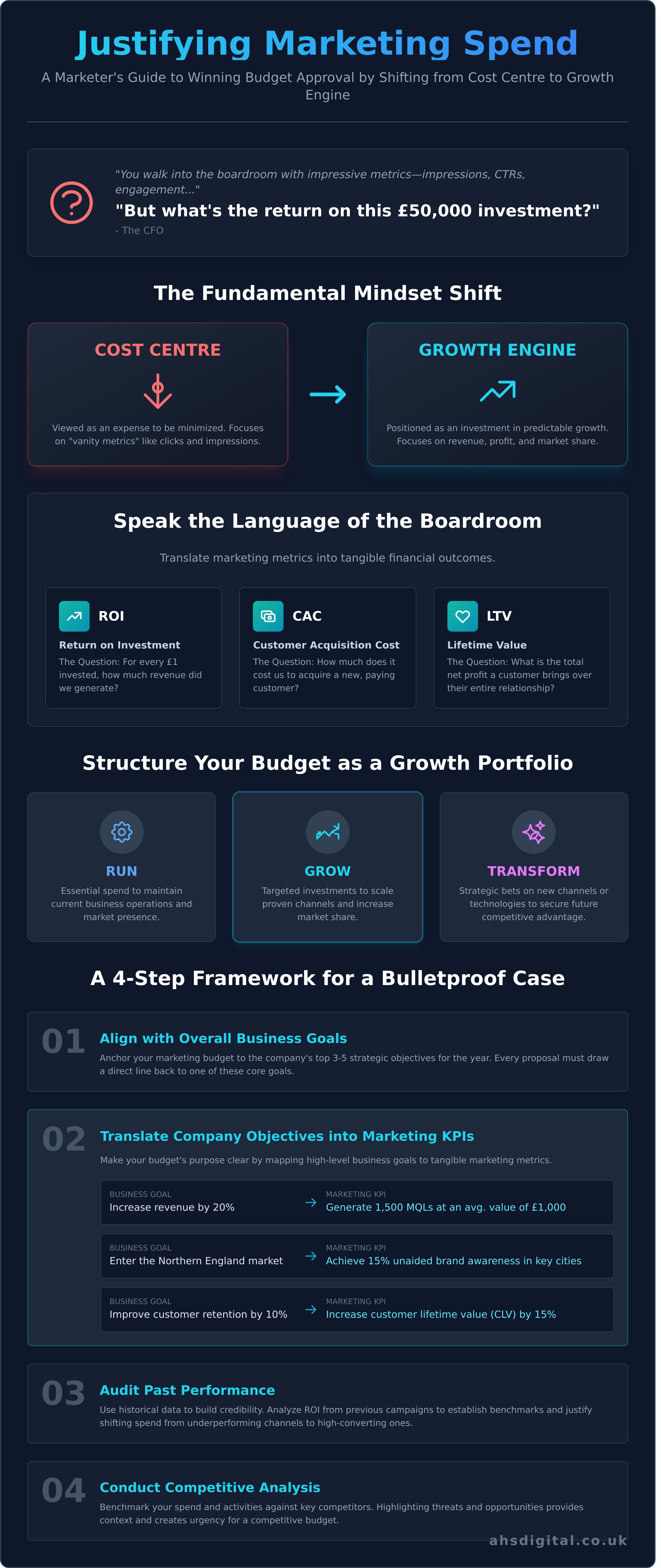
The single most important step in justifying marketing spend to management is to stop talking about it as an expense. Successful marketers reframe the entire conversation, positioning their department not as a cost centre, but as the primary engine for predictable business growth. This isn’t just a semantic trick; it’s a fundamental mindset shift that aligns marketing activities directly with C-suite objectives like revenue, profit, and market share.
When you present marketing as an investment in acquiring customers and building long-term value, you change the dynamic. The question is no longer “How much can we cut?” but “How much can we invest to achieve our growth targets?”
Speaking the Language of the Boardroom
Your management team doesn’t think in terms of clicks, impressions, or engagement rates. They think in terms of financial outcomes. To get buy-in, you must translate marketing metrics into the language of business. Instead of reporting on campaign reach, report on the pipeline it generated. It’s crucial to connect your activities to bottom-line results by focusing on three core metrics:
- Return on Investment (ROI): For every £1 invested, how much revenue did we generate?
- Customer Acquisition Cost (CAC): How much does it cost us to acquire a new, paying customer?
- Lifetime Value (LTV): What is the total net profit a customer will bring over their entire relationship with us?
Framing your efforts in these terms transforms the conversation. An effective SEO campaign isn’t an expense; it’s an investment in lowering future CAC. A deep focus on understanding marketing effectiveness allows you to present your budget with the same rigour as a proposal for new factory machinery-both are investments designed to generate a measurable return.
Adopting an Investment-Based Approach
Present your budget not as a list of costs, but as a portfolio of strategic growth investments. A powerful way to structure this is by categorising spend into ‘run,’ ‘grow,’ and ‘transform’ buckets. This demonstrates strategic foresight and makes the purpose of every pound crystal clear.
- Run: The essential spend to maintain current business operations and market presence.
- Grow: Targeted investments to scale proven channels and increase market share.
- Transform: Strategic bets on new channels or technologies to secure future competitive advantage.
This model moves the discussion away from line-item costs and towards a strategic allocation of capital designed to move the needle. It’s a proactive approach that positions marketing as a forward-thinking driver of the business’s future success.
The Foundation: Aligning Marketing with Overall Business Goals
Before a single pound is allocated, your marketing budget must be anchored to the company’s core strategy. A budget presented as a list of activities without a clear connection to business outcomes is the first to be cut. The most critical step in justifying marketing spend to management is to demonstrate that marketing is not a cost centre, but a primary engine for growth. Start by asking for the company’s top 3-5 strategic objectives for the year. Every subsequent proposal must draw a direct line back to one of these goals.
Translating Company Objectives into Marketing KPIs
Transform high-level business goals into tangible marketing metrics. This translation makes your budget’s purpose immediately clear to stakeholders who think in terms of revenue, market share, and profitability. By mapping your Key Performance Indicators (KPIs) directly to their objectives, you speak their language and build a powerful, data-driven case for investment.
- Business Goal: Increase annual revenue by 20% (from £5M to £6M).
Marketing KPI: Generate 1,500 Marketing Qualified Leads (MQLs) at an average value of £1,000. - Business Goal: Enter the Northern England market.
Marketing KPI: Achieve 15% unaided brand awareness in Manchester and Leeds within 9 months. - Business Goal: Improve customer retention by 10%.
Marketing KPI: Increase customer lifetime value (CLV) by 15% through targeted email and content campaigns.
Auditing Past Performance to Inform Future Spend
Use historical data to build a credible foundation for your future plans. Analyse the previous period to identify what moved the needle and what fell flat. Calculate the Return on Investment (ROI) for major campaigns to establish performance benchmarks. This evidence-based approach allows you to confidently justify shifting budget away from underperforming channels-like reallocating £10,000 from low-engagement trade shows to a high-converting PPC campaign.
Conducting a Competitive Analysis
Your business doesn’t operate in a vacuum, and neither should your budget. Benchmark your marketing activities and spend against your key competitors to provide essential context for management. Identify where rivals are investing to win market share. Highlighting these threats and opportunities creates urgency. Understanding industry benchmarks, like those found in CMO Survey marketing spend insights, can reveal if your proposed spend is in line with or lagging behind the market, strengthening your case for a competitive budget.
Gathering Your Arsenal: The Key Metrics and Data to Present
To win budget approval, your argument must be built on a foundation of solid, indisputable data. Forget vanity metrics like social media likes or impressions; management wants to see numbers that directly impact the bottom line. When justifying marketing spend to management, your ability to translate marketing activities into financial outcomes is your greatest asset. Frame every metric in the context of business growth.
The ‘Big Three’: ROI, CAC, and LTV
These three metrics form the cornerstone of any budget discussion. They connect your marketing efforts directly to the company’s financial health.
- Return on Investment (ROI): This is the ultimate proof of performance. It answers the critical question: for every pound we invest in marketing, how many pounds in revenue do we generate? A positive ROI is non-negotiable.
- Customer Acquisition Cost (CAC): This metric calculates the total cost to acquire a single new customer. A low and efficient CAC demonstrates that your marketing engine is running smoothly and scalably.
- Customer Lifetime Value (LTV): This shows the total revenue a business can expect from a single customer account. A high LTV proves that you aren’t just acquiring customers; you’re acquiring valuable ones who contribute to long-term growth.
Channel-Specific Performance Metrics
Beyond the high-level numbers, present data that shows how each component of your strategy is performing. This demonstrates a granular understanding of what works.
- SEO: Focus on the estimated value of your organic traffic (what it would cost in PPC), keyword rankings for high-intent commercial terms, and the number of qualified leads generated organically.
- PPC: Present clear Return on Ad Spend (ROAS), Cost Per Lead (CPL), and campaign conversion rates to show direct, measurable results from your ad budget.
- Content Marketing: Track leads generated from gated content, asset downloads that indicate audience engagement, and its influence on shortening the sales cycle.
Understanding how these channels integrate is key to building a powerful, cohesive strategy. A holistic approach that covers all core digital marketing services ensures every pound spent works harder to move the needle.
Forecasting and Setting Realistic Projections
Use historical data to build a credible forecast for your proposed initiatives. A simple but effective model is: (Historical Conversion Rate) x (Projected Reach/Traffic) = Expected Results. Present this using a best-case, expected-case, and worst-case scenario. This approach manages expectations effectively and shows that you are a strategic thinker who has considered all potential outcomes. It transforms your budget request into a well-reasoned investment plan.
Building the Business Case: How to Structure Your Proposal
You have the data and the strategy, but the final hurdle is presenting it effectively. When justifying marketing spend to management, the structure and clarity of your proposal are just as critical as the numbers inside. Executives are time-poor; they need to grasp the core value proposition instantly. Your document must be designed for a quick scan, leading with the conclusion and using every section to reinforce one central message: this is a profitable investment for the business.
The Executive Summary: Your One-Page Pitch
This is arguably the most important page of your entire proposal and might be the only one a senior leader reads in full. Start with the bottom line. State your total budget request and the specific business outcome you expect to achieve. Support it with your most powerful data points to immediately frame the investment as a strategic advantage.
- Total Ask: A marketing budget of £250,000 for H2 2024.
- Expected Outcome: To generate £1.25M in new pipeline revenue.
- Key Metric: A projected Return on Investment (ROI) of 5:1.
The Detailed Breakdown: Channels, Activities, and Costs
Here, you provide the evidence that supports your executive summary. Itemise the budget by channel and major initiative to demonstrate a clear, thought-out plan. Don’t just list costs; explain the ‘why’ behind each significant line item. For example, a budget for SEO is to capture long-term organic growth, while PPC is for immediate lead generation. Remember, all traffic needs a high-performing destination; that’s why professional web design is a non-negotiable component, built to maximise conversions and deliver a seamless user experience.
Assessing Risks and Outlining Contingency Plans
Acknowledging potential risks shows foresight and builds immense credibility. No plan is foolproof, so address potential challenges head-on, such as market volatility, competitor actions, or lower-than-expected conversion rates. More importantly, show you have a Plan B. Outline a contingency plan, such as a quarterly review process to reallocate funds from underperforming channels to those delivering the highest return. This proves you are a responsible steward of company funds, which is essential for successfully justifying marketing spend to management.
Presenting with Confidence and Handling Objections
You’ve built a data-driven case; now it’s time to secure approval. Your delivery is just as critical as your data. The final step in justifying marketing spend to management is to present your plan with clarity and conviction. Don’t just show spreadsheets-tell a compelling story. Frame your request as a strategic investment in the company’s future, narrating how this budget will directly fuel growth, expand market share, and move the needle on core business objectives.
Anticipating Tough Questions from the CFO
Your finance team is trained to scrutinise every pound. Be prepared for pointed questions and have concise, data-backed answers ready.
- “Can we achieve 80% of the results with 50% of the budget?” Explain the point of diminishing returns. Show how your proposed budget hits the sweet spot for efficiency, and how significant cuts would disproportionately harm performance and jeopardise key growth targets.
- “Why is this channel so expensive? What’s the direct return?” Have the direct ROI, Cost Per Acquisition (CPA), or lead value for that channel ready. Benchmark it against other channels or UK industry standards to provide crucial context.
Justifying ‘Hard-to-Measure’ Activities
Not every marketing activity has a direct, last-click ROI. It’s your job to connect the dots. Explain how top-of-funnel content and brand-building activities create a stronger pipeline for the future. Use correlation data to make your case, for instance: “When our branded search volume increased by 20% last quarter, our overall CPA decreased by 12%.” Activities like strong branding are not expenses; they are long-term assets that build trust and reduce acquisition costs over time.
Closing with a Clear Call to Action
End your presentation with absolute clarity. Leave no room for ambiguity. Restate your request and the expected outcome in one powerful sentence: “To achieve our goal of 30% revenue growth, we are requesting a budget of £150,000, which we project will deliver a 4:1 return on investment.” Clearly outline the next steps and the timeline for approval to create a sense of urgency and professionalism. Reiterate your confidence that this plan is the most effective path to achieving your shared business goals.
Transform Your Marketing from a Cost to a Cornerstone of Growth
Moving past the budget meeting with confidence is about more than just numbers; it’s about a fundamental shift in perspective. By reframing marketing as a primary engine for business growth and aligning every activity with clear company objectives, you build an unshakeable foundation. When you present this vision with compelling data and a clear ROI forecast, the task of justifying marketing spend to management transforms from a daunting challenge into a strategic opportunity to demonstrate undeniable value.
This data-driven approach doesn’t just secure budgets-it builds C-suite trust and solidifies marketing’s role as a critical contributor to the bottom line. If you’re ready to make that leap, you don’t have to do it alone. AHS Digital’s results-oriented creative suite has a proven track record in delivering measurable transformation for businesses across the U.K.
Ready to build a marketing strategy that management can’t say no to? Get in touch with AHS Digital. Partner with our dedicated, 100% U.K. based team and let’s craft a compelling, data-backed case for the investment your growth truly deserves.
Frequently Asked Questions
What is a good marketing ROI? How do I benchmark it?
A good marketing return on investment (ROI) is generally considered to be a 5:1 ratio-generating £5 in revenue for every £1 spent. However, this varies significantly by industry and profit margin. A high-margin business might thrive on a 3:1 ROI, while a lower-margin company may need 10:1 to be profitable. To benchmark, compare your results against your own historical performance, published industry averages for the UK market, and the typical performance of specific channels like PPC or SEO.
How can I justify brand marketing spend that has no direct, immediate ROI?
Frame brand marketing as a long-term investment in your company’s most valuable asset. Instead of direct ROI, measure its impact through leading indicators like increased brand search volume, higher direct website traffic, and improved share of voice against competitors. Explain to management that strong brand equity lowers future customer acquisition costs, increases customer loyalty, and builds a sustainable competitive advantage that performance marketing alone cannot achieve. It’s about building future demand, not just capturing existing interest.
What percentage of company revenue should be allocated to the marketing budget?
For established UK businesses, a common guideline is to allocate 5-10% of total revenue to marketing. However, this is not a fixed rule. Growth-focused startups or companies entering a competitive new market may need to invest much more, often between 15-25%. The right percentage depends entirely on your business stage, industry competitiveness, and strategic goals. The key is to link the budget directly to specific growth targets rather than an arbitrary percentage.
How do I justify a budget increase, especially after a campaign that underperformed?
Address the underperformance head-on with a data-driven analysis. Pinpoint exactly what went wrong-was it the targeting, the creative, or the channel strategy? Present these findings not as failures, but as valuable learnings. Your request for an increased budget should be directly tied to a new, refined strategy that rectifies those previous mistakes. This demonstrates accountability and a clear, forward-thinking plan to generate a better return, turning a negative outcome into a strong strategic pivot.
What are the most common mistakes marketers make when presenting their budget?
The most common mistake is focusing on vanity metrics like clicks and impressions instead of business outcomes like leads, sales pipeline, and customer lifetime value (CLV). Another error is presenting data without a clear narrative that connects marketing activities to revenue. Crucially, many marketers fail to align their budget request with the company’s overarching financial goals. Successfully justifying marketing spend to management requires speaking their language: growth, profitability, and market share.