

Is your marketing budget disappearing with little to show for it? For many ambitious UK companies, the quest for new customers feels like a frustrating guessing game—a series of disconnected efforts that fail to deliver a predictable flow of enquiries. This uncertainty is precisely why finding effective lead generation strategies for UK businesses isn’t just a marketing goal; it’s essential for sustainable growth.
Forget random acts of marketing. This definitive guide is designed to give you clarity and control. We will explore proven inbound and outbound tactics tailored specifically for the competitive UK landscape, helping you move the needle. You’ll learn how to build a cohesive system that attracts a steady stream of high-quality leads, understand which channels deliver the best ROI, and gain the confidence that every pound spent is a strategic investment in your company’s future.
Key Takeaways
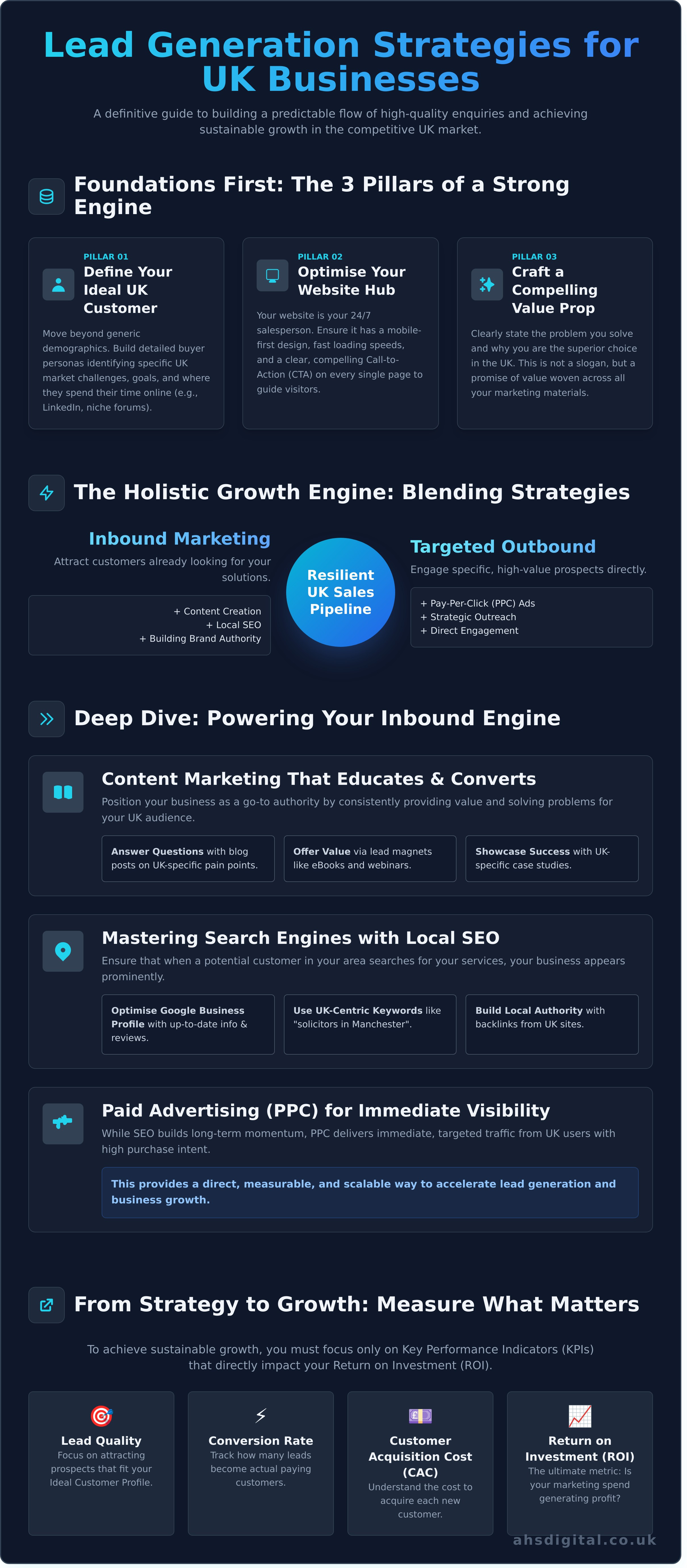
- Before launching any campaign, establish a solid foundation—including a clear Ideal Customer Profile (ICP) and a high-converting website—to turn interest into opportunity.
- A holistic approach that blends inbound marketing (like SEO and content) with targeted outbound methods is essential for building a resilient UK sales pipeline.
- To achieve sustainable growth, you must measure the right KPIs for your lead generation strategies for UK businesses, focusing only on metrics that directly impact ROI.
- Elevate your results by leveraging brand authority, as trust and credibility are critical assets for converting prospects in the competitive UK market.
Foundations First: Building Your UK Lead Generation Engine
Jumping into advanced marketing tactics without a solid base is like building a house on sand. Before you invest a single pound in ads or content, you must construct a robust engine designed to convert interest into tangible business leads. The most effective lead generation strategies for UK businesses are built on this non-negotiable groundwork. It begins with a deep understanding of what lead generation is at its core: the strategic process of attracting and converting strangers into prospects who have indicated an interest in your company’s product or service.
For a practical look at how these foundational elements come together to close leads, this video offers an excellent step-by-step breakdown:
Define Your Ideal UK Customer
Generic marketing misses the mark. To truly connect, you must move beyond simple demographics and build detailed buyer personas for your UK audience. This means identifying their specific challenges, professional goals, and the unique pressures of the UK market. Understand where they spend their time online—is it engaging with industry leaders on LinkedIn, seeking recommendations in UK-specific Facebook groups, or browsing niche forums? Mapping this journey allows you to tailor every message for maximum impact.
Your Website: The Hub of All Lead Generation
Your website is not just a digital brochure; it is your hardest-working salesperson, operating 24/7. A slow, confusing, or poorly designed site actively kills conversions and wastes your marketing spend. Prioritise a mobile-first, responsive design to capture on-the-go users. Every single page must feature a clear, compelling call-to-action (CTA) that guides visitors to the next step. To make your digital presence a true asset, ensure your site is built for performance with professional web design services.
Craft a Compelling Value Proposition
In a crowded marketplace, “why you?” is the most important question to answer. Your value proposition must clearly and concisely state the problem you solve for your customers and what makes you the superior choice over your UK competitors. It’s not a slogan; it’s a promise of the value you will deliver. This core message must be woven consistently across your website, social media profiles, and all marketing materials to build a strong, recognisable brand identity that attracts the right leads.
Inbound Lead Generation: Attracting Customers Already Looking in the UK
In today’s competitive landscape, the most effective lead generation strategies for UK businesses have shifted from interruption to attraction. Inbound marketing is the engine of this change. Instead of chasing customers with cold calls or mass advertising, you create valuable content and experiences that draw your ideal audience directly to you. This approach focuses on building long-term digital assets that generate highly qualified leads—people who are already actively searching for the solutions you provide, resulting in a higher conversion rate and a stronger ROI.
Content Marketing That Educates and Converts
Content is the currency of trust in the digital world. By consistently providing value, you position your business as a go-to authority in your industry. This isn’t just about selling; it’s about solving problems for your UK audience. A powerful content strategy builds a loyal following and a robust sales pipeline.
- Answer Questions: Create blog posts addressing common pain points for UK customers, such as “Navigating UK VAT Returns for Small Businesses.”
- Offer Value: Develop lead magnets like downloadable eBooks, checklists, or webinars that prospects exchange their contact details for.
- Showcase Success: Build credibility with UK-specific case studies detailing how you helped a client in, for example, Birmingham or Glasgow achieve measurable results.
Mastering Search Engines with Local SEO
For your content to be discovered, it needs to be visible where your customers are looking: search engines. Local Search Engine Optimisation (SEO) ensures that when a potential customer in your area searches for your services, you appear. Mastering these online lead generation fundamentals is non-negotiable for sustainable growth.
- Optimise Your Google Business Profile: This is your digital storefront. Keep it updated with accurate information, services, and positive reviews to capture local searches.
- UK-Centric Keyword Research: Target phrases your local customers use, like “commercial solicitors in Manchester” instead of generic terms.
- Build Local Authority: Earn high-quality backlinks from relevant UK-based websites, industry bodies, and local directories.
Paid Advertising (PPC) for Immediate Visibility
While content and SEO build long-term momentum, Pay-Per-Click (PPC) advertising delivers immediate traffic and leads. It allows you to place your business directly in front of UK users with high purchase intent, providing a direct and measurable way to accelerate growth. This is one of the most direct and controllable lead generation strategies for UK businesses looking for fast results.
- Target High-Intent Searches: Use Google Ads to appear at the top of search results for keywords that signal a user is ready to buy.
- Reach Specific Demographics: Leverage social media ads on platforms like LinkedIn or Facebook to target users by location, job title, or interests within the UK.
- Control Your Budget: Start with a manageable daily budget, perhaps £20-£50, to test campaigns and scale what delivers the best return on investment.
- Maximise Conversions: Always send ad traffic to a dedicated, high-converting landing page, not your homepage.
Proactive & Outbound Strategies: Reaching Your Ideal UK Customers
While inbound marketing creates a powerful magnetic pull, the most effective lead generation strategies for uk businesses also incorporate a proactive, outbound push. This isn’t about casting a wide, impersonal net. Modern outbound marketing is a precision tool, designed to actively engage specific, high-value prospects who fit your ideal customer profile. When executed correctly, it accelerates your sales pipeline and puts you in control. However, it’s crucial to operate with full compliance to UK regulations like GDPR. The key is to combine these tactics with your inbound efforts for a powerful, multi-channel approach that moves the needle.
Strategic Email Marketing (GDPR-Compliant)
Email remains a high-ROI channel, but only when it’s built on trust and relevance. Forget buying lists—it’s ineffective and a GDPR minefield. Instead, focus on building a quality, opted-in list through your lead magnets. From there, success hinges on:
- Audience Segmentation: Group your subscribers based on behaviour, industry, or interest to send highly personalised and relevant content that converts.
- Automated Nurturing: Create automated email sequences that guide new leads through their buyer’s journey, providing value and building trust at every step.
- Clear Unsubscribe: Always provide a simple, one-click way for users to opt-out. It’s a legal requirement and a sign of a reputable brand.
LinkedIn for B2B Lead Generation
For B2B companies, LinkedIn is a non-negotiable platform and a cornerstone of effective lead generation. It’s where your ideal clients are actively networking and seeking solutions. To leverage it effectively, you must optimise your personal and company profiles to act as compelling landing pages that showcase your expertise. The modern playbook has evolved; as highlighted by the Harvard Business Review, the new rules for B2B lead generation demand genuine engagement and value-led conversations. Use tools like Sales Navigator for hyper-targeted outreach and build authority by sharing valuable industry insights, not spammy sales pitches.
Modern Cold Calling and Direct Mail
The terms “cold calling” and “direct mail” might sound dated, but their modern iterations are surprisingly effective. The key is to transform them from cold outreach to warm, value-driven conversations. Before picking up the phone or sending a letter, conduct thorough research on your prospects to understand their pain points. Your goal is to offer a solution, not just make a sale. In a world of digital saturation, a creative, high-quality piece of direct mail can cut through the noise and make a memorable impact. Always follow up professionally across multiple channels, like email or LinkedIn, to build a cohesive and persistent campaign.
Leveraging Brand & Authority to Create a Lead Magnet
In a crowded marketplace, the most effective lead generation strategies for UK businesses are built on a foundation of trust and authority. A strong brand does more than just look good; it acts as a powerful magnet, drawing in qualified prospects and making every marketing effort more effective. For UK customers, credibility is paramount. By investing in your brand, you build the trust necessary to convert interest into tangible leads.
Building a Brand That Attracts Leads
Your brand is your reputation—the sum of every interaction a customer has with your business. It’s far more than a logo. Consistency in your messaging, tone of voice, and visual identity across all platforms builds recognition and fosters a deep sense of trust. Investing in a professional branding package ensures this cohesion, setting you apart from competitors. Use this foundation to tell your unique story, creating an emotional connection that resonates with your ideal audience and turns passive observers into engaged prospects.
The Power of Social Proof and Testimonials
What others say about you is infinitely more powerful than what you say about yourself. Social proof is one of the most persuasive tools in your arsenal. It validates your claims and gives potential customers the confidence to take the next step. To leverage it effectively:
- Actively collect and showcase reviews on key UK platforms like Google and Trustpilot.
- Feature detailed customer testimonials and in-depth case studies on your website to demonstrate tangible results.
- Display industry awards, professional certifications, and any positive media mentions to solidify your expertise.
- Encourage user-generated content on social media, turning happy customers into authentic brand advocates.
Using Professional Video and Photography
In a digital-first world, visual assets are crucial for capturing attention and communicating value quickly. Generic stock photos fail to build a genuine connection. Instead, use authentic photography of your team, your workplace, and your products in action to humanise your brand. Furthermore, high-quality videography is exceptional for explaining complex services in a simple, engaging format. A well-produced video testimonial can be your most compelling asset, combining a personal story with undeniable proof of your value. Always ensure these assets are optimised for fast loading times to protect your site’s user experience and SEO performance.
Measuring Success: How to Know Your Lead Generation is Working
In digital marketing, there’s a timeless saying: if you can’t measure it, you can’t improve it. Launching a campaign is only the first step; true growth comes from understanding the data, making informed decisions, and optimising your marketing spend. Effective lead generation strategies for UK businesses are not about guesswork—they are about turning raw numbers into tangible ROI.
By focusing on a few key metrics, you can gain a clear picture of what’s working, what isn’t, and where your budget is best invested to drive sustainable growth.
Key Lead Generation Metrics (KPIs) to Track
Don’t get lost in vanity metrics. Concentrate on the numbers that directly impact your bottom line. Here are the essential KPIs every UK business should monitor:
- Cost Per Lead (CPL): This calculates the exact cost in pounds (£) to acquire a single new lead. It is the ultimate measure of your campaign’s financial efficiency.
- Landing Page Conversion Rates: The percentage of visitors who complete a desired action (like filling out a form). This KPI tells you how persuasive and effective your landing pages are.
- Lead-to-Customer Rate: This crucial metric reveals the quality of your leads. What percentage of your leads are actually converting into paying customers?
- Customer Lifetime Value (CLV): Understanding the total revenue a single customer is likely to generate over time helps you justify your marketing spend and focus on acquiring high-value leads.
Essential Tools for UK Businesses
The right technology stack makes tracking these KPIs seamless. To effectively manage your leads and analyse performance, consider implementing these platforms:
- CRM System: A Customer Relationship Management tool like HubSpot or Salesforce is vital for organising, tracking, and nurturing leads through your sales funnel.
- Google Analytics: This free tool is non-negotiable for understanding how users find and interact with your website.
- SEO & Competitor Analysis Tools: Platforms like Semrush or Ahrefs provide critical insights into your search performance and what your competitors are doing.
- Email Marketing Platforms: Tools like Mailchimp or Klaviyo allow you to automate communication and nurture leads directly.
The Importance of A/B Testing and Optimisation
Data provides the “what,” but optimisation is the “how.” A/B testing—where you compare two versions of a webpage, email, or ad—is the engine of improvement. Continuously test different headlines, calls-to-action (CTAs), images, and layouts to see what resonates most with your audience. Even a small increase of 1-2% in your conversion rate can have a monumental impact on your ROI. A cohesive digital marketing strategy is never static; it includes constant optimisation to ensure your results keep growing.
Transforming Strategy Into Sustainable UK Growth
Mastering lead generation in the UK market isn’t about finding a single magic bullet. The most effective lead generation strategies for UK businesses involve building a robust engine—one that combines the magnetic pull of inbound marketing with the targeted precision of outbound strategies. As we’ve explored, success hinges on creating genuine authority and meticulously measuring what truly moves the needle for your bottom line.
Turning this knowledge into action is the next critical step. At AHS Digital, our 100% UK-based team of experts thrives on this challenge. We deliver a cohesive creative suite for a unified brand message, all underpinned by a results-driven approach focused squarely on your ROI. We don’t just talk about growth; we build the framework for it.
Stop guessing and start converting. Ready to grow? Let’s build your lead generation strategy together.
Frequently Asked Questions
How much should a UK small business spend on lead generation?
There is no single figure, but a strong benchmark for UK SMEs is allocating 5-15% of total revenue to marketing and lead generation. A new business focused on rapid growth might invest at the higher end, while an established company may spend less. The key is to focus on Return on Investment (ROI). An investment of £2,000 per month is highly effective if it generates £10,000 in new business, but a poor investment if it yields nothing.
What is the difference between lead generation and demand generation?
Think of it this way: demand generation creates the appetite, while lead generation provides the meal. Demand generation focuses on building brand awareness and educating your market about their problems and your solution—it’s top-of-funnel activity. Lead generation is the process of converting that awareness into tangible contact information from potential customers, such as an email from a form submission. One creates the crowd, the other captures the names.
How long does it take for lead generation strategies like SEO to work?
Patience is crucial for long-term strategies like SEO. You can typically expect to see initial movement and early results within 3-6 months, with significant, needle-moving impact taking 6-12 months. This is because it takes time to build authority with search engines. For faster results, Pay-Per-Click (PPC) advertising can generate leads almost immediately, but it requires continuous investment to maintain. A balanced approach often delivers the best overall ROI.
Which lead generation strategy is best for B2B vs. B2C businesses in the UK?
For UK B2B companies, strategies like LinkedIn outreach, account-based marketing (ABM), and content marketing with high-value assets like whitepapers are highly effective. B2C businesses often see greater success with social media marketing on platforms like Instagram and Facebook, influencer collaborations, and local SEO for physical stores. The best strategy always aligns with where your specific target audience spends their time online and what motivates their purchasing decisions.
What are the most common lead generation mistakes to avoid?
A primary mistake is targeting everyone and therefore no one; you must have a clearly defined Ideal Customer Profile. Another is ignoring lead nurturing—capturing a lead is only the first step. Many businesses also fail by having a slow, confusing website that hurts conversions. Ultimately, the biggest error is not tracking metrics. To avoid these common pitfalls, many businesses explore Lead Generation Systems to ensure their strategies are measured, analysed, and optimised for performance and ROI.
Do I need a CRM to start generating leads?
You don’t need a complex CRM on day one. Initially, a simple spreadsheet can manage a small number of leads. However, as your lead volume grows, a CRM (Customer Relationship Management) system becomes essential for efficiency and scalability. It allows you to track interactions, nurture relationships systematically, and ensure no potential customer falls through the cracks. We recommend implementing a CRM sooner rather than later to build a strong foundation for growth.