

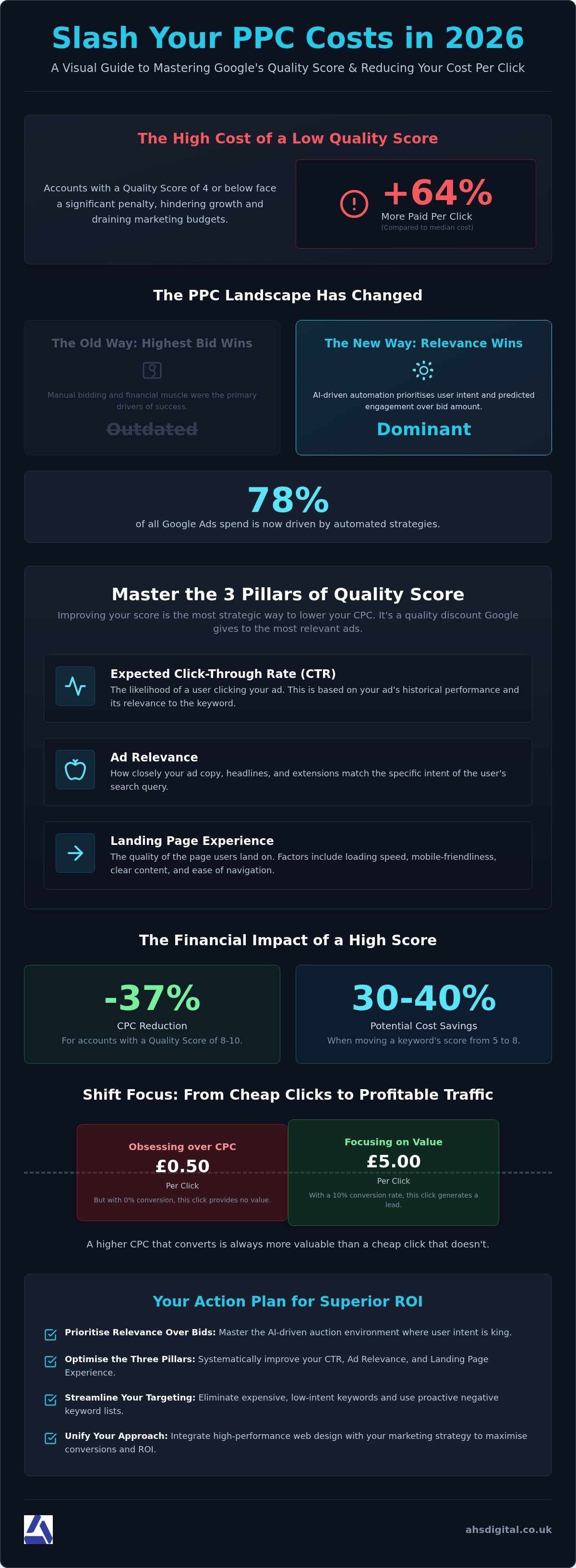
Did you know that accounts with a Quality Score of 4 or below pay 64% more per click than the median? It’s a staggering penalty for ambitious firms already battling vanishing marketing budgets and rising costs per lead. We know it’s frustrating to feel like your ad spend is trapped in a black box algorithm that prioritises platform profit over your growth. This guide is your definitive roadmap for reducing ppc cost per click by mastering the variables that truly dictate success in 2026.
You’ll discover how to slash your CPC and maximise ROI through strategic quality score improvements, precision targeting, and conversion-focused design. We’ll show you how a unified approach to your digital marketing campaigns transforms wasted spend into a high-velocity growth engine. Our team believes that performance is a holistic challenge, not just a bidding technicality, and we’re ready to help you win.
From leveraging the latest AI-driven automation to optimising landing page speed for a better user experience, it’s time to reclaim your competitive edge. We’ll break down the specific components of the 2026 Quality Score calculation and provide actionable steps to lower your costs while maintaining top-tier ad positions. Let’s turn your PPC account into a lean, results-driven investment.
Key Takeaways
- Master the 2026 auction environment where AI driven intent and relevance now outweigh traditional high bidding tactics.
- Unlock the secret to reducing ppc cost per click by optimising the three core pillars of Google’s Quality Score.
- Streamline your targeting by eliminating expensive vanity keywords and implementing proactive negative exclusions to capture high intent traffic.
- Leverage Conversion Rate Optimisation to double your results and effectively halve your cost per lead without increasing spend.
- Discover how a unified team approach integrates high performance web design with strategic marketing to deliver superior ROI.
Understanding the Cost Per Click Landscape in 2026
Success in digital advertising starts with a clear grasp of your primary metrics. At its core, Pay-per-click (PPC) is a model where you pay for each individual interaction with your ad. In the current market, Cost Per Click (CPC) isn’t a static fee; it’s a dynamic variable that shifts based on keyword competition, ad relevance, and the overarching auction environment. Understanding this fluidity is the first step toward reducing ppc cost per click and reclaiming your marketing budget.
The 2026 auction environment has moved far beyond the “highest bidder wins” mentality of previous years. Following Google’s July 2026 terms of service update, AI driven automation now dominates how ads are selected and served. User intent and predicted engagement carry more weight than simple financial muscle. This means that even if you’re willing to pay more, a competitor with better relevance and a sharper focus on intent can often secure a better position for less money.
To better understand this concept, watch this helpful video:
We’ve seen a massive shift from traditional ‘Max CPC’ bidding toward fully automated strategies. These systems, which now drive 78% of all Google Ads spend, prioritise conversion value over the cost of a single click. While manual bidding offers control, it often fails to keep pace with real time auction signals that AI tools process in milliseconds. Relying on outdated manual methods in 2026 can lead to missed opportunities or unnecessarily high costs in a fast moving market.
Why Your CPC is Rising: The 2026 Inflation Factors
Costs are trending upward across the board. The cross industry average CPC reached $2.96 in Q1 2026, marking a 12% increase from the previous year. High value UK sectors like legal services are seeing even steeper climbs, with averages hitting $6.75. This inflation is driven by saturated markets and privacy changes that have reduced targeting granularity, forcing advertisers to bid broader. Creative stagnation also plays a role, because if your assets remain the same for too long, platforms penalise you with higher costs to maintain visibility.
The True Cost of a Click: ROI vs. CPC
It’s easy to get obsessed with the price of a click, but the real metric is lead value. A £5 click that converts at 10% is significantly more valuable than a £0.50 click that never results in a sale. Shifting your focus from ‘cheap traffic’ to ‘profitable traffic’ is essential for long term sustainability. By integrating your efforts into a unified digital marketing campaign, you ensure that every penny spent on a click is backed by a high performance landing page and a clear brand message. This holistic approach turns a simple click into a meaningful business investment.
Mastering Quality Score: The Strategic Lever for Lower CPCs
Quality Score isn’t just a vanity metric; it’s your most powerful tool for reducing ppc cost per click. Google uses this rating to determine how relevant and useful your ads are to a user’s search. Think of it as a strategic multiplier for your bid. A high score allows you to win top positions while paying significantly less than competitors with poor scores. The system essentially rewards quality with a financial discount.
The system’s impact is massive. Data from 2026 indicates that accounts with a Quality Score between 8 and 10 pay 37% less than the median. If you can move a keyword from a score of 5 to 8, you’ll likely see a 30-40% reduction in your actual cost. This quality discount is the foundation of any high performance campaign. To achieve this, you must master the three pillars of the score:
- Expected Click-Through Rate (CTR): The likelihood of a user clicking your ad based on historical performance.
- Ad Relevance: How closely your ad copy matches the specific intent of the searcher.
- Landing Page Experience: The usefulness, clarity, and speed of the page where users land.
Your web design is the primary driver for that third pillar. If your site is confusing or slow, Google will penalise your Quality Score and charge you more for every single interaction. Investing in a high performance site isn’t just about aesthetics; it’s a direct investment in lowering your advertising overheads.
Improving Ad Relevance and Expected CTR
To boost your relevance, use Dynamic Keyword Insertion (DKI) to mirror searcher intent perfectly. When your ad headline matches the user’s exact phrase, they’re much more likely to click. We recommend crafting high energy, action oriented headlines that demand attention. Don’t settle for generic stock photos. Using professional photography in your ad creative builds immediate trust and significantly improves your CTR, which in turn elevates your Quality Score.
The Technical Side: Page Speed and Mobile Responsiveness
Technical performance is no longer optional. Google’s 2026 update makes page load speed 35% of the total landing page score. A slow loading site for a user in Manchester or Leeds directly increases your CPC. Core Web Vitals are now direct signals for ad platform algorithms. You must ensure a seamless transition from the ad click to mobile friendly content. High performance Conversion rate optimization starts with a site that responds instantly on any device. If you’re ready to stop overpaying for clicks, it might be time to speak with our team about a unified strategy.
Precision Targeting and Keyword Refinement
Precision is the enemy of waste. In 2026, simply bidding on popular terms is a recipe for a drained budget and stagnant growth. You must audit your keyword list to remove ‘vanity’ terms. These are high volume phrases that look impressive in reports but drive zero actual conversions. By stripping away these expensive distractions, you focus your spend on intent driven traffic, which is a fundamental step in reducing ppc cost per click.
The modern approach to negative keywords has shifted from reactive to proactive. You shouldn’t wait for irrelevant clicks to appear in your search term report before taking action. Instead, exclude low intent traffic before it ever hits the auction. Negative keywords act as a digital shield, preventing your daily budget from being drained by irrelevant searches that have zero chance of converting. Regular audits of these exclusion lists can reduce your costs by 15-25% while simultaneously cleaning up your traffic profile.
Leveraging ‘Intent-Based’ clustering is now superior to relying solely on rigid exact match phrases. Google’s AI driven systems look at the deep context behind a search. By grouping keywords based on what the user actually wants to achieve, you align your ads with the specific stage of the buying journey. Competitors often suggest long tail keywords as a cheap niche, but in 2026, the real advantage lies in understanding ‘Broad Match’ when it’s paired with strong AI signals. This nuanced approach is essential for any firm serious about reducing ppc cost per click while maintaining high volume.
Geographic Granularity: Localised PPC Success
Success often depends on where your clicks originate. Adjusting bids for high performing areas like Sheffield, Nottingham, and Leeds allows you to dominate your most profitable regions. Conversely, excluding regions that drain budget without delivering local leads prevents unnecessary spend. Using location extensions further increases your CTR, which directly helps in lowering your effective CPC through better Quality Scores. It’s about winning where it matters most.
Audience Signals and Remarketing Lists
Data is your most valuable asset in a competitive auction. Layering first party data allows you to bid more aggressively for ‘warm’ leads who have already interacted with your brand. We recommend using ‘Observation’ mode to identify high value demographics before committing your full budget. This synergy between digital marketing and audience segmentation ensures your ads reach the people most likely to convert. You’re no longer just buying clicks; you’re investing in the right people at the right time.
Beyond the Click: How CRO Slashes Your Effective Costs
Conversion Rate Optimisation (CRO) is the strategic process of increasing the percentage of visitors who take a specific, desired action on your website. While much of this guide focuses on the mechanics of the ad auction, the real magic happens after the user arrives at your site. You might be obsessed with reducing ppc cost per click, but your ultimate goal is reducing the cost of the result. If you double your conversion rate, you effectively halve your cost per lead, even if your CPC remains exactly the same. It’s the most efficient way to scale your business without simply throwing more money at ad platforms.
Trust is the invisible currency of the internet. The psychological impact of professional branding on your landing pages directly influences conversion speed and volume. When a user clicks an ad and lands on a page that looks amateur or inconsistent, their internal “risk meter” spikes. A cohesive brand identity signals competence and reliability, which lowers the mental barrier to entry for your potential customers. It’s about creating an environment where taking action feels like the natural next step.
Engagement is another critical factor in the CRO equation. Incorporating high quality videography on your landing pages is a proven method for reducing bounce rates and keeping users on the page longer. According to 2026 data, mobile devices now account for 65% of all Google Ads clicks, yet they only drive 47% of conversions. Video content helps bridge this gap by delivering information quickly and effectively to mobile users who are often browsing on the go. If you can capture their attention in the first three seconds, your chances of a conversion skyrocket.
Landing Page Design for Ambitious Brands
Ambitious brands prioritise focus. You must remove navigation friction by stripping away any links that lead users away from your primary call to action. We also emphasise ‘Message Match’, which ensures your ad copy perfectly aligns with your page headlines. If your ad promises a specific solution, that solution must be the first thing the user sees. Using social proof and clear trust signals further lowers the ‘mental cost’ of conversion, making it easier for users to say yes to your offer.
A/B Testing Your Way to Lower Costs
Success is rarely found on the first attempt. A/B testing allows you to pit different landing page variants against each other to see what actually resonates with your audience. We recommend testing high impact elements like headlines, hero images, and form length. By using data driven insights to retire underperforming variants, you constantly refine your path to profit. Our unified team handles the feedback loop between PPC data and design changes, ensuring your digital marketing campaigns are always evolving toward peak performance. If you’re ready to see how a better landing page can transform your ROI, contact our team today for a strategic audit.
Partnering for Growth: The Unified AHS Digital Strategy
Fragmented marketing efforts are a significant drain on resources. When your designer doesn’t talk to your PPC manager, and your photographer is a disconnected freelancer, your brand message dilutes. We believe in a different model. The ‘Unified Team’ approach at AHS Digital ensures that every specialist involved in your growth is working from the same playbook. This synergy is the ultimate competitive advantage for reducing ppc cost per click because it ensures that the technical, creative, and strategic elements of your campaign are perfectly aligned.
Having designers, photographers, and marketers in one room eliminates the friction that typically plagues digital projects. This integrated model provides several tangible benefits for your bottom line:
- Immediate Feedback Loops: PPC data informs web design changes in real time to improve conversion.
- Visual Consistency: Custom imagery that matches ad intent perfectly for higher trust.
- Technical Excellence: Developers who understand that page speed equals lower costs in the auction.
When we identify a high cost keyword that isn’t converting, our marketers can immediately brief our team to adjust the landing page. If a hero image isn’t resonating with a specific demographic, our professional photography team can produce a high performance alternative in hours, not weeks. This velocity allows us to react to real time data and platform changes with precision.
The AHS Digital Advantage in Northern England
Our roots are firmly planted in the North. We provide deep local expertise across Sheffield, Manchester, and the Midlands, helping ambitious UK firms dominate their regional markets. We don’t just manage ads; we build foundations for expansion. Our track record includes transforming Magento 2 and e-commerce performance by integrating high energy commercial videography into the sales funnel. This integrated model sets our clients apart from competitors who rely on fragmented, surface level strategies.
Ready to Optimise Your Spend?
Managing costs is only half the battle. The real goal is driving aggressive organisational transformation through superior digital performance. We invite you to move beyond simple maintenance and start focusing on meaningful expansion. Our team is ready to conduct a strategic audit of your current digital marketing campaigns to identify hidden waste and untapped opportunities for reducing ppc cost per click.
If you’re ready for a partnership built on tangible ROI and professional rigor, speak with our team today. Let’s build a unified strategy that turns your ad spend into a powerful engine for growth. Professional, integrated digital marketing is the only way to win in 2026.
Elevate Your Digital Performance Today
Mastering the 2026 auction environment requires a shift from defensive bidding to offensive quality management. By prioritising the three pillars of Quality Score and refining your targeting through intent based clustering, you’ve already taken the first steps toward reducing ppc cost per click. The most successful brands understand that a click is only the beginning. Contrast your current fragmented efforts with a singular, integrated entity that handles every touchpoint of the user journey. True growth happens when your high performance web design and conversion focused creative work in perfect harmony.
As specialists in unified branding, design, and marketing, AHS Digital has a proven track record of increasing ROI for ambitious UK organisations. Our expert Magento 2 and e commerce transformation team ensures that your digital presence is built for measurable impact. It’s time to stop overpaying for traffic and start building a sustainable growth engine. Maximise your ROI with a results driven PPC strategy from AHS Digital. Your future expansion starts with a single, strategic decision.
Frequently Asked Questions
How quickly can I expect to see a reduction in my PPC cost per click?
You can often see initial shifts in your CPC within a few days of optimising your Quality Score. While technical site changes might take a week or two to be fully indexed and reflected in your metrics, the ad auction reacts quickly to improved relevance and CTR. Consistency is vital for long term stability and sustained performance gains.
Will lowering my CPC bids reduce my ad’s visibility or ranking?
Lowering bids in isolation will typically drop your position. However, by focusing on reducing ppc cost per click through higher Quality Scores, you can actually maintain your visibility while spending less. It’s a strategic balance between your financial bid and the perceived value of your ad, allowing you to win top spots for less money.
Is Quality Score more important than the actual bid amount in 2026?
Quality Score is arguably the most significant lever you have in the modern auction environment. Because Google’s AI driven system prioritises user experience, high quality ads receive a massive discount in the auction. A lower bid with a perfect Quality Score will often beat a high bid with poor relevance, making quality your primary competitive advantage.
Can professional web design really help lower my advertising costs?
High performance web design is the foundation of lower advertising costs. Since Landing Page Experience accounts for a huge portion of your Quality Score, a fast, mobile responsive site directly reduces your overheads. It ensures you aren’t being penalised for a poor user journey, which keeps your effective costs as low as possible.
What is a ‘good’ cost per click for a UK-based business?
A ‘good’ CPC varies wildly depending on your specific industry and location. For example, UK e commerce firms might aim for under £1, while legal or professional services often expect to pay £5 or more. You should always measure success by your return on investment and lead quality rather than the cost of a single interaction.
How often should I audit my negative keyword list to maintain low costs?
You should audit your negative keyword list at least once a week for active, high spend campaigns. Proactive exclusion prevents your budget from being wasted on low intent searches that don’t lead to conversions. This regular maintenance is one of the most effective ways of reducing ppc cost per click and protecting your daily marketing spend.
Should I use automated bidding or manual bidding to control my CPC?
Automated bidding is generally more effective in 2026 because it leverages real time AI signals to find the best value clicks. While manual bidding offers total control, it can’t compete with the speed of automated systems that now drive 78% of all spend. Smart bidding strategies often lead to a 22% lower cost per conversion.
Why is my CPC higher on mobile devices compared to desktop?
While industry data shows mobile CPC is often 24% lower than desktop, individual accounts may see higher costs due to intense competition for limited screen space. If your mobile costs are spiking, it’s often a sign that your mobile site usability needs urgent attention. Improving your mobile landing page experience will help bring these specific costs back under control.