

Search Engine Optimisation. For many business leaders, the term conjures images of a complex, technical ‘black box ‘- an expensive marketing channel with unclear results. Perhaps you’ve struggled to measure the ROI on your efforts, felt frustrated by the slow pace of results, or even been burned by a bad agency promising the world. This uncertainty can be a major roadblock to growth, but it doesn’t have to be your story. A powerful, well-executed seo strategy is one of the most effective ways to drive consistent, high-quality traffic to your website.
You can certainly handle basic SEO tasks yourself, such as optimising page titles and creating blog content. This is a great starting point for any business. However, achieving significant growth requires advanced expertise in technical SEO, strategic link building, and in-depth data analysis. Hiring an expert or agency like Digital Symphony Media accelerates results, avoids costly mistakes, and allows you to focus on running your business while a strategic partner handles the complexities of driving qualified traffic.
This guide is designed to cut through the jargon and demystify SEO for good. We’re moving beyond simple definitions to give you a clear framework for understanding how search engines work and how you can leverage them to achieve tangible business outcomes. By the end, you’ll be equipped to evaluate if SEO is a worthwhile investment for your UK business, have an intelligent conversation with any agency, and ultimately, turn your website into a reliable engine for generating qualified leads and sales.
What is SEO? A Plain-English Definition for Business Leaders
Think of your website as a prime piece of digital real estate. Right now, it might be an empty plot of land. Search Engine Optimisation is the strategic development that turns that plot into a flagship store on the busiest digital high street, attracting a constant stream of high-value customers.
In short, it’s the practice of improving your site to increase its visibility when people search for products or services related to your business in Google and other search engines. The goal isn’t just more traffic; it’s the right traffic-potential customers actively looking for the solutions you provide, ready to convert.
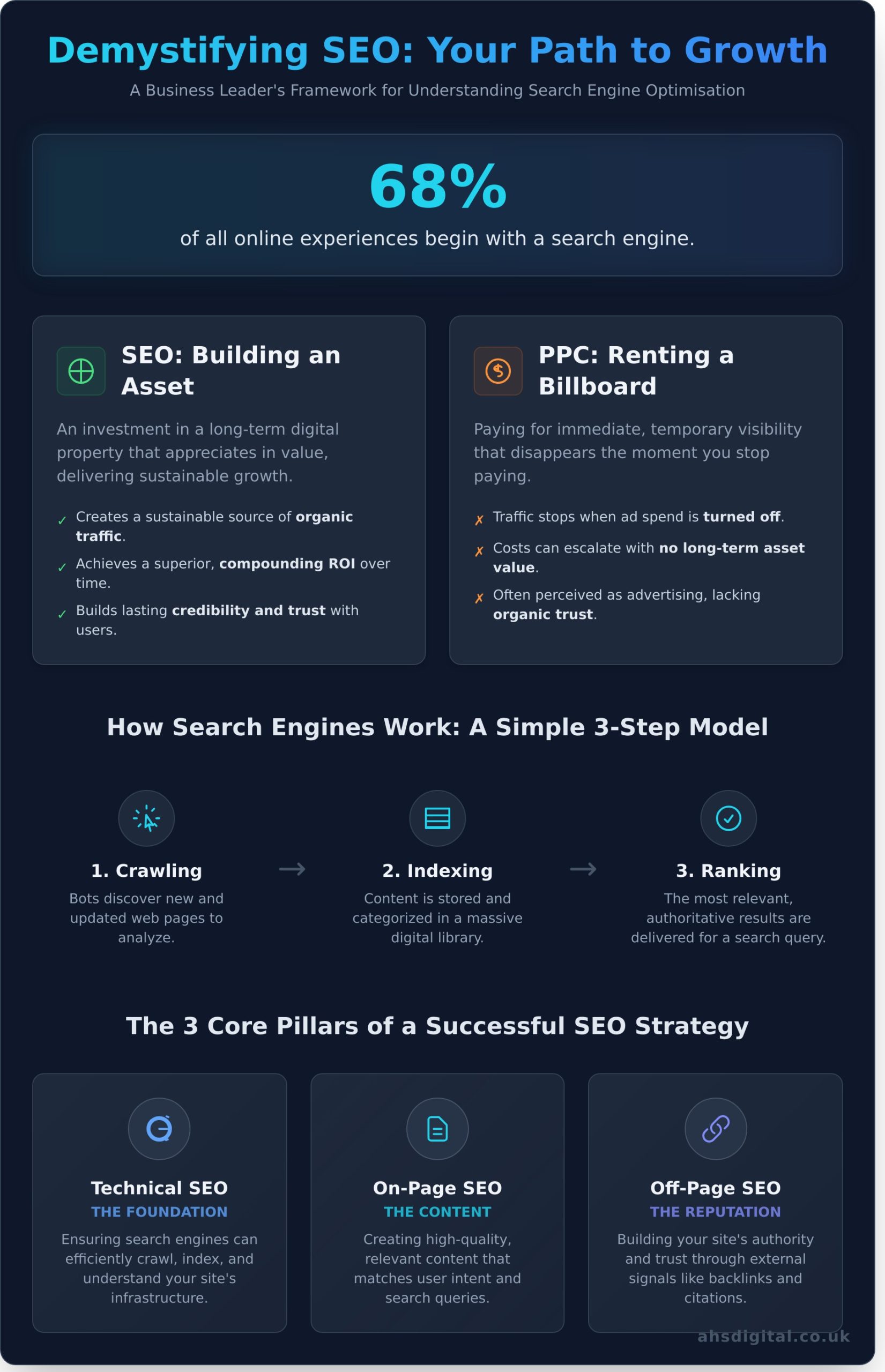
This is fundamentally different from paid advertising (PPC). PPC is like renting a billboard; your visibility disappears the moment you stop paying. A powerful seo strategy is about building a valuable, long-term asset. By investing in your website’s authority and relevance, you create a sustainable source of organic traffic that grows over time, delivering an exceptional return on investment and driving scalable growth.
How Search Engines Actually Work: A Simple 3-Step Model
To master the digital high street, you first need to understand how it’s organised. Search engines like Google use a powerful, three-step process to find and rank your content:
-
Crawling: Search engines deploy automated bots (or "spiders") to travel the web, discovering new and updated pages to analyse.
-
Indexing: They store and categorise this discovered content in a colossal digital library, known as an index.
-
Ranking: When a user enters a query, the engine instantly sifts through its index to deliver the most relevant and authoritative results.
SEO vs. SEM: Understanding the Difference
You’ll often hear these terms used together, but they aren’t interchangeable. Search Engine Marketing (SEM) is the umbrella term for all marketing activities designed to increase search engine visibility. It has two core components:
-
The organic practice, formally known as Search Engine Optimisation (SEO), focuses on earning traffic through unpaid, algorithm-driven rankings.
-
The paid component is Pay-Per-Click (PPC) advertising, where businesses pay to have their ads displayed for specific search queries.
Why SEO is a Non-Negotiable for Modern Business Growth
In today’s digital marketplace, visibility is currency. If your customers can’t find you online, you effectively don’t exist. With research showing that 68% of all online experiences begin with a search engine, neglecting your search presence is no longer an option. Effective Search Engine Optimisation (SEO) is not a marketing expense; it’s a fundamental investment in a powerful, long-term asset that drives sustainable growth, increases market share, and delivers tangible business outcomes.
A robust seo strategy moves the needle by directly connecting your business with customers actively seeking your solutions. It’s about building a digital foundation that pays dividends for years to come.
Build Lasting Credibility and Trust
Ranking high on Google is more than just a vanity metric-it’s a powerful third-party endorsement. Users inherently trust Google’s algorithm to deliver the most relevant and authoritative results. By appearing on the first page, you are instantly perceived as a credible leader in your field. This trust is deepened by creating high-quality content that aligns with Google’s E-E-A-T guidelines (Experience, Expertise, Authoritativeness, and Trustworthiness). When you consistently provide value, you build a reputation that converts visitors into loyal customers. This commitment to quality is why SEO fosters transparency, aligning your business goals with the user’s need for reliable information.
Drive a Consistent Stream of High-Quality Leads
Unlike traditional outbound marketing that interrupts potential customers, SEO is a powerful inbound strategy that pulls them towards you. The traffic generated from organic search is highly qualified because users are proactively searching for answers, products, or services that you provide. They have a clear need and intent. This means every click from a search engine represents a potential customer who is already engaged and further down the buying funnel, leading to higher conversion rates and a more efficient sales process.
Achieve a Superior, Long-Term ROI
While paid advertising campaigns like PPC offer immediate visibility, the traffic stops the moment you stop paying. SEO works differently. A single, well-optimised piece of content or a service page that achieves a high ranking can become a digital asset, generating qualified leads and sales for years with minimal ongoing cost. Every organic click is essentially free, which dramatically increases your profit margins over time. This compounding effect makes SEO one of the most cost-effective and scalable marketing channels for achieving superior, long-term Return on Investment (ROI).
The Three Core Pillars of a Successful SEO Strategy
Search Engine Optimisation can seem overwhelmingly complex, but a successful strategy is built on three core pillars. Understanding this framework helps demystify the process and clarifies where a digital agency focuses its efforts to deliver tangible growth. Think of it like building a house: you need a solid foundation, a well-designed structure, and a great reputation in the neighbourhood to attract visitors.
For a business aiming to move the needle, mastering these interconnected disciplines is non-negotiable. A deep understanding of how SEO works reveals that neglecting one pillar undermines the strength of the others. True, sustainable results are achieved when all three work in perfect harmony.
Pillar 1: Technical SEO – The Foundation of Your Website
Before you can impress users with content, you must ensure search engines can efficiently find, crawl, and understand your website. Technical SEO is the foundation that makes this possible. It involves optimising your site’s backend infrastructure to meet the standards of modern search algorithms. Key elements include:
-
Site Speed: Ensuring your pages load quickly to prevent user frustration.
-
Mobile-Friendliness: Guaranteeing a seamless experience on all devices, from desktops to smartphones.
-
Security: Using HTTPS to protect user data and build trust.
This also includes a logical site architecture and an XML sitemap-essentially a roadmap that helps Google navigate your content effectively.
Pillar 2: On-Page SEO – Content and Relevance
With a solid foundation in place, the next pillar is the structure itself: your content. On-Page SEO is the practice of optimising individual web pages to rank higher and earn more relevant traffic. This is where you tell both users and search engines what your business is about. It revolves around two primary activities:
-
Keyword Research: Identifying the terms and phrases your target audience is searching for.
-
High-Quality Content Creation: Producing valuable, engaging, and relevant content that answers those search queries.
This pillar also includes optimising elements like title tags, meta descriptions, and headers to signal relevance clearly to search engines.
Pillar 3: Off-Page SEO – Building Authority and Reputation
The final pillar is your website’s reputation across the wider internet. Off-Page SEO involves actions taken outside of your own website to impact your rankings. Its primary goal is to show search engines that your site is authoritative, trustworthy, and a credible source of information. The most crucial element is earning high-quality backlinks from other reputable websites, which act as votes of confidence. Other important signals include brand mentions and positive online reviews, all of which contribute to your digital authority.
Your First Steps: How to Start Building Your SEO Presence
Understanding the principles of SEO is the first milestone. Now, it’s time to translate that knowledge into action. Building a powerful online presence doesn’t happen by accident; it begins with a clear, strategic foundation. These initial steps will set the course for meaningful, measurable growth and help you move the needle for your business.
Step 1: Define Your Goals and Target Audience
Effective SEO strategy is not about chasing vanity metrics; it’s about achieving tangible business objectives. Before you do anything else, define what success looks like. Are you aiming to generate more qualified leads, increase e-commerce sales, or build brand authority? Your goals will dictate your entire approach. At the same time, get specific about who you want to reach. Create customer personas to understand their pain points, motivations, and exactly what problems they are trying to solve when they turn to a search engine.
Step 2: Basic Keyword Research
Keywords are the bridge between your audience’s needs and your solution. They are the words and phrases your ideal customers type into Google. A crucial concept here is search intent. Is someone looking for information ("how to choose a business accountant"), comparing options ("best accounting software for small business UK"), or ready to buy ("accountant in Manchester")? Start by brainstorming from your customer’s perspective. What terms would they use to find a business like yours? This simple exercise is the starting point for a data-driven content plan.
Step 3: Evaluate Your Options: DIY vs. Hiring an Agency
With your foundational goals in place, you face a critical decision: manage your SEO in-house or partner with an agency. Each path has distinct implications for your resources and timeline.
-
DIY Approach: Taking control of your own SEO offers maximum control and can have a lower initial cash outlay. However, it demands a significant investment of your time, a steep learning curve, and the risk of making strategic errors that can set you back.
-
Agency Partnership: Working with a specialist agency gives you immediate access to expertise, advanced tools, and a team dedicated to delivering results. This path frees you to focus on your core business while professionals drive your digital growth.
The right choice depends on your business’s ambition and capacity. If you’re ready to make a significant impact without the trial and error, it’s time to consider a professional partner. Discover how a strategic SEO partner can accelerate your growth.
From Insight to Impact: Your SEO Journey Starts Now
You’ve seen that search engine optimisation is not a dark art, but a fundamental engine for modern business growth. It’s a strategic investment built on three core pillars-technical excellence, compelling on-page content, and off-page authority. Understanding these principles is the first critical step, but turning that knowledge into tangible results is where the real transformation begins.
Executing a successful seo strategy that delivers a genuine return on investment demands a dedicated, expert approach. That’s where we come in. As your 100% UK-based strategic partner, our team is committed to delivering results-driven strategies that truly move the needle. We don’t just focus on rankings; we offer a cohesive creative suite to ensure every part of your digital marketing works in perfect harmony to convert visitors into loyal customers.
Ready to move the needle? Let’s build your SEO strategy.
Frequently Asked Questions About SEO
How long does it take for SEO to start working?
SEO is a long-term strategy, not an overnight fix. Businesses typically begin to see initial positive movement, such as improved rankings and traffic, within 4 to 6 months. However, to achieve significant, needle-moving results and a strong return on investment, a consistent strategy is often required for 6 to 12 months. Factors like your industry’s competitiveness and your website’s current health will influence this timeline, making it a marathon, not a sprint.
What is the difference between Local SEO and national SEO?
Local SEO focuses on attracting customers within a specific geographic area, like a city or region. It targets "near me" searches and optimises your Google Business Profile to appear in the local map pack. For example, a Manchester-based plumbing company would use Local SEO. National SEO, in contrast, targets a country-wide audience for broader keywords, aiming to attract customers irrespective of their location. An e-commerce store selling trainers across the UK would use a national strategy.
How much should a business invest in SEO services?
The investment in SEO services in the UK varies based on your goals and competition. For a small business or a local campaign, a monthly retainer might range from £500 to £1,500. For more ambitious national or highly competitive e-commerce campaigns, businesses should expect to invest £2,000 to £5,000+ per month. Think of it not as a cost, but as a strategic investment in sustainable business growth and a powerful channel for generating leads and sales.
Can I do SEO myself, or do I need to hire an expert?
You can certainly handle basic SEO tasks yourself, such as optimising page titles and creating blog content. This is a great starting point for any business. However, achieving significant growth requires advanced expertise in technical SEO, strategic link building, and in-depth data analysis. Hiring an expert or agency accelerates results, avoids costly mistakes, and allows you to focus on running your business while a strategic partner handles the complexities of driving qualified traffic.
What are the most important SEO metrics to track?
While there are many metrics, focus on those that directly impact business growth. Key performance indicators to track include Organic Traffic (total visitors from search), Keyword Rankings (your position for target terms), and Conversion Rate (the percentage of visitors who become customers). Also, monitor your Backlink Profile to gauge your site’s authority. Ultimately, the goal isn’t just traffic; it’s converting that traffic into tangible revenue and achieving a positive ROI.
Is SEO still important with the rise of AI search (SGE)?
Absolutely. The rise of AI search, like Google’s SGE, makes foundational SEO more important than ever. AI models need to pull information from reliable, authoritative sources to generate answers. By focusing on creating high-quality, expert-led content and building site authority, you position your website as a trusted source. This increases the likelihood of being featured in AI-generated results, making a solid SEO strategy essential for future visibility and growth.
Read our other SEO related blog here –