

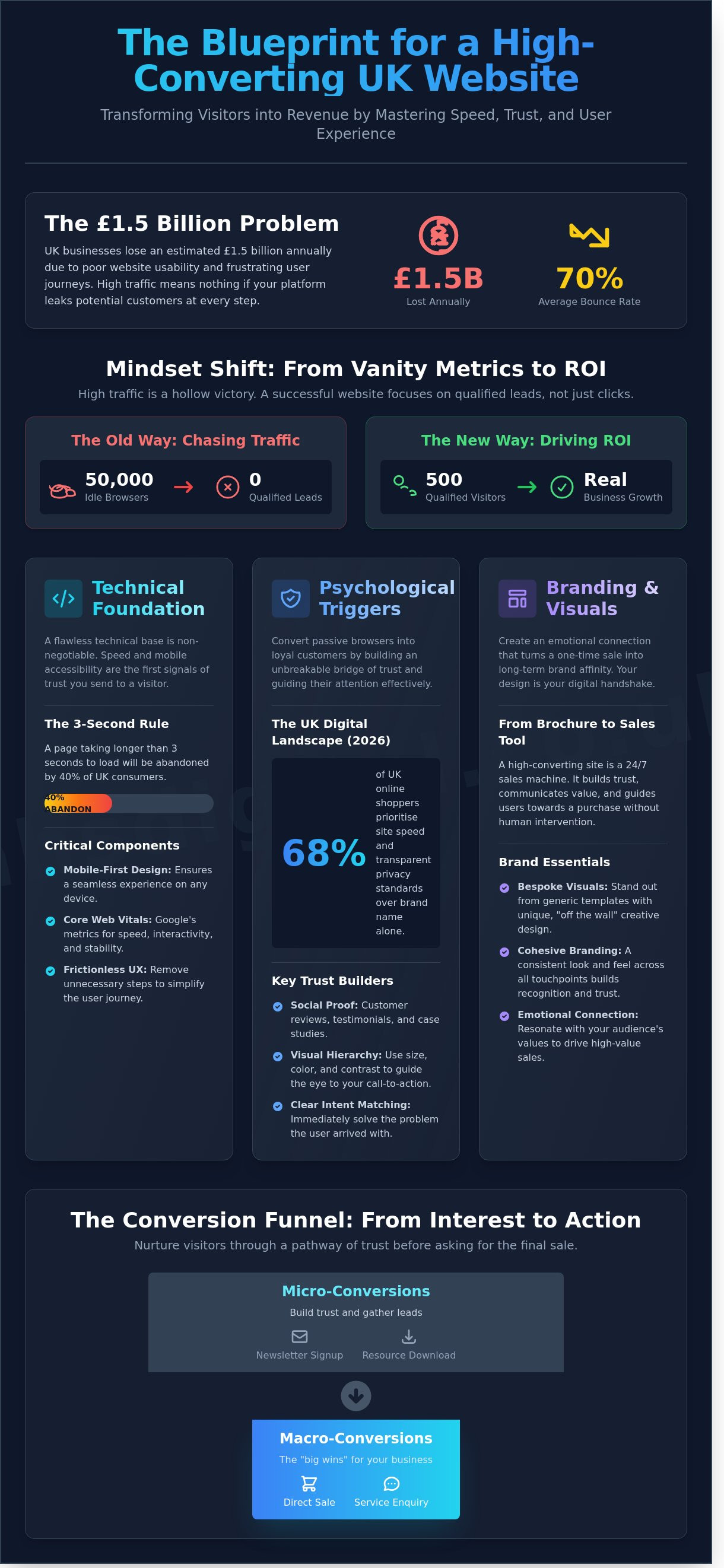
Recent industry data shows that UK businesses lose an estimated £1.5 billion annually due to poor website usability and frustrating checkout processes. If you’ve felt the sting of a 70% bounce rate or watched your ad spend vanish without a single lead, you aren’t alone. It’s incredibly draining to invest in digital marketing only to have a clunky interface hold your growth back. You deserve a platform that works as hard as you do, turning every visitor into a tangible result.
You’ve likely asked yourself what makes a high-converting website different from a digital brochure that just gathers dust. We’re here to provide the answer. By mastering the power of conversion rate optimisation, you can stop the leak in your sales funnel and start seeing a real return on your investment. This guide breaks down the psychological triggers, lightening fast technical requirements, and creative flair needed to dominate the UK market in 2026. We’ll show you how to build a brand that looks professional, builds instant trust, and, most importantly, moves the needle on your bottom line.
Key Takeaways
- Learn why lightning-fast loading speeds and a mobile first design are non-negotiable requirements for building immediate trust with sceptical UK consumers.
- Discover what makes a high-converting website by shifting your strategic focus from vanity traffic metrics to genuine user intent and brand affinity.
- Understand how bespoke, “off the wall” visuals and a cohesive branding package create the emotional connection necessary to drive high-value sales.
- Master the psychological triggers and social proof strategies that bridge the trust gap, turning passive browsers into loyal, long-term customers.
- Implement a practical conversion audit framework to identify performance leaks and ensure your digital platform is constantly evolving to move the needle on ROI.
The Conversion-First Mindset: Why Traffic is Vanity and ROI is King
High traffic is a hollow victory if your bank account remains stagnant. When investigating what makes a high-converting website, the answer lies in shifting your focus from raw numbers to specific business goals. A site that attracts 50,000 idle browsers is worth significantly less than one that brings in 500 qualified leads, which is why leveraging high-intent audience targeting through Specificity Inc. is essential for ensuring your traffic is primed to convert. ROI is the only metric that truly matters for long-term survival.
By 2026, the digital space has moved beyond simple click-bait tactics. Users now demand brand affinity and clear intent matching. If your site doesn’t immediately solve a problem or resonate with a visitor’s values, they’ll bounce within seconds. We’ve realised that a results-oriented approach transforms your website from a static digital brochure into a 24/7 sales tool that works while you sleep.
To better understand this concept, watch this helpful video:
Distinguishing between micro-conversions and macro-conversions is essential for a healthy sales funnel. Micro-conversions might include newsletter sign-ups or whitepaper downloads, while macro-conversions are the “big wins” like direct sales or service enquiries. Both are vital components of what makes a high-converting website because they build a pathway of trust before the final transaction occurs.
The UK Digital Landscape in 2026
British consumers are more discerning than ever. Recent data shows that 68% of UK online shoppers now prioritise site speed and transparent privacy standards over brand name alone. To remain competitive, local businesses must invest in professional digital marketing services to ensure their value proposition is communicated effectively. Economic shifts have made users more cautious; they don’t just want a product, they want a partner they can trust to deliver genuine value for their Pound.
Moving the Needle: From Clicks to Customers
The Technical Foundation: Speed, Mobile-First Design, and Seamless UX
Lightening-fast loading times aren’t just a “nice-to-have” feature; they’re the non-negotiable entry requirement for any digital business. When we look at 1. what makes a high-converting website, we have to respect the psychology of the “three-second rule.” Research indicates that 40% of UK consumers will abandon a page if it takes longer than three seconds to load. Latency doesn’t just frustrate your visitors; it actively kills trust. If your site feels sluggish, users subconsciously assume your service or product delivery will be equally slow. In a competitive market, speed is your first opportunity to prove you’re a reliable partner.
Removing friction is about simplifying the journey. Every unnecessary step, cluttered sidebar, or confusing pop-up acts as a barrier to sale. You want a path so smooth that the user moves from landing to checkout without a second thought. This means stripping away the digital noise and focusing purely on the user’s intent. When you reduce the cognitive load, you increase the likelihood of a completed transaction.
Lightening-Fast Performance and Core Web Vitals
Technical web design directly influences your search engine rankings and bounce rates through Google’s Core Web Vitals. These metrics measure how quickly your content becomes interactive and how stable the layout remains as it loads. You can improve these scores by optimising images using Next-Gen formats like WebP and minifying scripts to ensure they don’t block the page from rendering. High-quality hosting also plays a vital role. It provides the necessary infrastructure to maintain site stability during traffic spikes, ensuring your brand stays online when it matters most.
UX and UI: Designing for the Human Brain
Visual hierarchy is a powerful tool to guide the eye toward your “Most Wanted Action.” By using size, colour, and contrast, you can dictate what a visitor sees first. This strategic layout is 1. what makes a high-converting website stand out from a generic template. Navigation should be so intuitive that users never have to “think” about where to click next. If they have to search for a contact button or a product category, the design has failed.
According to research by the Nielsen Norman Group, your Conversion Rate is tied to how effectively your interface supports user goals. Accessibility is another major driver for growth. Ensuring your site works for the 16 million people in the UK living with a disability isn’t just about compliance; it’s about opening your doors to every potential customer. A truly inclusive site is a more effective site for everyone.
If you’re ready to transform your online presence, we can help you move the needle with a results-oriented strategy tailored to your goals.
The Power of Creative Storytelling: How Branding, Video, and Photography Drive Action
Generic stock photos of people shaking hands or staring blankly at laptops don’t just look dated; they actively kill your conversion rates. When visitors land on your page, they’re looking for a reason to trust you. If your site looks like every other template on the web, you’ve already lost the battle. Understanding 1. what makes a high-converting website starts with breaking the “generic” mould. You need “off the wall” visuals that stop the scroll and demand attention. Real, bespoke imagery creates an immediate sense of authenticity that stock assets simply can’t replicate.
Eye-tracking studies from the Nielsen Norman Group show that users almost completely ignore decorative stock photos, yet they spend significant time looking at real photos of actual team members. This is why we focus on showcasing the human side of our 100% UK-based team. It positions you as a transparent, reliable partner rather than a faceless entity. By combining this human element with strategic Conversion rate optimization (CRO) techniques, you transform a passive browser into an active lead.
Visual Impact: Videography and Photography
Static pages often struggle to hold attention. Using professional videography is a game-changer for increasing “time on page,” a metric that correlates directly with higher search rankings and better lead quality. Video allows you to explain complex products in under sixty seconds, making it perfect for ambitious businesses with technical offerings. Bespoke brand photography works alongside this to “show, not just tell” your story. Whether it’s dynamic drone footage of a project site or high-energy reels for a service page, these assets elevate your credibility and move the needle on your ROI.
Branding as a Conversion Tool
A comprehensive branding package is the engine behind the emotional connection required for high-value sales. It isn’t just about a pretty logo; it’s about a consistent narrative that sets you apart. When you align your typography, colour palette, and tone of voice, you build a recognisable brand that inspires confidence. Your value proposition should speak directly to the pains and desires of your target audience, making the decision to buy feel like a natural next step. This cohesive approach is exactly 1. what makes a high-converting website stand out in a crowded UK market, ensuring your business is the one that sticks in the customer’s mind.
- Bespoke visuals build trust faster than generic templates.
- Video content can increase user engagement by over 80%.
- Consistent branding removes friction in the buyer’s journey.
- Professional photography humanises your brand and increases credibility.
Psychological Triggers and Social Proof: Building Irresistible Trust
UK consumers are naturally sceptical; they’ve been conditioned by years of exaggerated marketing claims and digital clutter. A 2023 report by the Edelman Trust Barometer highlighted that only 52% of respondents trust businesses to do what is right, creating a significant “Trust Gap” that can stall your sales funnel. To understand 1. what makes a high-converting website, you must first address this scepticism by proving your brand is both competent and reliable. You can’t just tell people you’re the best; you have to show them through verifiable evidence and industry-recognised standards like Cyber Essentials or ISO certifications, and you can learn more about how these standards can boost consumer confidence.
Bridging this gap requires a strategic blend of logic and emotion. While your technical specs might satisfy the rational mind, psychological triggers like social proof and authority signals do the heavy lifting for conversions. By showcasing that other British businesses have already trusted you and achieved measurable results, you lower the perceived risk for the next customer.
Crafting Compelling CTAs
Your Call-to-Action (CTA) is the most critical element on your page, yet many businesses still rely on generic “Submit” or “Contact Us” buttons. Data from a 2022 HubSpot study revealed that personalised CTAs convert 202% better than basic versions. Use action-oriented language that promises a specific outcome, such as “Start My Transformation” or “Claim My Free Audit”. This shifts the focus from what the user has to do to what they are going to get.
Your buttons should appear exactly when the user is ready to make a decision, not just as an afterthought in the footer. We recommend placing CTAs after every major benefit section to capture intent while it’s at its peak. Testing different button shapes and micro-copy is essential; sometimes a simple change from “Buy Now” to “Get Started” can move the needle by as much as 15% in click-through rates.
Social Proof That Actually Converts
Effective social proof goes beyond a scrolling carousel of five-star logos. Your “Recent Work” section should tell a story of transformation, focusing on specific data points like “Increased ROI by 35%” rather than vague praise. Video testimonials are particularly powerful in the UK market, as they humanise your brand and make your expertise undeniable. Research shows that 88% of consumers have been convinced to buy a product or service by watching a brand’s video.
Leveraging SEO strategies ensures these trust signals are visible even before a user clicks on your site. When your high-quality reviews and case studies appear in search results, you’ve already won half the battle. This visibility is a core component of 1. what makes a high-converting website because it builds authority before the first page load.
Ethical scarcity and urgency can also encourage immediate action without feeling pushy. Mentioning that you only have “2 project slots left for September” or offering a “limited-time £500 discount” creates a genuine reason to act now. When combined with a cohesive creative suite and a 100% U.K. based team, these triggers make your offer feel exclusive and urgent.
Turning Insights into Results: A Conversion Audit Framework for UK Businesses
A high-converting website is never truly finished; it’s a living digital asset that requires constant refinement. Many UK business owners fall into the trap of “launch and leave,” but 2023 industry data shows that companies performing regular conversion audits see a 15% higher average order value than those that don’t. Understanding what makes a high-converting website involves moving past aesthetic guesses and looking at the cold, hard data of user behaviour. We don’t rely on “best practices” alone; we rely on what your specific audience is telling us through their clicks and scrolls.
Identifying and Fixing Conversion Leaks
Instead of guessing where users click, we use tools like heatmaps and session recordings to see exactly where they get stuck. This data-driven approach allows us to move the needle by making small, incremental changes that lead to massive growth. When you stop guessing and start observing, you can rectify issues like confusing navigation or broken buttons that 88% of users say would stop them from returning to a site.
Partnering for Growth
Building a brand from the ground up requires a unified strategy. Why hire five different freelancers who don’t talk to each other? You often end up with a disjointed brand and a website that feels like a patchwork quilt. At AHS Digital, we offer a cohesive creative suite that ensures your branding, web design, and digital marketing all pull in the same direction. We love a challenge and pride ourselves on being a 100% UK-based team that understands the nuances of your local market, from consumer expectations to regional search trends.
We focus on creating responsive, lightening-fast websites that don’t just look pretty; they convert visitors into loyal customers. If you’re ready to elevate your brand and see real results, contact our team today for a consultation. We’re ready to help you take your marketing to the next level and turn your digital presence into a powerful engine for growth.
Transform Your Digital Presence Into a Revenue Engine
Success in 2026 isn’t about how many clicks you get; it’s about how many visitors you turn into loyal customers. You’ve seen that 1. what makes a high-converting website is a strategic blend of lightning-fast technical foundations and compelling creative storytelling. High-performing sites now require a mobile-first approach that prioritises seamless UX, especially as mobile commerce in the UK is projected to grow by over 10% annually through the end of the decade. By layering psychological triggers and social proof over a solid technical framework, you create a digital storefront that builds immediate trust.
Don’t let your brand get lost in the noise of mediocre templates. Our 100% UK-based team of experts delivers a cohesive creative suite, ranging from bespoke branding to high-impact videography, to ensure your message resonates. We’ve built a proven track record of increasing ROI for ambitious brands by focusing on what actually moves the needle. You can learn more about how professional videography drives action to see these principles in practice. We love a challenge and we’re ready to help you scale.
Let’s move the needle on your business growth, contact AHS Digital today
Your journey toward a more profitable digital future starts with a single step, and we’re excited to help you take it.
Frequently Asked Questions
What is a good conversion rate for a UK business website?
A good conversion rate for a UK e-commerce business typically sits between 1.7% and 2.4%, based on 2024 industry benchmarks from IRP Commerce. If you’re running a lead-generation site, you should aim for a higher bracket of 5% to 10% to ensure your marketing spend is working effectively.
Success depends on your specific sector and price point. High-ticket items often see lower percentages, while impulse-buy products naturally convert faster. We focus on moving the needle beyond these averages to maximise your specific growth potential.
How long does it take to see results from conversion rate optimisation?
You’ll often see initial shifts in user behaviour within 14 to 21 days of implementing strategic changes. However, reaching statistical significance to confirm what makes a high-converting website for your audience usually requires a full 90-day cycle of testing and data collection.
Patience is vital because rushing the data leads to false conclusions. We monitor your metrics daily to ensure every tweak to your layout or copy contributes to a measurable increase in your ROI.
Can I improve my conversion rate without a full website redesign?
Yes, you can achieve substantial gains by making iterative improvements to your existing site structure and messaging. Small changes to your call-to-action buttons, headline clarity, or page load speeds often deliver a better ROI than a costly, total overhaul.
Refining your digital marketing strategy to align with your current landing pages is a powerful way to boost results. We love a challenge and often find that fixing “friction points” in the checkout process is enough to transform a struggling site.
Why is mobile responsiveness so important for conversion in 2026?
Mobile responsiveness is critical because mobile devices accounted for 61% of all UK web traffic in early 2024, a figure expected to rise by 2026. If your site doesn’t function perfectly on a smartphone, you’re effectively turning away six out of every ten potential customers before they’ve even seen your offer.
Google’s mobile-first indexing also means your search rankings depend entirely on your mobile performance. A site that’s “lightening-fast” and easy to navigate on a touch screen isn’t just a luxury, it’s a fundamental requirement for business survival.
How does site speed affect my sales and ROI?
Site speed has a direct, linear relationship with your profit margins, as a 1-second delay in load time can drop conversions by 7% according to Portent research. Slow sites frustrate users and increase your bounce rate, which wastes your hard-earned advertising budget and lowers your overall ROI.
Every millisecond saved helps keep a user engaged with your brand. We prioritise technical performance to ensure your pages load instantly, keeping your customers in the “buying zone” rather than clicking away to a competitor.
What are the most effective trust signals for a British audience?
The most effective trust signals for UK consumers include clear “100% U.K. Based” identifiers, verified Trustpilot reviews, and visible physical addresses. Data from 2023 suggests that 81% of shoppers research a brand’s reputation online before committing to a purchase, making social proof essential.
Displaying recognised payment icons like Apple Pay and Visa alongside professional accreditations creates a sense of security. These markers act as a digital handshake, proving your business is competent, reliable, and legitimate.
Is professional photography really worth the investment for my site?
Professional photography is absolutely worth the investment because bespoke imagery can increase user engagement by 40% compared to generic stock photos. High-quality, original visuals showcase your products and team with a level of authenticity that stock images simply cannot replicate.
Unique photos help tell your brand story and build an emotional connection with your visitors. In a competitive digital landscape, showing the “real” side of your business makes you more approachable and memorable to your target audience.
How do I know if my current website is high-converting or not?
You can determine your site’s effectiveness by calculating your conversion rate in Google Analytics 4 and comparing it against the 2% industry standard. If your traffic is high but your sales or enquiries are stagnant, your site isn’t performing its primary job as a strategic partner.
Analysing heatmaps and user recordings will reveal exactly where people are dropping off. Understanding what makes a high-converting website allows you to identify these gaps and implement the transformations needed to elevate your business to the next level.