

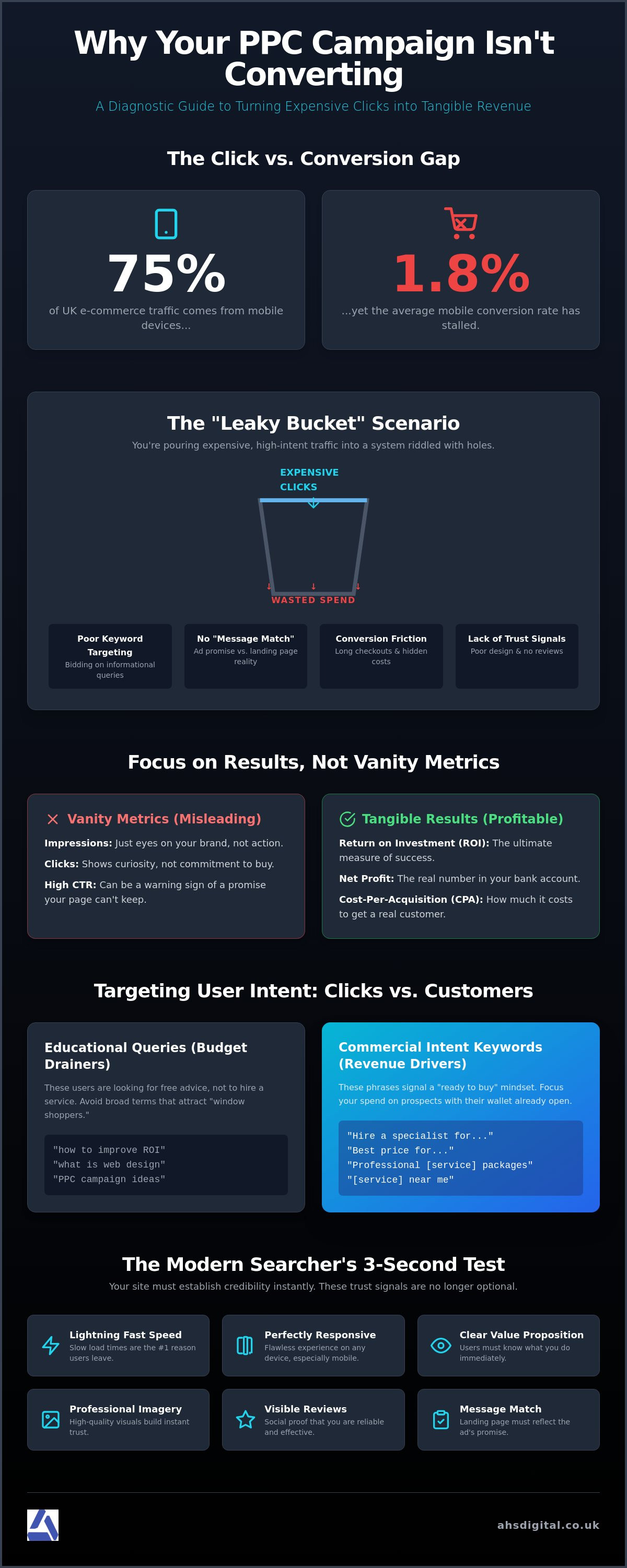
Did you know that while mobile devices drive up to 75% of UK e-commerce traffic, the average mobile conversion rate has stalled at a mere 1.8%? It is incredibly frustrating to watch your budget vanish into the void of irrelevant clicks while your agency hands over reports filled with green vanity metrics that don’t actually grow your bank balance. You aren’t alone in asking why my ppc campaign is not converting, especially when the gap between an expensive click and a loyal customer feels wider than ever in this competitive 2026 landscape.
We understand the pressure to deliver measurable results rather than just abstract data points. This diagnostic guide will strip away the jargon to reveal the exact technical, creative, and strategic reasons your ad spend is bleeding, giving you the power to turn traffic into tangible revenue. We’ll explore everything from the impact of the latest 2026 regulatory shifts to the critical need for an integrated website design that actually closes the deal. It’s time to stop the budget bleed and start scaling your brand with confidence.
Key Takeaways
- Stop prioritising vanity metrics and learn to identify the “leaky bucket” in your sales funnel that transforms expensive clicks into wasted spend.
- Align your keyword strategy with actual user intent to stop bidding on broad, informational terms that drain your budget without delivering sales.
- Uncover the precise technical and creative reasons why my ppc campaign is not converting, including the critical “message match” between your ads and landing pages.
- Optimise your Quality Score to lower your cost-per-acquisition and secure better ad placements without simply increasing your daily budget.
- Transition to an integrated strategy where your digital marketing campaigns work in total harmony with your website’s technical performance.
The Click vs. Conversion Gap: Why Traffic Isn’t Enough
Driving high volumes of traffic to your site is relatively straightforward, but converting that traffic into paying customers is the real challenge. Many UK brands fall into the trap of thinking that a busy website equals a successful business. It’s a classic “leaky bucket” scenario; you’re pouring expensive, high-intent traffic into a vessel riddled with holes. If your website isn’t primed for the specific needs of the 2026 consumer, you’re essentially subsidising search engines while your own bank balance remains stagnant.
The fundamental Pay-per-click (PPC) model is built on the premise of paying for opportunity, not guaranteed results. Interestingly, a high Click-Through Rate (CTR) can often be a warning sign rather than a badge of honour. If your ads are attracting clicks but failing to trigger sales, it suggests your ad copy is making promises that your landing page cannot keep. This disconnect is a primary reason why my ppc campaign is not converting. You are paying for curiosity, not commitment.
To better understand this concept, watch this helpful video:
Vanity Metrics vs. Tangible Results
Agencies often hide behind “green” reports that celebrate millions of impressions and thousands of clicks. These numbers look impressive in a monthly slide deck, but for a business in Sheffield or Nottingham, they are just background noise. You don’t need more eyes on your brand; you need more leads in your CRM and a lower cost-per-acquisition. True success is measured in ROI and net profit, not abstract engagement stats. Conversion Friction is the silent killer of PPC, and it’s often the hidden reason why my ppc campaign is not converting despite a healthy budget.
When you focus purely on clicks, you ignore the technical barriers that stop a user from completing a purchase. These barriers might include a checkout process that is too long, hidden shipping costs that appear only at the last second, or a lack of clear contact details. Each point of friction is an opportunity for your potential customer to bounce back to the search results and choose a competitor instead.
The Psychology of the 2026 Searcher
Modern UK searchers have developed a sophisticated “internal filter” for digital credibility. With mobile devices now accounting for over 75% of e-commerce traffic, your site must be lightning fast and perfectly responsive. If a user doesn’t find exactly what they are looking for or feel an immediate sense of trust within the first three seconds, they’ll leave. Trust signals like professional imagery, clear value propositions, and visible reviews are no longer optional extras; they are the baseline for survival.
Understanding What is Web Design? is crucial because it goes far beyond simple aesthetics. It’s about building a structural foundation that guides a user’s eyes toward the call to action while answering their unspoken objections. Without that strategic design, your ad spend is simply a donation to the digital void. You must prove your expertise and reliability the moment the page loads, or that expensive click is wasted.
Common Targeting Errors Bleeding Your Budget
Your budget isn’t just disappearing; it’s being misallocated to users who have zero intention of buying. While we previously explored the “leaky bucket” of poor website performance, this section focuses on the quality of the traffic you’re inviting in. A primary reason why my ppc campaign is not converting is a fundamental mismatch between user intent and your keyword selection. In 2026, where 78% of Google Ads spend is managed by automated bid strategies, providing the algorithm with precise guardrails is the only way to avoid wasting money on high-volume, low-value clicks.
Broad match keywords are a particular danger in the current landscape. While Google’s AI has improved, it still prioritises spend over specificity unless you intervene. Without a robust list of negative keywords, your ads will inevitably show for irrelevant terms that drain your resources. You need to be the architect of your own success by telling the platform exactly who you don’t want to reach.
Commercial Intent vs. Educational Queries
Ambitious brands often confuse search volume with sales potential. Bidding on educational terms like “how to improve ROI” might bring traffic, but these users are looking for free advice, not a service provider. To fix the issue of why my ppc campaign is not converting, you must pivot toward transactional modifiers. Focus on high-intent phrases that signal a “ready to buy” mindset. Examples include:
- “Hire a specialist for…”
- “Best price for…”
- “Service near me”
- “Professional [service] packages”
By excluding “window shopper” keywords, you ensure every penny of your investment targets a prospect with their wallet already open. If your current strategy feels like a shot in the dark, exploring professional digital marketing campaigns can help align your targeting with your actual commercial goals.
Geo-Targeting for UK Businesses
UK brands often fall for the “All UK” trap. Targeting the entire country might seem like a growth move, but it usually leads to budget exhaustion and irrelevant leads. Local search intent differs significantly across the North and the Midlands. A user in Barnsley has different expectations and search habits than one in London. If your logistics or service capacity is regional, your ads should be too.
Setting up precise radiuses around hubs like Leeds, Derby, or Nottingham allows for much tighter control over your cost-per-acquisition. You can adjust bids based on where your most profitable customers live, rather than competing in high-cost areas that don’t yield results. This granular approach ensures your brand remains a dominant force in the locations that actually matter to your bottom line. Stop being a small fish in a giant pond; start owning your specific territory with surgical precision.
The Invisible Barrier: Landing Page and Brand Disconnect
You have spent hours refining your keyword lists and perfecting your bid strategies, yet the sales aren’t materialising. This gap between the click and the conversion is where most budgets go to die. A primary reason why my ppc campaign is not converting is a lack of “Message Match”. If your ad copy promises a specific “24-hour delivery” but your landing page headline talks vaguely about “industry leading logistics”, the user feels an immediate sense of cognitive dissonance. They clicked for a specific promise, and the moment that promise feels unverified, they will bounce back to the search results.
Modern UK consumers are incredibly savvy and have a low tolerance for digital friction. They expect a seamless transition from the search engine to your checkout. If your branding feels fragmented or your message is inconsistent, you’re essentially paying for traffic that you’re then actively pushing away. It is not enough to just be visible; you must be credible from the very first millisecond of the visit.
Speed and Responsive Performance
The 3-second rule is a brutal reality in the 2026 digital economy. If your landing page takes longer than three seconds to load, you aren’t just losing a potential lead; you’re actively being penalised by the platforms you’re paying. There is a direct, measurable correlation between page load speed and your cost-per-click. Google rewards high performing, fast loading sites with better Quality Scores, which means you pay less for better ad positions.
Mobile responsiveness is no longer a “nice to have” feature. With mobile traffic in the UK hovering around 75%, a site that isn’t perfectly optimised for thumb-driven navigation is a liability. This technical failure is a massive factor in why my ppc campaign is not converting. Investing in high performance website design ensures that your technical foundation supports your marketing spend rather than sabotaging it. A fast site isn’t just a technical metric; it is a fundamental trust signal.
Branding and Trust Signals
Visual friction is a silent conversion killer. When a user lands on a page with inconsistent logos, clashing colours, or generic stock imagery, they experience “scam anxiety”. This psychological barrier prevents them from entering their credit card details or filling out a lead form. Professional photography adds a layer of authenticity that stock photos simply cannot replicate, positioning your brand as a legitimate and established entity.
Strategic branding creates a cohesive narrative that guides the user from the initial ad click all the way to the final thank you page. By maintaining a unified visual identity and a clear, authoritative voice, you build the necessary trust to turn a casual browser into a loyal customer. Your brand is the bridge between a click and a conversion; make sure it’s strong enough to carry the weight of your ambitions.
Auditing Your Ad Strategy for ROI
The “set and forget” mentality is a relic of the past. In 2026, where 78% of all Google Ads spend is managed by automated bid strategies, your role has shifted from manual button-pusher to strategic pilot. If you are frustrated by why my ppc campaign is not converting, it is likely because the algorithm lacks the high-quality data it needs to learn. An audit isn’t just about finding errors; it is about refining the signals you send to the AI to ensure every pound spent is an investment, not an expense.
Success in the current landscape requires a balance between machine learning and human intuition. While Smart Bidding can report 14% higher conversion rates on average, it still requires you to define the “win”. If your tracking is broken or your goals are too broad, the AI will simply find more of the wrong people. You must maintain manual control over your strategic direction while letting the software handle the micro-adjustments.
The PPC Audit Checklist
A rigorous audit starts with the Search Terms report. This is where you find the hidden waste that “Broad Match” often invites. Benchmarking is equally vital for context. With the average conversion rate for Google search ads sitting at 3.75% and UK e-commerce specifically at 3.4%, you need to know exactly where you stand. If your metrics are lagging behind these national averages, your technical foundation is failing you.
- Review the Search Terms report to identify and exclude non-commercial queries.
- Compare your mobile conversion rate against the UK average of 1.8% to spot “Mobile Friction”.
- Analyze your click-to-lead time to see if users are stalling during the checkout process.
Quality Score is the most important technical metric because it acts as the primary lever for reducing your cost-per-click while simultaneously improving your ad visibility and position.
Refining the Offer
Sometimes the ad is perfect, but the deal is dull. “Contact Us” is often the weakest CTA you can use; it’s a high-friction request for a first-time visitor. Ambitious UK brands succeed by offering “low-friction” entry points like lead magnets, free audits, or exclusive guides. These bridge the gap between curiosity and commitment without demanding an immediate sale.
A/B testing your ad copy is the only way to find the emotional hook that resonates with your specific audience. Test different value propositions, such as “Save Time” versus “Increase Revenue”, to see which drives the highest quality traffic. If you’re ready to stop the budget bleed and start scaling, our digital marketing campaigns are designed to align your ad strategy with tangible business growth. Stop guessing and start using data to drive your decisions.
Fixing the Bleed: Why a Unified Approach Wins
Success in the 2026 digital landscape requires more than just a healthy ad budget; it demands total strategic alignment. Many ambitious brands in Sheffield and across the UK are held back by the “fragmented agency” model. When your web developers, branding experts, and PPC managers operate in silos, the result is a disjointed user journey that confuses potential customers. This lack of cohesion is the ultimate reason why my ppc campaign is not converting. You cannot fix a marketing problem with a broken website, and you cannot fix a design problem with more ad spend.
At AHS Digital, we operate as a singular, integrated entity. We believe that professional rigour and creative flair must work in tandem to drive meaningful growth. By housing every specialist under one roof, we eliminate the “blame game” that often occurs between departments. Our goal is to transform your underperforming campaigns into high-velocity ROI engines by ensuring every technical and creative element is synchronised for conversion.
The Power of a Singular Team
Having your technical developers and marketing strategists in the same room is a game changer for your bottom line. When a PPC manager identifies a high bounce rate on mobile, a developer can implement an immediate fix to improve load speeds or refine the UI. This rapid responsiveness ensures your budget isn’t wasted on a “leaky bucket” for a second longer than necessary. It’s about creating a seamless bridge between the initial search intent and the final checkout.
A unified approach allows for a much deeper understanding of What are Digital Marketing Services? and how they interact with your brand’s technical health. Instead of looking at clicks in a vacuum, we analyse how site structure, visual trust signals, and ad copy work together to influence human behaviour. This holistic perspective is what separates market leaders from those who are simply “paying for presence”.
Action Plan for Your Campaign
You don’t have to accept poor performance as the status quo. If you’re tired of asking why my ppc campaign is not converting, start with these immediate steps:
- Review your Search Terms report and aggressively exclude non-commercial queries.
- Audit your landing page load times on mobile to ensure they meet the 3-second rule.
- Verify that your ad headlines exactly match the primary headers on your landing pages.
- Replace generic “Contact Us” buttons with low-friction offers that provide immediate value.
Ambitious businesses deserve tangible results, not just abstract data. If you are ready to stop the budget bleed and start scaling your brand with confidence, it is time for a professional diagnostic. Ready for tangible results? Contact AHS Digital to fix your PPC and turn those expensive clicks into loyal customers.
Elevate Your Digital Performance and Own Your Market
Success in the 2026 landscape demands more than just visibility; it requires a surgical alignment between your ad strategy and your technical foundation. We have explored how high cost-per-acquisition often stems from a fragmented approach where marketing and design don’t speak the same language. Understanding why my ppc campaign is not converting is the essential first step toward reclaiming your budget and scaling your business. By prioritising a fast, responsive website and a cohesive brand narrative, you transform your ad spend from a drain into a powerful growth engine.
Our UK-based team brings professional rigour to every project, offering a holistic approach that spans high-performance branding, design, and targeted ads. As specialists in Magento 2 and high-performance e-commerce, we focus on tangible outcomes over vanity metrics. You don’t have to settle for reports that show growth on paper but not in your bank balance. Stop the bleed and start converting with a professional PPC audit today. Your brand’s next chapter of growth starts with a partner ready to deliver results.
Frequently Asked Questions
Why is my PPC cost-per-click so high but I have no sales?
High CPC with no sales usually indicates a mismatch between your ad’s promise and the actual landing page experience. You are likely winning the auction for competitive terms but failing to convert users due to “Conversion Friction” or targeting informational rather than transactional keywords. If your ad attracts clicks but your site doesn’t deliver an immediate solution, you’re simply paying for curiosity rather than commitment.
What is a good conversion rate for a UK PPC campaign in 2026?
A “good” rate depends on your sector, but the 2026 UK average for Google search ads is approximately 3.75%. For e-commerce specifically, the average sits at 3.4%, while mobile-specific traffic often converts at a lower rate of around 1.8%. Benchmarking your performance against these national figures helps you identify if your technical foundation or your creative offer needs a strategic overhaul.
Can poor web design affect my Google Ads Quality Score?
Yes, your landing page experience is a core component of your Quality Score and directly impacts your costs. Google’s algorithm penalises sites with slow load times, poor mobile responsiveness, or irrelevant content. This results in a lower score, which forces you to pay more for the same ad positions as competitors with better designed, faster loading websites.
How long should I run a PPC campaign before deciding it is not working?
You should typically allow at least three months for a campaign to mature and gather enough data for automated bid strategies to optimise. Deciding too early can be premature as the algorithm needs time to learn user behaviour. However, if you’re still asking why my ppc campaign is not converting after 90 days of consistent spend, it’s time for a professional deep-dive audit.
Is it better to hire a specialised PPC agency or a full-service creative agency?
A full-service creative partner that integrates PPC with website design and branding often delivers a far superior ROI. This unified approach prevents the “fragmented agency” problem where marketing and design teams work in isolation. When your ads and your website are built by the same strategic team, the entire user journey becomes a seamless, high-converting experience.
How do I know if my landing page is the reason my ads are not converting?
High click-through rates combined with high bounce rates usually point toward a landing page issue rather than an ad problem. If users are clicking your ads but leaving within the first three seconds, your page likely lacks “Message Match” or the trust signals required to convert. You must ensure your landing page headline mirrors your ad copy exactly to maintain credibility and momentum.
What are negative keywords and how do they save me money?
Negative keywords are specific terms you exclude from your campaigns to prevent your ads from appearing for irrelevant searches. By filtering out queries related to “free”, “jobs”, or “information”, you ensure your budget is reserved for high-intent, transactional searches. This surgical approach stops budget bleed on users who have zero intention of actually purchasing your services or products.
Does my business need a huge budget to see results from PPC in Manchester or Leeds?
You don’t need an astronomical budget to succeed in regional hubs like Manchester or Leeds, but you do need surgical targeting. By using precise geo-fencing and focusing on local commercial intent, smaller brands can outmanoeuvre larger competitors who waste spend on broad, national campaigns. Owning a specific territory with a refined, high-performance strategy is often more profitable than being a small fish in a giant pond.