

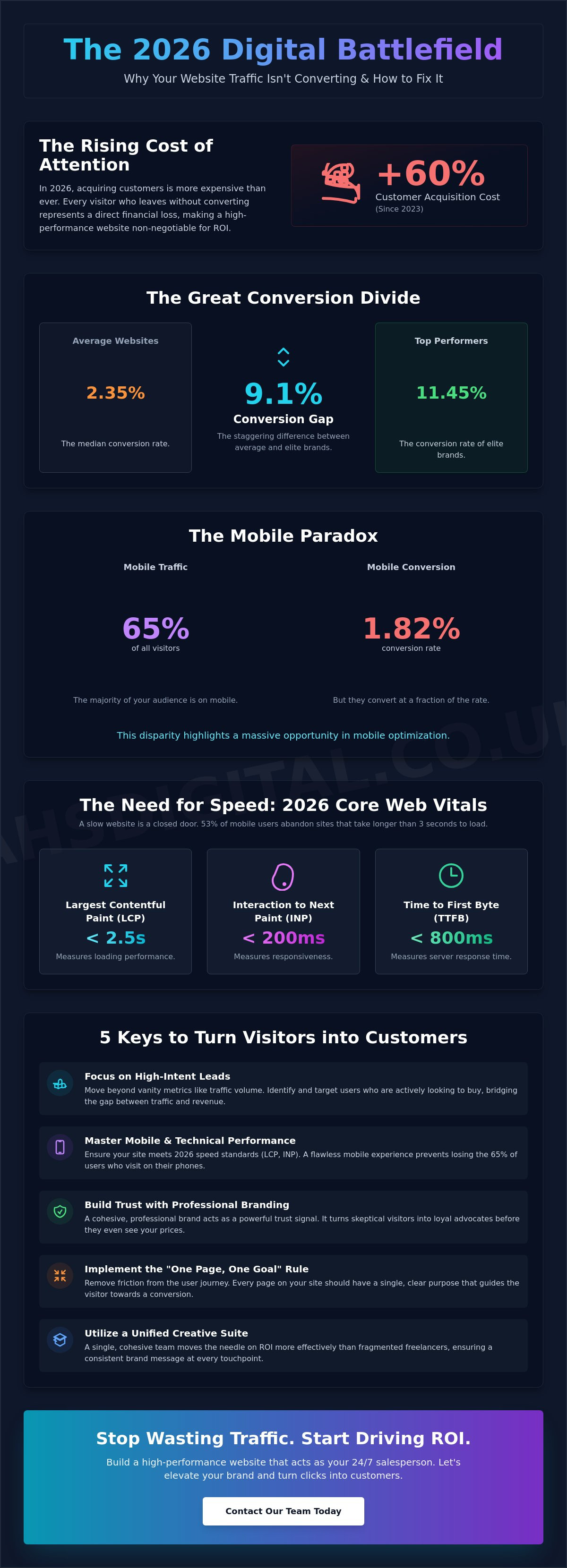
Did you know that in 2026, the gap between average websites and top performers has widened to a staggering 9.1%, with elite brands converting at 11.45% or higher? If you’re seeing high ad spend with low ROI, you’re likely feeling the sting of this year’s 60% rise in customer acquisition costs. It’s frustrating to watch 65% of your traffic arrive via mobile only to see it convert at a dismal 1.82%. You’ve likely spent hours researching 5. how to turn website visitors into customers to stop the leak in your sales funnel.
We agree that inconsistent branding and clunky user experiences are the silent killers of digital growth. This article reveals the strategic framework you need to stop wasting traffic and start driving measurable ROI through cohesive design and psychological triggers. We’ll explore five proven methods to move the needle, from meeting the 200ms Interaction to Next Paint standard to leveraging AI search referrals that convert at 3.49%. If you’re ready to build a site that acts as a salesperson round the clock, it’s time to contact our team and elevate your brand today.
Key Takeaways
- Learn to stop chasing vanity metrics and start identifying high-intent leads to bridge the gap between traffic and revenue.
- Master the 2026 technical standards for speed and mobile performance to ensure your digital storefront never loses a customer to a slow-loading page.
- Discover why a professional branding package acts as a vital trust signal that transforms cynical visitors into loyal brand advocates.
- Uncover the strategic framework for 5. how to turn website visitors into customers by applying the “One Page, One Goal” rule to remove friction from the user journey.
- See how a unified creative suite moves the needle on ROI more effectively than a fragmented team of individual freelancers.
The Vanity Metric Trap: Why Traffic Without Conversion Is a Cost, Not an Investment
High traffic looks great on a monthly report, but in 2026, it’s often a liability if those users don’t buy. With customer acquisition costs jumping 60% since 2023, every bounce is money down the drain. You aren’t just losing a lead; you’re paying for the privilege of being ignored. This is the “Conversion Gap”, the distance between the 2.35% median rate and the 11.45% achieved by top performers. Bridging this gap is the secret to 5. how to turn website visitors into customers. It requires a move away from passive “window shoppers” toward intent-driven buyers who value their time as much as you value your ROI. If 65% of your traffic is mobile but your site isn’t optimised for it, you’re effectively throwing away two-thirds of your budget.
To better understand this concept, watch this helpful video:
Understanding the Psychology of the Modern UK Consumer
By 2026, the average UK consumer’s digital attention span has compressed into a sub-second snap judgment based entirely on visual credibility and speed. If your site looks “good enough”, you’ve already lost. Professional digital marketing campaigns fail when the landing page doesn’t trigger an immediate emotional “yes”. Modern shoppers don’t just want a product; they want a frictionless experience that respects their intelligence. They look for subtle trust signals, like cohesive branding and local expertise, before they even consider your price point. If your design fails to inspire confidence, they’ll bounce to a competitor within three seconds.
Defining Success Beyond the Initial Click
Success isn’t just a single “Buy” button. It’s a series of micro-conversions, like watching a video or signing up for a newsletter, that lead to the final sale. This process, often called conversion rate optimization, is about plugging the leaks in your funnel. Use Google Analytics to find exactly where 53% of your mobile users are dropping off. If your bounce rate is high, your branding likely lacks the authority to inspire trust. Set realistic ROI goals that account for the $200 to $700+ CAC seen in B2B tech sectors today. Focus on “moving the needle” through quality interactions rather than just chasing more clicks. This mindset shift is the first step in creating a 24/7 salesperson through your website.
Speed and Style: Building a High-Performance Digital Storefront
A slow website is a ghost town. By May 2026, the performance standards have shifted, and 53% of mobile users will abandon a site if it takes longer than three seconds to load. You can’t build a business on a foundation of lag. To meet modern Google Core Web Vitals, your Largest Contentful Paint must be under 2.5 seconds, and your Interaction to Next Paint should be 200 milliseconds or less. If your technical setup doesn’t hit these marks, you’re effectively invisible to search engines and frustrating to humans. High-performance design is the first pillar in 5. how to turn website visitors into customers because it removes the initial barrier to entry: impatience.
Style isn’t just about looking pretty; it’s about communicating value instantly. Generic stock photos of people shaking hands are a trust killer in 2026. Ambitious brands now rely on bespoke photography to showcase their authentic identity. When a visitor sees your actual team, your real products, and your unique workspace, their internal “scam detector” switches off. This authenticity is amplified by commercial videography, which can explain a complex B2B service or a luxury product in a 15-second reel. These visual assets aren’t just decorations; they’re high-speed data delivery systems for your brand’s soul.
The Need for Speed: Technical Optimisation and Magento
Platform choice is the difference between a scalable empire and a digital ceiling. Many businesses start on basic builders only to find they can’t handle high-volume traffic or complex integrations. This is where Magento development proves its worth by providing the robust architecture needed for growth. It allows for deep technical optimisation, ensuring your Time to First Byte stays at or below 800 milliseconds. Scalability means your site remains lightening-fast even as your product catalogue expands to thousands of SKUs.
Visual Storytelling That Stops the Scroll
To win in a crowded marketplace, your visuals must be “off the wall” and impossible to ignore. Using drone footage or high-energy social reels on your landing pages creates a dynamic experience that static sites can’t match. Academic research on website design and consumer behavior highlights that visual hierarchy is a primary driver of purchase intent. By using bold, original imagery to guide the eye toward your primary call to action, you simplify the decision-making process. If your current site feels static or dated, it might be time to elevate your web design to meet the expectations of today’s savvy shoppers.
Trust Is the New Currency: Leveraging Social Proof and Brand Authority
Trust is the bridge between a click and a conversion. In 2026, where AI-generated content is everywhere, 22% of shoppers now use AI search tools to verify a brand’s legitimacy before they even consider a purchase. This makes your authority more than just a “nice to have” feature; it’s a prerequisite for survival. A 100% UK-based team acts as a powerful trust signal for British consumers who value local accountability and local expertise. This proximity suggests a level of reliability and cultural alignment that offshore alternatives simply can’t match.
Visual consistency is your silent closer. A professional branding package ensures your colours, typography, and tone of voice align across every digital and physical touchpoint. When a website looks disjointed, it triggers an immediate “flight” response in the user’s brain. By following established website optimization tips, you can ensure your trust signals, like industry certifications and secure payment badges, are placed exactly where the buyer feels most vulnerable. This is a fundamental part of 5. how to turn website visitors into customers, as it replaces hesitation with confidence.
Building a Cohesive Brand Story
Stop acting like a service provider and start positioning yourself as a strategic partner. Your brand story should speak directly to your customer’s aspirations, not just their problems. This narrative must remain consistent across your website, social media, and even print materials. When your voice is unified, you build a sense of reliability that makes the final “Buy Now” click feel like a natural next step. We love a challenge when it comes to refining these narratives to ensure they move the needle for ambitious businesses.
The Power of the Case Study
Generic testimonials are easy to ignore, but a detailed case study provides tangible proof of results. We showcase “projects we are proud of” to demonstrate our capability in real-world scenarios. Using creative, thematic headlines like “Cultivating Digital Growth” or “Reeling in a New Look” makes your portfolio more engaging and encourages users to delve deeper into your success stories. A well-written case study isn’t just a report; it’s a persuasive sales tool that shows exactly how you’ve solved complex problems for others. This social proof is the final nudge needed to transform a curious visitor into a committed customer.
The Frictionless Journey: Optimising Your Conversion Funnel
Mapping the journey from the first digital marketing touchpoint to the final thank you page requires a ruthless focus on simplicity. In 2026, the average e-commerce conversion rate hovers around 2.3%, but top decile performers hit 11.45% by removing every ounce of buyer friction. This is the core of 5. how to turn website visitors into customers. You must adopt the “One Page, One Goal” rule to succeed. If a single page asks for a sale, a newsletter sign-up, and a social follow, the user usually does none of them. Cognitive load is the ultimate enemy of ROI, especially when 65% of your traffic arrives via mobile devices.
Simplifying the checkout is critical for e-commerce brands where average CAC is now between $50 and $100. Magento development shines in this area, allowing for bespoke, single-page checkouts that handle complex shipping or tax calculations without slowing down the user. Unlike basic platforms, Magento allows for “Agentic AI” integrations that can pre-fill data or offer real-time support to prevent cart abandonment. This technical robustness ensures your Largest Contentful Paint stays under 2.5 seconds. It prevents the 53% of mobile users from leaving when a form feels like an interrogation rather than a helpful interaction.
Mastering the Call to Action (CTA)
Using the word “Submit” on a button is a psychological dead end because it implies a loss of control rather than a gain of value. Action-oriented language like “Elevate Your Brand” or “Get a Quote” inspires much more momentum. High-performance design relies on strong colour contrast and ample white space around these buttons to ensure they remain the focal point. This visual clarity guides the user’s eye naturally toward the conversion goal, making the path to purchase feel intuitive and rewarding.
Personalisation and Dynamic Content
By 2026, 22% of shoppers use AI tools to research brands, so your site must feel personal from the first second. Dynamic content allows you to show returning visitors the exact products or case studies they previously viewed, which is a key tactic for 5. how to turn website visitors into customers. This strategy relies heavily on high-quality SEO to bring in high-intent visitors who are actually ready to convert. When your traffic is targeted, your funnel doesn’t need to work as hard to move the needle. If you want a website that acts as a 24/7 salesperson, contact our team today to start your transformation.
Beyond the Freelancer: Why a Cohesive Creative Suite Moves the Needle
Managing five different freelancers is a recipe for “Frankenstein Marketing”, where your website looks like a patchwork of conflicting ideas. One person handles the code, another takes the photos, and a third manages the ads. This fragmentation is exactly why the gap between average and top performing sites has widened to 9.1% in 2026. When your technical performance, visual storytelling, and strategy aren’t aligned, you lose the ability to build deep trust. Choosing a unified web design agency ensures that every element of your site works in harmony. This holistic approach is the definitive answer to 5. how to turn website visitors into customers because it removes the friction caused by inconsistent branding.
Our 100% UK based team understands the local market nuances that offshore teams often miss. This cultural alignment acts as a major trust signal that helps move the needle on your conversion rates. We love a challenge and treat your business growth as a collaborative mission rather than a simple transaction. By integrating every service, we ensure your brand voice remains professional and confident from the first click to the final checkout.
Efficiency Through Integration
Managing separate vendors is a hidden cost that eats into your ROI. When design, development, and digital marketing live under one roof, the speed advantage is undeniable. You don’t have to wait weeks for a developer to understand a designer’s vision. This integration creates a “compound interest” effect for your brand growth. Every branding package we deliver is built with conversion in mind from day one. It ensures your site isn’t just a digital brochure; it’s a high performance sales engine. This unified strategy is a proven method for 5. how to turn website visitors into customers, as it ensures your message is never diluted by fragmented communication.
Taking the Next Step
2026 is the year to transform your digital presence from a passive expense into a powerhouse. Start by auditing your current site for quick wins, such as checking if your Largest Contentful Paint is under the 2.5 second standard. Look for inconsistent typography or outdated stock photos that might be hurting your credibility in a marketplace where CAC has risen by 60%. If your current setup feels fragmented, it’s time to scale with a partner that delivers measurable results. Ready to move the needle? Contact our expert team today to start your digital transformation.
Transform Your Digital Presence into a Sales Powerhouse
The digital landscape of 2026 doesn’t reward “good enough” websites. To bridge the 9.1% performance gap between average and elite brands, you must prioritise technical speed and visual authenticity. We’ve explored the strategic framework of 5. how to turn website visitors into customers, from hitting those 200ms interaction targets to ditching generic stock photos for bespoke imagery. Success isn’t about chasing more traffic; it’s about making every click count through a frictionless journey and a cohesive brand story.
Managing multiple freelancers often leads to fragmented results and rising costs. Our 100% U.K. Based team offers a cohesive creative suite designed to move the needle on your ROI and deliver sustainable growth. We love a challenge and are ready to help you build a site that acts as a 24/7 salesperson. Ready to take your marketing to the next level? Get in touch with AHS Digital today. Your transformation from a digital brochure to a high-performance powerhouse starts now.
Frequently Asked Questions
What is a good conversion rate for a UK business website in 2026?
The median website conversion rate for a UK business in 2026 is 2.35%. However, top-decile performers are currently achieving rates of 11.45% or higher by focusing on high-performance design and psychological triggers. Aiming for at least 5% is a realistic goal for ambitious brands looking to maintain a healthy LTV:CAC ratio of 3:1 in a competitive market.
How long does it take to see results from Conversion Rate Optimisation?
You can typically see initial improvements in micro-conversions, such as newsletter sign-ups or video views, within 30 days of implementation. Statistical significance for macro-conversions, like completed purchases, usually requires 90 days of consistent A/B testing. AI-powered testing methods in 2026 now achieve these results 31% faster than traditional manual processes.
Can I improve my conversion rate without a full website redesign?
Yes, you can move the needle significantly by focusing on high-impact technical tweaks and visual updates. Refreshing your branding package or introducing professional photography can build immediate trust. Small changes to CTA button contrast or simplifying lead capture forms often provide the highest ROI without the need for a total overhaul.
How does mobile responsiveness affect my ability to turn visitors into customers?
Mobile traffic accounts for 65% of all website traffic in 2026, making it the primary storefront for most UK consumers. Despite this volume, mobile conversion rates sit at a dismal 1.82% compared to 3.14% on desktop. This gap exists because many sites fail to provide a “lightening-fast” mobile experience that respects the user’s limited time and attention.
What are the most common mistakes that kill website conversions?
The most frequent conversion killers are slow loading times and inconsistent branding that fails to inspire trust. 53% of mobile users will leave a website if it takes longer than three seconds to load. Other mistakes include using vague CTA text like “Submit” and failing to provide clear social proof or industry certifications at the point of purchase.
Is it better to focus on SEO or CRO first?
You should run SEO and CRO in parallel because bringing traffic to a site that doesn’t convert is an expensive vanity exercise. SEO brings high-intent visitors to your door, but understanding 5. how to turn website visitors into customers is what actually drives ROI. A holistic strategy ensures that every pound spent on digital marketing has the best chance of resulting in a sale.
How much does it cost to hire a digital marketing agency for CRO?
While costs vary based on the complexity of your funnel, the investment should always be weighed against your current Customer Acquisition Cost. For B2B SaaS companies, the average CAC is now between $200 and $700+. Partnering with a web design agency for CRO focuses on reducing these costs by improving the efficiency of your existing traffic.
What role does page speed play in turning clicks into sales?
Page speed is the fundamental pillar of 5. how to turn website visitors into customers because it removes the first barrier to engagement. By 2026 standards, your Largest Contentful Paint must be under 2.5 seconds to prevent users from bouncing. Every 100ms delay in interaction can reduce your conversion rate by 7%, making technical performance a primary driver of your bottom line.