

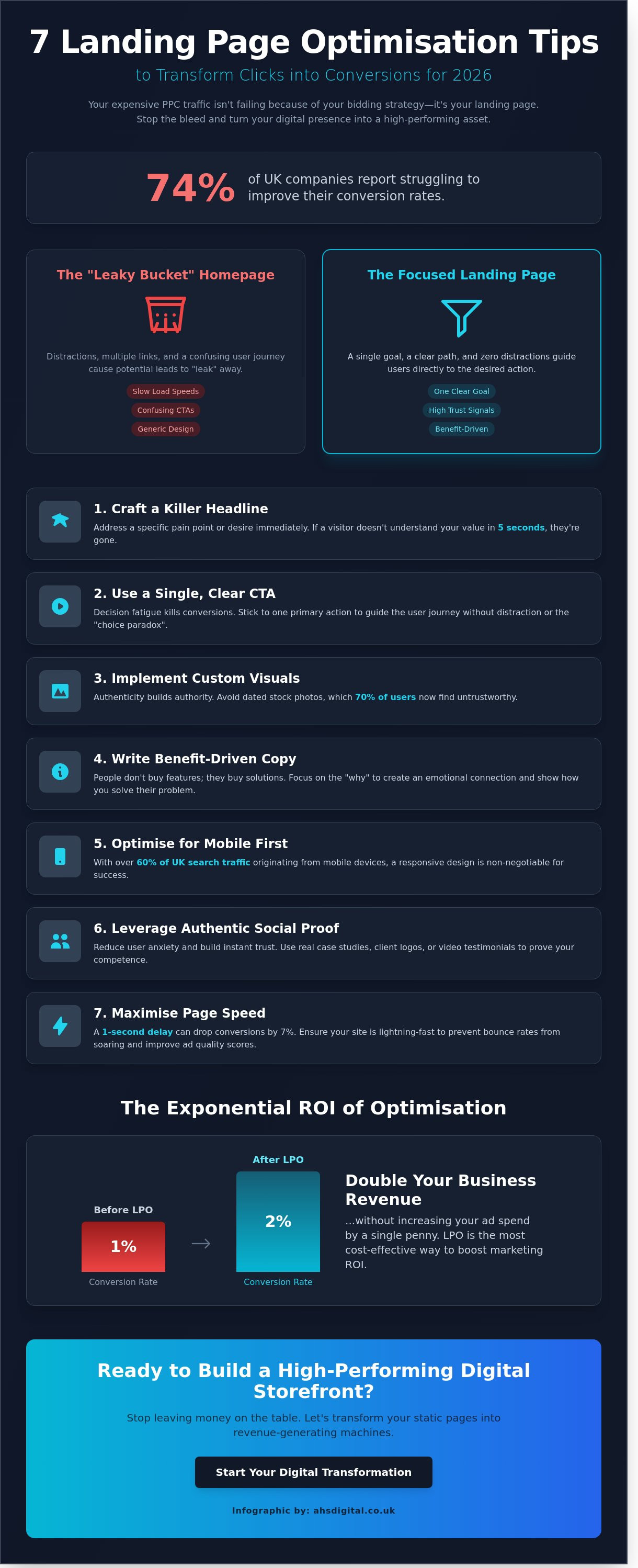
What if your most expensive PPC traffic isn’t failing because of your bidding strategy, but because your landing page is stuck in 2022? It’s a common frustration for ambitious businesses, especially since 74% of UK companies report struggling to improve their conversion rates according to data from Econsultancy. You’ve likely felt the sting of high bounce rates on premium ad traffic while trying to decode conflicting technical advice that leads nowhere. To stop the bleed, you need proven landing page optimisation tips that move the needle and transform your digital presence into a high performing asset for 2026.
We understand that you want a site that reflects your premium brand without looking like a generic template. You’ve worked hard to build your reputation, and your digital storefront should build trust instantly rather than causing confusion. This guide shares seven strategic shifts that turn static pages into revenue generating machines. We’ll explore how to lower your cost per acquisition and create a professional, cohesive user experience. From lightning fast load speeds to psychological triggers, here is how we elevate your results. If you’re ready to start your digital transformation, let’s dive into the strategy.
Key Takeaways
- Learn why refining your page elements is the most cost effective way to boost your marketing ROI without increasing your monthly ad spend.
- Discover the 7. landing page optimisation tips that remove decision fatigue and turn static pages into high performing, revenue generating assets.
- Understand how technical performance and Core Web Vitals influence your ad quality scores, making a [lightening fast web design](https://ahsdigital.co.uk) essential for success.
- Leverage the psychology of trust and social proof to reduce user anxiety, ensuring your brand remains consistent and professional across all touchpoints.
- Move the needle by using heatmaps and session recordings to transform raw data into a continuous cycle of strategic growth and evolution.
Understanding Landing Page Optimisation and Why It Moves the Needle
Landing page optimisation (LPO) isn’t just about changing button colours or picking pretty fonts. It’s the calculated process of refining every element on a specific page to increase the percentage of visitors who take a desired action. Understanding Landing Page Optimisation is the foundation of any successful online campaign. It allows you to squeeze more value out of your existing traffic. Instead of pouring more money into expensive ad platforms, you’re making your current assets work harder. It’s the most cost effective way to improve your ROI without touching your ad budget.
To see how these 7. landing page optimisation tips look in practice, watch this helpful video:
A standard web page, like your homepage, usually tries to do everything at once. It has menus, links to “About Us,” and perhaps a blog feed. This creates a “leaky bucket” effect where potential leads get distracted and wander off. A dedicated, results oriented landing page is different. It’s a focused environment designed to guide the user toward one single goal. By removing the leaks, you ensure that the money you spend on clicks actually turns into enquiries or sales rather than disappearing into the digital void.
The ROI of a Focused User Journey
Small improvements in your conversion rate lead to exponential growth in profit. If you move from a 1% conversion rate to 2%, you’ve effectively doubled your business revenue without increasing your ad spend by a single penny. A great page triggers a psychological shift in the visitor from “just browsing” to “deciding.” This is why professional digital marketing services prioritise LPO. It’s about creating a seamless path that makes saying “yes” the easiest thing for the customer to do.
Common Mistakes That Kill Conversions
One of the biggest conversion killers is the “choice paradox.” When you give people too many options, they often get overwhelmed and do nothing at all. Another common pitfall is using generic, stock heavy designs that look exactly like every other competitor in the UK market. Authenticity builds trust, whereas lazy design destroys it. High performing web design should always be a continuous process of testing and refinement to ensure you aren’t leaving money on the table every single day.
7 Essential Landing Page Optimisation Tips for Ambitious Brands
To move the needle in a competitive UK market, your digital storefront needs to work harder. Implementing these 7. landing page optimisation tips will ensure your digital presence is built for scalability and results. We love a challenge, and transforming a static page into a high-performing conversion engine is where strategic expertise meets creative flair.
- Craft a Killer Headline: Address a specific pain point or desire immediately. If a visitor doesn’t understand your value within five seconds, they’re gone.
- Use a Single, Clear CTA: Decision fatigue kills conversions. Stick to one primary action to guide the user journey without distraction.
- Implement Custom Visuals: Authenticity builds authority. Avoid the dated “suit-shaking-hands” stock photo trap that 70% of users now find untrustworthy.
- Write Benefit-Driven Copy: People don’t buy features; they buy solutions. Focus on the “why” to create an emotional connection.
- Optimise for Mobile First: With over 60% of UK search traffic originating from mobile devices, a responsive design is mandatory for success.
- Leverage Authentic Social Proof: Use real case studies or video testimonials to prove your competence and build trust.
- Maximise Page Speed: A one-second delay can drop conversions by 7%. Ensure your site is lightning-fast to prevent bounce rates from soaring.
These 7. landing page optimisation tips provide a framework for growth. If you want to see how these strategies move the needle for your ROI, explore our digital marketing services today.
Crafting a Value Proposition That Converts
Your headline must pass the 5-second test, meaning a stranger should grasp your offer instantly. Support this with subheadlines that use emotional hooks or hard data to anchor the promise. A value proposition is the intersection of customer need and your unique solution. You can Optimize Landing Pages by ensuring this core message remains consistent across every touchpoint on your site.
Visual Storytelling Through Custom Media
Generic stock photos feel dated and reduce trust in 2026. Ambitious brands use professional photography to showcase real products and the genuine faces behind the business. High-quality commercial videography can increase time on page by 80%, explaining complex offers quickly. This visual investment builds a level of authority and connection that stock imagery simply cannot match.
Beyond the Surface: Technical Performance and UX Architecture
A stunning landing page is a liability if it’s sluggish. While aesthetics capture attention, technical architecture secures the lead. Google’s Core Web Vitals now directly influence your search visibility and ad quality scores. If your Largest Contentful Paint (LCP) exceeds 2.5 seconds, you’re likely haemorrhaging potential customers before they even see your headline. Professional web design isn’t just about choosing the right hex codes; it’s about engineering a platform that balances high-resolution visuals with aggressive performance metrics. This balance is one of the most critical 7. landing page optimisation tips for any growing business.
UX architecture relies heavily on the strategic use of white space. This isn’t “empty” space; it’s a functional tool that prevents cognitive overload. By giving your elements room to breathe, you guide the user’s eye toward the conversion goal without distraction. A cluttered page creates friction, while a clean, spacious layout communicates confidence and clarity. When we design for conversion, we treat every pixel of white space as a roadmap leading directly to your call to action.
Lightening Fast Speeds for UK Users
UK mobile users on 4G and 5G networks expect instant gratification. Research from 2023 indicates that 53% of mobile visits are abandoned if a page takes longer than three seconds to load. To stay competitive, you must move beyond basic hosting and look at the granular details of your site’s build. Technical efficiency is a cornerstone of our 7. landing page optimisation tips. We recommend implementing image optimisation through next-gen formats like WebP and ensuring your CSS and JavaScript are minified to shave off vital milliseconds.
Speed doesn’t just improve the user experience, it lowers your acquisition costs. A faster page improves your Google Ads Quality Score, meaning you pay less for every click than a slower competitor. By prioritising a “lightening-fast” infrastructure, you’re not just pleasing your visitors; you’re actively stretching your marketing budget further and increasing your ROI.
Removing Friction in the Conversion Funnel
Friction is the enemy of the conversion. Every extra form field you include acts as a barrier to entry. Industry data suggests that reducing a form from six fields to three can increase conversions by up to 66%. Ask only for the essentials. If you don’t need a phone number to start the conversation, don’t ask for one. Your primary CTA must sit “above the fold” so users don’t have to hunt for the next step after arriving on your page.
Integrating landing page optimization best practices often involves using subtle visual cues to direct attention. An arrow pointing toward a sign-up button or a hero image where the subject’s gaze is directed at the form can subconsciously guide the user’s eye. These psychological nudges, combined with a clear value proposition, create a seamless path from curiosity to conversion. We love a challenge, and refining these micro-interactions is where we often see the most significant growth for our clients.
The Psychology of Trust: Social Proof and Branding Cohesion
Trust is the primary currency of the digital world. Without it, your marketing efforts will fail to convert even the most qualified leads. Every visitor who arrives on your site is subconsciously asking if you’re a legitimate business or a potential risk. This is why brand consistency across every touchpoint is vital for reducing user anxiety. When your landing page feels like a natural extension of your branding, you immediately lower the barrier to entry for new customers.
There’s a massive difference between “claimed” trust and “earned” trust. Claimed trust is what you say about yourself in your marketing copy. Earned trust is the third party validation that proves those claims are true. Incorporating this distinction into your strategy is one of the most effective 7. landing page optimisation tips for driving long term growth and improving your ROI.
Leveraging Authentic Social Proof
Social proof isn’t a one size fits all solution. There’s a clear hierarchy of effectiveness that you should follow to maximise impact. While text quotes are better than nothing, video testimonials are currently the gold standard. A 2023 industry report found that 88% of consumers trust user reviews as much as personal recommendations. Video adds a layer of human connection and authenticity that text simply cannot replicate.
- Video Testimonials: Use these for high-ticket services to build deep rapport and showcase real transformations.
- Trust Badges: Display industry certifications or security seals specifically near the payment or sign up button to reassure hesitant users.
- Mini Case Studies: Instead of a generic quote, showcase a specific result, such as “Generated £12,450 in new revenue within 30 days.”
Avoid cluttering your design with too many badges or logos. Select the three most recognisable certifications to maintain a clean, professional aesthetic that doesn’t distract from your primary call to action.
Why Brand Consistency Builds Immediate Credibility
A brand disconnect happens when your marketing assets don’t match your landing page experience. If your social media ad uses a specific tone and vibrant colour palette, but your landing page looks dull or outdated, users feel a sense of “clickbait” anxiety. This jarring experience leads to high bounce rates and wasted ad spend. Professionalism is signaled through cohesive typography and a controlled colour scheme that reflects your core identity.
Data from a 2022 brand consistency study suggests that uniform brand presentation across all platforms can increase revenue by 23%. This isn’t just about aesthetics; it’s about scalability and proving that your business is a stable, professional entity. Every element, from the button radius to the photography style, must feel intentional. If you want to move the needle on your digital presence, you need a unified creative suite that handles your visual identity with precision.
Turning Data into Growth: Testing and Continuous Evolution
Effective optimisation isn’t a one-off task; it’s a permanent cycle of refinement. While implementing these 7. landing page optimisation tips will provide a strong foundation, true growth comes from seeing how real people interact with your design. You shouldn’t rely on gut feelings when you can use hard evidence to move the needle. Data removes the ego from design decisions, allowing your audience to tell you exactly what they want.
Tools like heatmaps and session recordings are vital for this process. Heatmaps show you where users click and how far they scroll, often revealing that 60% of your visitors never even see your primary call to action because it’s buried too low. Session recordings take this further, letting you watch anonymous replays of user journeys. If you notice users repeatedly “rage clicking” a non-functional element or getting stuck on a complex form field, you’ve found a concrete friction point that’s costing you money.
The golden rule of testing is to change one variable at a time. If you change the headline, the hero image, and the button colour all at once, you won’t know which element caused the shift in performance. By isolating variables, you gain clear, actionable insights that lead to a compounding 24% or 30% increase in conversions over time.
A/B Testing Without the Headache
Split testing allows you to run two versions of a page simultaneously to see which performs better. It’s the most reliable way to validate changes to your headlines, layouts, or offer structures. Instead of guessing which message resonates with your audience, you let the conversion rates decide. This scientific approach ensures every design tweak is backed by user behaviour rather than subjective preference.
Driving high-quality traffic is essential for these tests to yield results quickly. This is where SEO becomes your best friend. By attracting high-intent visitors through organic search, you provide your landing pages with a steady stream of users who are already looking for your solution. This volume of data allows you to reach statistical significance faster, accelerating your growth cycle.
When to Hire a Cohesive Creative Suite
Many businesses hit a ceiling because they rely on a fragmented mix of five different freelancers. This approach often results in a disjointed brand experience that can lower consumer trust by up to 20%. A landing page that doesn’t match your social media or your email marketing feels “off” to potential customers. We offer a cohesive creative suite where every element of your brand is built from the ground up to work in total harmony.
Choosing AHS Digital means working with a 100% UK based team that understands the nuances of the British market. We handle the complexity of the testing cycle, from initial digital marketing strategy to technical implementation. We love a challenge and pride ourselves on delivering responsive, lightening-fast pages that turn clicks into loyal customers. If you’re ready to take your marketing to the next level, get in touch for a bespoke optimisation strategy today.
Elevate Your Digital Results for 2026
Success in 2026 requires more than just a pretty design; it demands a strategic alignment of speed, trust, and data. Implementing these 7. landing page optimisation tips ensures your brand stays ahead of the curve. Focus on technical excellence, as industry data confirms a one second delay can drop conversions by 7%, and prioritise social proof to build immediate credibility, which can increase revenue by 23%. Ambitious brands don’t leave growth to chance; they evolve through continuous testing and refined UX architecture.
You don’t have to navigate this digital transformation alone. Our 100% UK Based team of creative experts offers a cohesive creative suite covering design, marketing, and media to ensure your brand stands out. We have a proven track record of increasing ROI for ambitious brands, moving the needle where it matters most. It’s time to stop guessing and start growing.
Ready to move the needle? Contact AHS Digital today for a high performing landing page strategy.
Your journey toward scalable growth and better customer engagement starts with a single, well optimised step. We love a challenge and can’t wait to see what we can achieve together.
Frequently Asked Questions
What is a good conversion rate for a landing page in 2026?
According to industry projections for 2026, a good conversion rate sits between 3% and 5.5% across most UK sectors. High performers in the finance or legal space often aim for 10% or more to stay competitive. Focus on continuous improvement and clear data insights to move the needle rather than just hitting a static benchmark. Our team helps you reach these ambitious targets.
How many call to action buttons should I have on one page?
You should ideally have one primary call to action (CTA) repeated at strategic points to maintain a single focus. While you might use multiple buttons, they should all lead to the same goal to avoid choice paralysis. A 2023 study by Unbounce showed that landing pages with a single link convert 1.6% higher than those with multiple competing offers on the same page.
Should my landing page be different for mobile and desktop users?
Yes, your landing page design must adapt because mobile users now account for 58.67% of global web traffic as of late 2023. Mobile users require larger tap targets and simplified navigation compared to desktop browsers. We build responsive, lightning-fast sites that cater to these specific user behaviours to ensure your ROI stays high and your brand remains competitive in the UK market.
How often should I perform A/B tests on my landing pages?
You should perform A/B tests at least once a month or after every 1,000 conversions to ensure your data is statistically significant. Testing too frequently without enough traffic leads to noise rather than actionable insights. Implementing regular testing is one of the most effective 7. landing page optimisation tips for businesses looking for long-term scalability and better ROI across all digital channels.
Does landing page speed really affect my Google Ads performance?
Page speed is a critical factor in your Google Ads Quality Score, directly impacting your cost-per-click (CPC). Google’s data indicates that a delay of just one second in mobile load times can impact conversion rates by up to 20%. Improving speed helps you win more auctions at a lower price point. If your site is sluggish, contact us today.
Can I use my homepage as a landing page for my marketing campaigns?
No, using a homepage for a specific marketing campaign usually drops conversions because it’s too general. Homepages often have 10 or more exit points, whereas a dedicated landing page focuses on one specific offer. Check out our guide on the power of PPC to see how targeted pages move the needle and drive growth.
What is the single most important element to optimise first?
Your headline is the most important element to optimise first because 80% of visitors won’t read past it. It must be punchy, focused on benefits, and align perfectly with the ad that brought the user there. If your headline fails to grab attention in under 3 seconds, the rest of your 7. landing page optimisation tips will likely go to waste.