

According to data published in January 2024, 37% of visitors will leave a website if the navigation is confusing, which directly impacts your bottom line. As a founder, you’ve likely experienced the frustration of search engines failing to index deep pages or seeing potential customers drop off before they reach the checkout. It’s a common challenge, but your site’s organisation shouldn’t be the thing that holds your business back from its full potential.
We’re here to help you move the needle with a clear strategy. Discover the 8. best website structure for SEO types to boost your search rankings, improve user experience, and drive the conversions you need to scale. By the end of this guide, you’ll have a concrete plan to ensure your brand is ready for the AI-driven search environment of 2026.
We’ll walk you through eight proven blueprints that turn complex sites into streamlined, high-performing assets. Whether you’re looking to refresh your web design or start a new project from the ground up, these structures are designed to deliver measurable results.
Key Takeaways
- Understand how your site framework dictates how Googlebot discovers your pages, ensuring your crawl budget is used to maximise visibility.
- Explore the 8 best website structure for SEO to identify the ideal blueprint that aligns with your specific content volume and business growth targets.
- Learn how to match your digital architecture to your unique goals, whether you are scaling a service based business or an expansive ecommerce platform.
- Master the technical pillars of siloing and internal linking to group related content, creating a seamless journey for both users and search engine bots.
- Discover how a cohesive creative suite approach integrates branding with structure to elevate your digital experience and move the needle on ROI.
Why Website Structure is the Secret Engine of Your SEO Strategy
Website structure isn’t just a technical chore; it’s the invisible scaffolding of your entire digital presence. Think of it as the structural design of shared information environments that dictates how both humans and bots interact with your brand. When you get this right, you’re not just organising pages; you’re building a clear path for revenue and growth.
In 2026, search engines don’t just crawl; they comprehend. A logical structure ensures your crawl budget isn’t wasted on dead ends or duplicate content. If Googlebot can’t find your high-value pages within three clicks, they might as well not exist. This is why choosing the 8. best website structure for SEO is a fundamental decision for any founder looking to scale their business in a competitive market.
To better understand this concept, watch this helpful video:
We’re also moving beyond traditional search into the era of Generative Engine Optimisation (GEO). AI models now summarise your brand’s authority based on how your data is connected across your domain. A fragmented site leads to a fragmented AI response. By aligning your content logically, you ensure that LLMs (Large Language Models) perceive your business as a coherent leader in your niche.
The Link Between Architecture and ROI
A messy site structure is a silent killer for your marketing budget. When your digital marketing efforts drive traffic to a confusing interface, your bounce rate skyrockets. Research shows that 88% of online consumers are less likely to return to a site after a bad user experience. A logical flow reduces friction, turning a casual browser into a loyal customer. Site architecture is the blueprint for digital growth.
How Google Sees Your Site in 2026
Google now prioritises topical authority over isolated keywords. Your structure signals expertise by clustering related topics together. Internal linking distributes “link juice” across your domain, ensuring your newest posts benefit from your established pages. By 2026, clear hierarchies help AI models summarise your brand accurately, which is essential for appearing in AI-generated search snippets. Implementing the 8. best website structure for SEO ensures your authority is undeniable and your content is discoverable.
- Topical Hubs: Grouping related content to signal deep expertise.
- Authority Distribution: Using internal links to pass power to high-conversion pages.
- AI Readiness: Structuring data so generative engines can easily parse your value proposition.
The 8 Best Website Structure Types for SEO and User Experience
The layout of your digital estate determines how search engines perceive your authority and how easily users convert. Finding the 8. best website structure for SEO isn’t about following a generic template; it’s about mapping your content to your specific business goals. You must plan this blueprint before a single pixel of web design work begins. A well-organized structure ensures search spiders don’t get lost in a digital maze, which directly impacts your rankings in 2026.
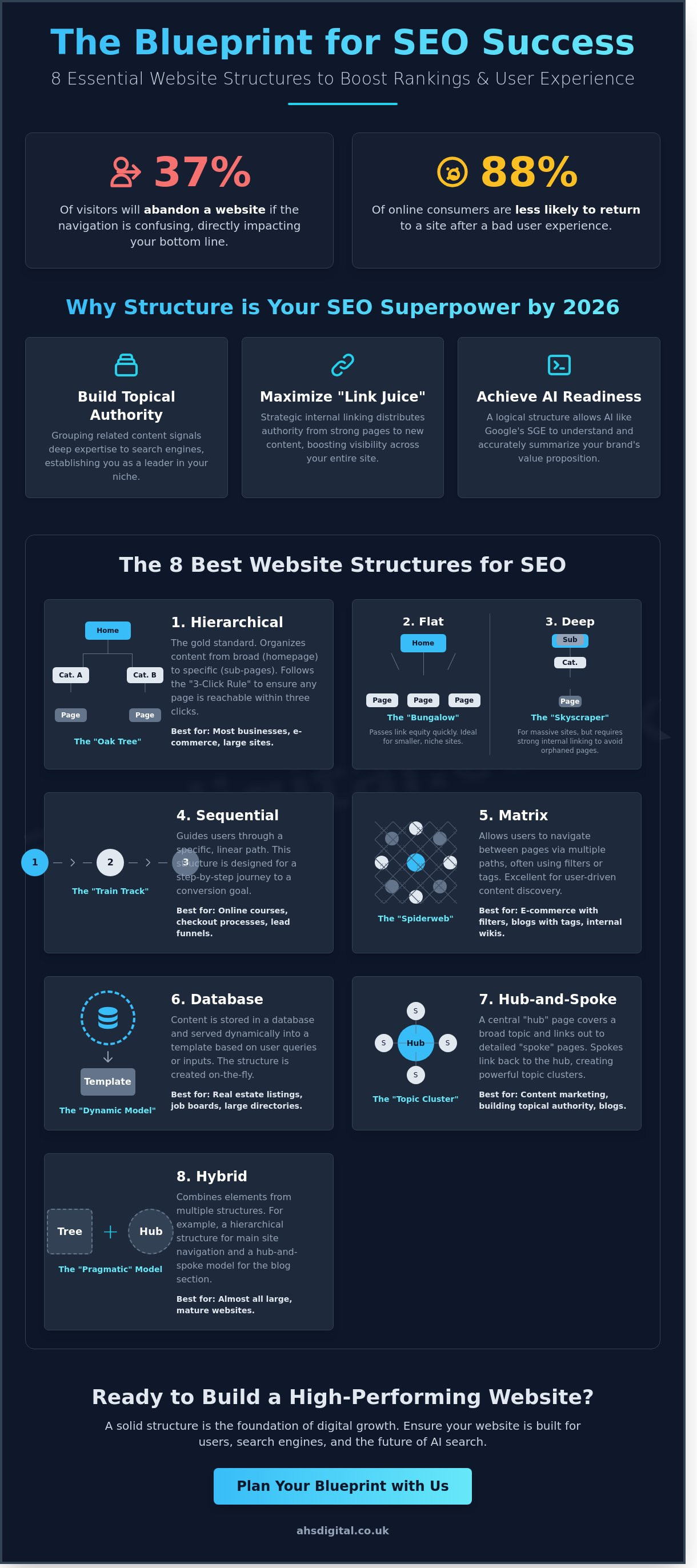
1. Hierarchical Structure (The Oak Tree)
The Oak Tree model is the gold standard for ambitious UK businesses. It starts with a strong trunk (your homepage) and branches out into primary categories, then smaller sub-categories. It organises content from broad concepts to specific service pages. To maintain peak UX, we follow the “Rule of Three.” This ensures no page is more than three clicks away from the homepage, keeping your bounce rates low and crawl efficiency high.
2. Flat Structure vs. 3. Deep Structure
The Flat Structure (The Bungalow) is perfect for smaller sites where every page is easily reachable from the top level. It passes link equity quickly, making it a powerful choice for niche brands. Conversely, the Deep Structure (The Skyscraper) is necessary for complex organisations with thousands of pages. While Skyscrapers allow for massive scale, they require meticulous internal linking to prevent pages from becoming “orphaned” and invisible to Google. A skyscraper without an elevator is useless, so your navigation must be flawless.
4. Sequential, 5. Matrix, 6. Database, 7. Hub-and-Spoke, and 8. Hybrid
- Sequential (The Train Track): This model leads users through a strict step-by-step journey. It’s the 8. best website structure for SEO when launching educational courses or lead magnets where the order of information is critical for conversion.
- Matrix (The Spiderweb): This highly interconnected style lets users browse via multiple tags or categories. It’s excellent for creative portfolios but can confuse search bots if your internal linking isn’t disciplined.
- Hub-and-Spoke (The Bicycle Wheel): This is our preferred method for building topical authority. You create a central “Hub” page that links out to various “Spokes” (detailed articles). This creates a cluster of relevancy that search engines love. You can learn more about this in our guide on what is SEO and how it impacts growth.
- Database (The Library Archive): Ideal for search-heavy sites, this structure relies on a bottom-up approach where users find content via filters and search queries rather than a fixed menu.
- Hybrid (The City Plan): As brands grow, they often combine these types. A site might use a hierarchical layout for services but a hub-and-spoke model for its blog to dominate local search results.
If you aren’t sure which blueprint fits your 2026 growth targets, our digital marketing experts can help you map out a strategy that moves the needle.
Choosing Your Blueprint: Matching Structure to Your Business Goals
Selecting a blueprint requires a cold, hard look at your 2026 growth targets. Founders often make the mistake of choosing a structure that fits their current inventory rather than their future ambitions. Whether you are launching a boutique agency or a massive online shop, the 8. best website structure for SEO is one that balances user experience with crawl efficiency. When mapping out your hierarchy, referencing a comprehensive guide to site architecture can prevent common technical pitfalls before they cost you rankings.
Restructuring an existing website is a delicate operation. It is like performing heart surgery while the patient is running a marathon. You need a 1:1 redirect map to ensure you don’t lose that hard earned SEO equity. A botched migration can lead to a 40% loss in organic visibility within weeks. Plan for scalability from day one; your architecture should allow you to add 50 new pages without cluttering the main navigation or burying content too deep for Google to find.
Structure for Service-Based Businesses
For service providers, the goal is clarity and conversion. Your site should be organised around core offerings like web design or photography. Each service needs its own dedicated landing page that feeds into a “Recent Work” or case study section. This creates a logical cluster that proves your expertise. We love a challenge, and building a cohesive creative suite means ensuring every page moves the needle. To drive results, ensure every path leads directly to your contact page. This eliminates friction and turns visitors into leads.
- Core Services: High level pages that define your primary expertise.
- Evidence: Case studies linked directly from service pages to build trust.
- Conversion: A persistent, logical route to the final call to action.
Structure for Ecommerce and Magento Stores
Large scale retail requires a different beast entirely. When you are managing thousands of products, category and sub-category organisation is your best friend. A flat hierarchy is essential; no product should be more than three clicks away from the homepage. If you are using a robust platform, check out our Magento Agency guide for specific tips on handling massive inventories. These platforms are built for growth, but they require expert configuration to stay lightening-fast.
Faceted navigation is a common hurdle for ecommerce founders. While filters for size, colour, or price help users, they can create thousands of duplicate URLs that confuse search engines. Use canonical tags and robots.txt files to manage these variations. This ensures Google only indexes your most valuable pages, protecting your crawl budget and boosting your ROI. By keeping your 8. best website structure for SEO clean and logical, you provide a seamless shopping experience that converts.
The Technical Pillars: URLs, Internal Linking, and Site Depth
The technical foundation of your site dictates how easily Google discovers and indexes your content. When building the 8. best website structure for SEO, your URLs must reflect a clear, logical hierarchy. They aren’t just digital addresses; they’re maps for both users and search bots. A URL like /services/web-design/ tells a story of relevance, whereas a string of dynamic parameters like ?p=123 creates a dead end for crawl spiders.
We implement a siloing technique to group related content together. This involves creating thematic clusters where every subpage links back to a central pillar page. Siloing establishes high topical authority, proving to search engines that you’re an expert in your niche. To assist with navigation, we use strategic breadcrumbs. These provide a secondary path for users and generate rich snippets in Google search results, which can increase click through rates by up to 30% based on recent 2024 industry benchmarks. Our approach to content is distinctly British, so we remove transitional hyphens to ensure a cleaner, more professional flow that aligns with UK English standards.
Mastering Internal Link Architecture
Internal links are the nervous system of your website. They transport authority and context from your most powerful pages to your newest blog posts. It’s vital to use descriptive anchor text that signals page relevance to Google. Avoid “click here” or “read more” at all costs. Instead, use keyword rich phrases that describe the destination. While navigational links in your header help with site utility, contextual internal links within your body text are what truly move the needle for rankings. They keep users engaged longer, reducing bounce rates and signaling to Google that your content is valuable.
URL Slugs and Hierarchy
Clean URL slugs are a non negotiable part of the 8. best website structure for SEO. You should always aim for a structure that mimics your site hierarchy, such as /blog/seo-strategy/. Avoid dynamic parameters or session IDs in your primary URLs as these cause duplicate content issues. A flat site depth is equally important; no page should be more than three clicks away from the homepage. You can audit your current links using our sitemap to identify any orphaned pages or deep folders that are hiding from search engines. Fixing these structural gaps is a quick way to see a measurable boost in crawl efficiency.
Ready to build a website that scales with your ambition? Take your web design to the next level with our expert team.
Beyond the Sitemap: Building a High-Converting Digital Experience
Technical SEO provides the blueprint, but a blueprint isn’t a home. To find the 8. best website structure for SEO, you have to look past the spreadsheets and think about the human on the other side of the screen. At AHS Digital, we treat your site as a transformation tool. It’s not a static folder of files; it’s a dynamic environment where branding and architecture merge to tell your story. When your structure and story align, users don’t just browse; they convert.
Engagement is the currency of 2026. Recent data from the UK digital sector indicates that 88% of online consumers won’t return to a site after a single bad experience. That’s why we integrate high-end videography into our structural designs. Video content on key structural pages can increase conversion rates by over 80%. It turns a standard hierarchical page into an immersive brand experience that builds immediate trust and keeps people on the page longer.
The AHS Digital Approach to Web Transformation
We don’t just build sites; we move the needle for UK businesses. Our “cohesive suite” approach means you don’t have to manage five different freelancers who don’t talk to each other. We provide a unified, 100% U.K. based team that understands how every pixel impacts your ROI. We ditch the boring, generic stock photos of people looking at laptops. Instead, we use “off the wall” imagery that sparks curiosity and reflects your unique identity. A structured site should feel creative, not clinical. We’ve seen this holistic approach help clients achieve a 40% increase in lead quality within the first six months of a launch.
Next Steps for Your Website Project
Start by looking at your current site through a visitor’s eyes. Can you reach your most important service in three clicks or less? If your bounce rate is currently sitting higher than 55%, your structure is likely confusing your visitors. A basic audit involves checking for broken links and ensuring your URL strings are clean and descriptive. If you’re ready for a full digital marketing and design overhaul, we’re here to help. We love a challenge and specialise in taking brands from the ground up. Don’t let a messy sitemap hold your growth back. Contact us today to take your marketing to the next level.
Architecting Your Digital Success for 2026
Your website’s architecture is the invisible framework that determines whether visitors convert or bounce. It’s the engine of your digital growth, ensuring that search engines and users can navigate your brand with ease. Choosing the 8. best website structure for SEO isn’t just a technical task; it’s a strategic move to future proof your ROI. By 2026, the focus will shift even more towards site depth and internal linking that prioritises the user’s journey. If you’re managing complex ecommerce transformations, you need a blueprint that scales without friction.
Don’t let a messy sitemap hold your business back. Our 100% UK Based team of experts brings a cohesive creative suite approach to every project, from Magento builds to full scale digital marketing growth. We specialise in creating responsive, lightening fast websites that don’t just look great but actively move the needle for your bottom line. We’ve delivered proven results for ambitious brands across the UK, and we’re ready to do the same for you.
Ready to transform your site structure? Get in touch with our UK-based team today!
We love a challenge and we’re excited to help you elevate your online presence to the next level.
Frequently Asked Questions
Is a flat or hierarchical structure better for SEO in 2026?
A hierarchical structure is generally superior for SEO in 2026 because it organises content into clear, logical topical clusters. While a flat structure ensures every page is reachable in fewer clicks, it often lacks the context search engines need to establish authority on specific subjects. By late 2024, data from leading SEO audits indicated that sites using clear silos saw a 22% increase in topical relevance scores compared to unorganised flat sites.
How does website structure affect my crawl budget?
Website structure dictates how efficiently Googlebot navigates your site, which directly impacts your crawl budget. A messy architecture forces bots to waste resources on broken links or duplicate content instead of your high-converting landing pages. Proper mapping ensures search engines prioritise your most valuable assets, which is vital since 2024 research showed that 40% of crawl budget is often wasted on non-indexable pages.
Can I change my website structure without losing my Google rankings?
You can change your website structure without losing rankings, provided you implement 1:1 301 redirects for every altered URL. Failing to map old URLs to new ones leads to 404 errors that tank your visibility and destroy user trust. We recommend a phased migration approach to maintain your ROI, and you can contact our team to ensure your technical transition is seamless.
What is the “three-click rule” and does it still matter for SEO?
The three-click rule suggests users should find any piece of information within three clicks, and it remains a vital UX principle for the 8. best website structure for SEO. While Google doesn’t use a literal click count as a direct ranking signal, high bounce rates from frustrated users will damage your long-term performance. A 2023 usability report found that conversion rates drop by 50% if a user has to dig through more than four levels of navigation.
How do internal links help search engines understand my site structure?
Internal links act as a digital roadmap that tells search engines which pages are the most important for your business growth. By using descriptive anchor text, you signal the relationship between different topics and distribute authority across your entire domain. Effective internal linking can increase organic traffic by up to 40%, as it helps bots discover new content 3 times faster than sites with poor connectivity.
What are the most common site structure mistakes that hurt SEO?
The most common mistakes include creating orphan pages with no internal links and burying content more than 5 levels deep. Another frequent error is keyword cannibalisation, where multiple pages compete for the same search term and confuse the crawler. According to 2024 industry audits, 65% of sites suffer from bloated navigation that dilutes their topical authority and prevents them from scaling effectively.
How should I structure a multi-language or international website?
For international growth, use a subdirectory structure like /uk/ or /fr/ combined with correctly implemented hreflang tags. This approach is more cost-effective than managing multiple ccTLDs and consolidates your domain authority into one powerful entity. Data from 2023 suggests that subdirectories perform 15% better for brand consistency compared to subdomains, which Google often treats as entirely separate websites.
Does my URL structure have to match my site navigation exactly?
Your URL structure doesn’t need to match your navigation exactly, but keeping them aligned improves the user experience and search engine clarity. A clean, descriptive URL provides a clear signal to search engines about the page content before it is even crawled. Using the 8. best website structure for SEO means prioritising readability, as URLs that mirror logical navigation see a 25% higher engagement rate in search results.