

Stop treating your marketing budget like a speculative bet. According to a 2023 report by Gartner, nearly 26% of marketing spend is wasted due to poor tracking and attribution. You’ve likely felt the headache of conflicting data from different platforms, or the struggle of explaining the value of soft branding to a board that only cares about the bottom line. We agree that marketing should be a predictable growth engine, not a black hole for your hard earned pounds.
This guide provides the exact framework you need to gain total clarity. We’ll dive into 5. how to measure marketing ROI so you can bridge the gap between creative spark and hard data with absolute confidence. You’ll learn which channels to scale, which to cut, and how to move the needle on your 2026 growth targets. To see how these strategies look in practice, explore our digital marketing services which focus on conversion led growth.
Key Takeaways
- Move beyond basic formulas to attribute real revenue growth to specific initiatives, ensuring your marketing spend truly moves the needle.
- Master a comprehensive framework for 5. how to measure marketing ROI that tracks every touchpoint of the modern customer journey instead of just the final click.
- Discover why high quality brand imagery and creative assets are strategic investments that elevate your brand and directly boost conversion rates.
- Identify the assisted conversions that start the conversation, allowing you to reallocate budget from vanity metrics to high ROI channels.
- Bridge the gap between creative spark and hard data to transform raw insights into a scalable strategy that delivers a tangible return for your £.
What is Marketing ROI and Why the Simple Maths is a Trap
Marketing ROI is the strategic practice of attributing profit and revenue growth directly to specific marketing initiatives. It serves as the definitive litmus test for every pound your business invests. To build a solid foundation, many leaders look toward the Return on marketing investment (ROMI) framework, which helps distinguish between incremental revenue and basic attribution. If you are currently researching 5. how to measure marketing ROI, you likely want more than just a surface-level percentage; you want a map for growth.
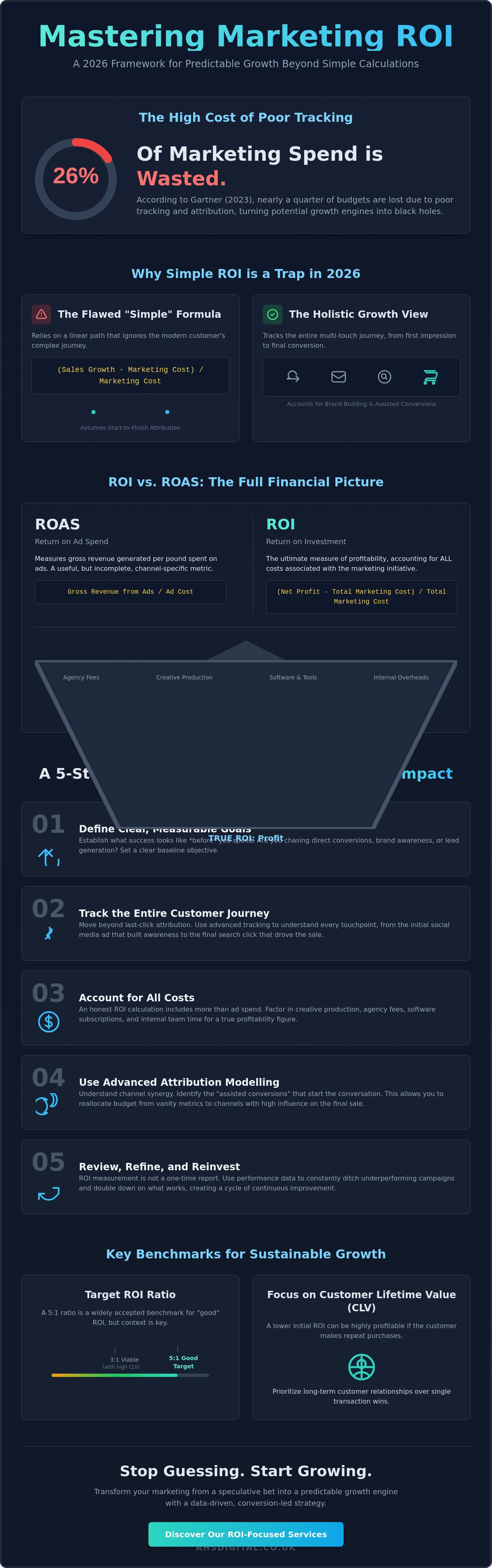
The traditional “Simple ROI” formula is often expressed as: (Sales Growth – Marketing Cost) / Marketing Cost. While this provides a quick snapshot of whether a campaign is keeping its head above water, relying on it exclusively in 2026 is a dangerous game. It assumes a linear path that rarely exists in a modern, multi-channel environment.
To better understand this concept, watch this helpful video:
The trap lies in the narrow focus of the calculation. In 2026, the customer journey is fragmented across dozens of digital touchpoints. A business might observe a 12% increase in sales and attribute it entirely to a single PPC campaign, yet this ignores the long-term brand equity built through organic content months prior. We must transition toward a view of holistic growth rather than just chasing short-term, isolated campaign wins.
The Difference Between ROI and ROAS
Return on Ad Spend (ROAS) is a useful metric, but it only tells half the story. It tracks gross revenue generated per pound spent on specific advertisements. For instance, if you spend £1,000 on Meta ads and generate £5,000 in sales, your ROAS is 5:1. However, this figure ignores your £1,500 agency fee, your creative production costs, and your internal overheads. ROI is the ultimate measure of business profitability.
Why 2026 Marketing Demands Better Measurement
The shift towards privacy-first tracking, accelerated by the 2024 phase-out of third-party cookies, has made data collection more complex. You can no longer rely on perfect, one-to-one attribution for every click. Success now requires a focus on long-term brand equity over temporary spikes in traffic. Ambitious firms partner with Digital Marketing Services to build strategies that are resilient to these data shifts. Mastering 5. how to measure marketing ROI in this climate involves blending hard data with a deep understanding of customer lifetime value.
A 5-Step Framework to Measure Your Marketing Impact
To move the needle in 2026, you need a framework that prioritises precision over guesswork. High-growth businesses don’t just “check the stats” at the end of the month; they build measurement into the very fabric of their campaigns. Here is how to structure your approach to ensure every £1 spent is working hard for your brand.
- Step 1: Define clear, measurable goals. Before you commit a single penny to a campaign, establish what success looks like. Are you chasing brand awareness or direct conversions? Knowing exactly 5. how to measure marketing ROI starts with setting a baseline for your primary objective.
- Step 2: Track the entire customer journey. Stop looking at the final click in isolation. Use advanced tracking to see how a user first engaged with your brand and what steps they took before buying.
- Step 3: Account for all costs. True ROI includes more than just your ad spend. You must factor in creative production, agency fees, and management time to get an honest figure.
- Step 4: Use attribution modelling. Understand channel synergy. A social media ad might not get the final sale, but it often introduces the customer to your brand.
- Step 5: Review, refine, and reinvest. Use performance patterns to ditch underperforming ads and double down on what works.
Setting Your Baselines and KPIs
You cannot accurately measure marketing effectiveness without identifying your organic sales growth first. If you sold 100 units last month without any ads, those 100 units shouldn’t be credited to your new PPC campaign. By isolating this “natural” growth, you avoid over-attributing success to your marketing spend.
Focus on your Customer Lifetime Value (CLV) rather than just the initial transaction. A 5:1 ratio is widely considered a “good” benchmark for ROI, meaning for every £1 spent, you generate £5 in revenue. However, if your CLV is high, you might comfortably operate at a 3:1 ratio while scaling. If you want to see how these metrics transform your bottom line, our digital marketing experts can help you map out your specific KPIs.
Tracking the Multi-Touch Journey
The path to purchase is rarely a straight line. A potential client might see a video on LinkedIn, read a blog post three days later, and eventually search for your brand directly to make a purchase. If you only track the final search, you miss the value of the video and the blog.
CRM systems are vital here, acting as the bridge that connects digital clicks to physical sales or signed contracts. They allow you to see the “messy” middle of the journey where most conversions are actually won. (Visual suggestion: An “off the wall” graphic showing a tangled web of neon lines connecting different icons like a play button, a magnifying glass, and a shopping basket to represent the non-linear journey). Understanding 5. how to measure marketing ROI in this complex environment requires a holistic view of every touchpoint. If you are ready to stop guessing and start growing, contact us today to refine your strategy.
Beyond the Spreadsheet: Measuring the ROI of Brand and Creative
Many directors view branding as a “nice to have” or a “soft” cost. They’re wrong. When you’re looking at 5. how to measure marketing ROI, you have to account for the Brand Premium. This is the tangible financial value that allows a company to charge £200 more than a generic competitor for essentially the same hardware. It’s not magic; it’s a calculated asset. High-quality imagery doesn’t just look pretty. It directly influences your Conversion Rate Optimisation (CRO). A 2023 study found that 46% of UK consumers will pay more for a brand they trust, and trust is built through visual consistency. If your identity feels disjointed, you’re leaking revenue. A cohesive branding strategy ensures every touchpoint reinforces your value.
The Impact of Professional Videography and Photography
Static stock photos are a conversion killer. In 2024, 73% of UK shoppers said they prefer seeing “real” product photos over studio renders. Professional photography services provide the authenticity that builds trust. Similarly, videography services are no longer optional for SEO. Video content increases time-on-page by an average of 2.6x, sending powerful signals to Google that your content is valuable. You don’t just measure this in direct sales. You look at:
- Social shareability and engagement rates as leading indicators.
- Dwell time and its impact on your search engine rankings.
- Click-through rates (CTR) on visual-heavy ad campaigns.
Turning Visual Identity into Tangible Growth
We’ve seen UK-based clients reduce their bounce rate by 32% simply by overhauling their visual hierarchy. It wasn’t about changing the product; it was about changing the perception. Creative ROI is the “multiplier effect” on your ad spend. If you spend £1,000 on PPC with poor creative, you might get a 1% return. With high-end web design and elite visuals, that same £1,000 spend can yield a 4% return. The creative is the lever that makes every other pound work harder. Understanding 5. how to measure marketing ROI means realising that your visual identity is the foundation of your entire sales funnel. When your brand looks like a market leader, you can price like one.
Avoiding the Attribution Trap: How to Track the Modern Journey
Measuring success by the final click is a dangerous game for growth-focused firms. It ignores the complex reality of how people actually buy. In 2026, the average B2B customer interacts with a brand 27 times before converting, according to recent industry benchmarks. If you only credit the last ad they clicked, you’re starving the very channels that sparked their interest. Mastering 5. how to measure marketing ROI requires a shift from simplistic tracking to a multi-touch perspective.
This is where assisted conversions become vital. Your social media or display ads might not close the deal immediately, but they move the needle by building trust. When SEO and PPC work together, they dominate the search results page, capturing intent at every stage. For example, a user might see a PPC ad on Monday, read a blog post on Wednesday, and finally convert via an organic search on Friday. To understand how to build that long-term organic foundation, check out our SEO Guide. It explains how organic value compounds, providing a much higher return than short-term spikes.
Comparing Attribution Models
Choosing the right model depends on your business size and the complexity of your sales cycle. A 2024 report by the DMA showed that UK businesses often misallocate up to £2,400 per month due to poor attribution choices. Use this breakdown to find your fit:
- First-Click: Best for brand awareness. It credits the initial spark that brought the user to your site.
- Last-Click: Best for short, impulsive sales cycles. It’s simple but often overvalues bottom-of-funnel ads.
- Linear: Best for nurture-heavy brands. This gives equal credit to every touchpoint in the journey.
- Data-Driven: Best for high-volume accounts. It uses machine learning to assign credit based on actual conversion paths.
For businesses with sales cycles exceeding 90 days, Time Decay models are essential. These give more weight to interactions closer to the conversion while still acknowledging the early research phase. This holistic approach is the only way to truly understand 5. how to measure marketing ROI in a fragmented digital world.
Tools for the Job in 2026
Google Analytics 4 (GA4) is your baseline. You must set up custom events to track specific actions like PDF downloads, video views, or button clicks. Data only tells you what happened; it doesn’t always tell you why. This is where heatmaps and user recordings become transformative. They reveal exactly where users get frustrated or confused on your site.
If your data shows a high bounce rate on your landing pages, the problem often lies in the user experience. We build conversion-focused websites that ensure your traffic doesn’t go to waste. A well-designed site can increase conversion rates by 200% compared to a generic template. We love a challenge, especially when it involves turning a leaky sales funnel into a high-performance engine.
Ready to see the real impact of your spend? Let’s transform your tracking today.
Turning Insights into Action: Partnering for Growth
Data serves no purpose if it sits in a spreadsheet gathering digital dust. The ultimate goal of learning 5. how to measure marketing ROI is to gain the clarity needed to pivot your strategy. Ambitious businesses in the UK don’t just track numbers; they use them to ruthlessly prune underperforming tactics. If your data shows a specific vanity channel is draining £1,200 a month with zero conversions, it’s time to stop. Move that capital into high-ROI streams like targeted SEO or performance-driven digital marketing that actually impacts your bottom line.
Fragmentation is the silent killer of growth. Hiring five different freelancers for web design, social media, and copywriting often results in a disjointed brand voice and inefficient spend. A cohesive creative suite ensures every asset works in harmony. This unified strategy eliminates the friction that typically slows down scaling efforts. When your branding aligns perfectly with your lead generation ads, your conversion rates naturally climb because the customer journey feels seamless and professional.
Why a Unified Agency Approach Wins
Our 100% U.K. based team understands the local landscape, ensuring your message resonates with British consumers and follows local regulations. When Search, Social, and Creative efforts are integrated, they create a halo effect. This means your paid ads don’t just drive immediate clicks; they build brand equity that improves your organic search performance over time. Don’t just measure the past, plan for a high-ROI future where every pound spent works twice as hard. By identifying that 5. how to measure marketing ROI is about future-proofing, you can scale with total confidence.
Ready to Move the Needle?
We don’t just deliver reports; we deliver results that transform businesses. If you’re ready to take your marketing to the next level and discuss your specific growth targets for 2026, we’re here to help. Whether you need to overhaul your digital presence or refine your current strategy, our team is equipped to handle the heavy lifting. Visit our Contact Page to book a bespoke consultation. We love a challenge, and we’re ready to help you scale your business and dominate your market.
Mastering Your Growth Metrics for 2026 and Beyond
Navigating the digital landscape of 2026 requires more than a basic calculator. You’ve seen why simple maths often fails to capture the full picture of brand value and creative impact. By implementing a structured 5-step framework and sidestepping common attribution traps, you’re now equipped to turn raw data into a strategic roadmap for your business. Mastering 5. how to measure marketing ROI isn’t just about justifying your current spend; it’s about scaling your ambition with total precision.
Stop guessing which 50% of your budget is actually working. Our 100% U.K. Based Team specialises in moving the needle for ambitious brands through a results-oriented creative suite. We’ve helped partners across the country transform their digital presence, ensuring every pound contributes to tangible growth and long-term scalability. You don’t need five different freelancers when you can partner with a cohesive team that lives for a challenge.
Ready to see real results? Take your marketing to the next level with AHS Digital
Your data is waiting to tell a better story. Let’s start writing it today.
Frequently Asked Questions
What is a good ROI for a digital marketing campaign in the UK?
A 5:1 ratio is generally the gold standard for a successful digital marketing campaign in the UK. This means for every £1 you invest, you generate £5 in revenue. High-performing sectors often reach a 10:1 ratio, while a 2:1 ratio suggests your margins are likely too slim once you account for overheads. We focus on strategies that move the needle toward that 5:1 sweet spot to ensure your business scales effectively.
How long does it take to see a positive ROI from SEO?
Expect to wait between 6 and 12 months to see a positive ROI from SEO. It’s a long-term investment that builds digital equity rather than providing the instant hit of PPC. Most UK businesses notice a measurable shift in organic traffic and conversions around the 182-day mark. Our digital marketing experts focus on building a foundation that delivers transformation rather than a temporary spike in numbers.
Can I measure the ROI of social media engagement?
Yes, you can measure social media engagement ROI by using specific attribution models and conversion tracking. While likes and shares are great for brand awareness, we focus on how those interactions translate into tangible sales. By using UTM parameters and CRM integration, you can see if that £500 ad spend resulted in the 12 new enquiries you received last month. It’s the only way to ensure your social presence isn’t just noise.
Why is my Google Ads ROI different from my CRM data?
Discrepancies between Google Ads and CRM data usually happen due to different attribution settings and cookie tracking limitations. Your CRM records the final sale date, while Google Ads might attribute it back to the original click date. Since the 2024 updates to cookie consent, a 20% data gap is standard. Understanding how to measure marketing ROI effectively requires aligning these two data sources to find the truth in the middle.
What are the most important KPIs for a new e-commerce website?
The most critical KPIs for a new e-commerce site are Customer Acquisition Cost (CAC), Average Order Value (AOV), and Conversion Rate. A healthy UK e-commerce site typically aims for a 2.5% conversion rate. If your CAC is £15 but your average order value is only £20, your business won’t scale. We help you elevate these metrics to ensure your web design isn’t just pretty, but a high-performing sales engine.
Is it worth paying for a professional branding agency if I’m just starting out?
Investing in a professional branding agency is worth it because it builds the trust necessary to convert visitors into customers. According to the 2023 Edelman Trust Barometer, 71% of consumers say it’s more important than ever to trust the brands they buy from. Starting with a cohesive creative suite prevents an expensive rebrand 18 months down the line. If you’re ready to build your brand from the ground up, contact us today.
How do I calculate ROI if my sales happen offline or over the phone?
You can track offline or phone sales by using dynamic call tracking and unique voucher codes. If a customer calls your UK office after seeing a PPC ad, dynamic number insertion attributes that sale back to the specific keyword. This bridge between digital and physical sales is crucial for how to measure marketing ROI for service businesses. We love a challenge like this, ensuring no lead goes uncounted in your growth journey.
What is the difference between ROI and ROAS in simple terms?
ROI calculates your total profit after all costs, while ROAS only measures gross revenue against your direct ad spend. If you spend £1,000 on ads and make £4,000, your ROAS is 4:1. However, if your product costs and staff wages total £3,500, your ROI is actually negative. We focus on ROI because it’s the metric that actually determines if your business is profitable and ready for future scalability.