

What if the biggest drain on your marketing budget isn’t the channel you’ve chosen, but the fact that you’re treating your strategy like a coin toss? Many UK brands find themselves trapped in a cycle of high acquisition costs, often seeing up to 60% of their digital spend vanish into broad tactics that simply don’t convert. It’s a common frustration to feel like you’re shouting into a void while your competitors seem to scale effortlessly. This guide explores 3. inbound vs outbound marketing strategies to show you how to stop the bleed and start seeing real growth.
We’ll help you stop guessing which digital channels actually move the needle and provide a clear framework for your budget allocation. You’ll discover how to blend these two approaches into a high ROI strategy that delivers a cohesive brand presence across every touchpoint. From understanding core differences to achieving higher conversion rates, we’re laying out the roadmap to transform your marketing into a performance engine. If you’re ready to elevate your digital marketing and take your brand to the next level, this guide is for you.
Key Takeaways
- Understand the fundamental “push” and “pull” mechanics to determine which strategy will most effectively move the needle for your brand’s unique growth goals.
- Master the 3. inbound vs outbound marketing landscape to build a high-ROI strategy that balances immediate proactive wins with sustainable, long term digital assets.
- Learn how to bridge the “Inbound Gap” by analysing lead costs over a 12 month period, ensuring your budget is optimised for both scalability and efficiency.
- Discover why a cohesive creative suite outperforms fragmented freelancers, especially when using targeted outbound data to fuel your organic inbound engine.
The Great Marketing Divide: Inbound vs Outbound Marketing Explained
Every ambitious brand wants to grow, but the methodology you choose to fuel that growth determines how effectively you scale. The choice between inbound and outbound marketing isn’t just a technical preference; it’s a strategic decision that dictates how you interact with your audience. Understanding the core differences between 3. inbound vs outbound marketing is essential for any business looking to move the needle in a competitive UK market.
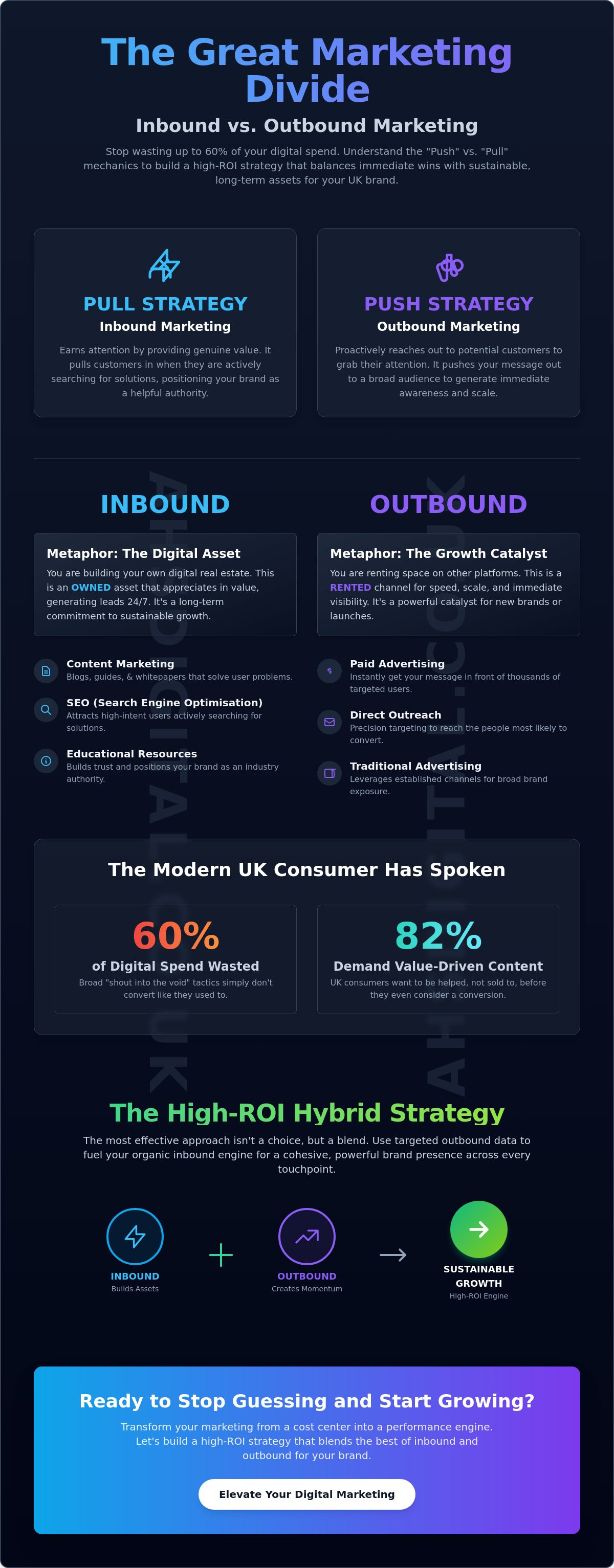
Inbound marketing is the “pull” strategy. It’s designed to earn attention by providing genuine value, positioning your brand as a helpful resource rather than a persistent salesperson. Conversely, outbound marketing is the “push” strategy. This involves proactively reaching out to potential customers to grab their attention, often through traditional advertising or direct outreach. While one waits for the customer to come to them, the other goes out to find the customer.
By 2026, consumer behaviour has shifted significantly. Recent data suggests that 82% of UK consumers now demand to see educational or value-driven content before they even consider a conversion. The “interruption” model of outbound, which relies on breaking into a user’s experience, is being challenged by the “attraction” model of inbound. People don’t want to be sold to; they want to be helped. However, both strategies have a unique role to play in a comprehensive digital marketing suite.
The Inbound Philosophy: Earning Your Way In
The inbound approach is built on the foundation of trust. Instead of shouting into a crowd, you create helpful, relevant content that solves specific user problems. This strategy transforms your brand into an authority within your niche. It’s a long term play that builds a sustainable pipeline of leads who already value your expertise. Key elements include:
- Content that addresses specific pain points and FAQs.
- Educational resources like guides, blogs, and whitepapers.
- A heavy focus on search engine optimisation to ensure your brand is discoverable when users search for solutions.
When you focus on inbound, you aren’t just buying clicks; you’re building an asset. It’s about being in the right place at the right time with the right answer.
The Outbound Approach: Buying Your Way In
While inbound is a slow burn, outbound is about speed and scale. It acts as a powerful catalyst for new brands with zero existing visibility. If you have a new product launch or a seasonal offer, you can’t always wait for organic search to catch up. Outbound allows you to get your message in front of 50,000 targeted individuals instantly. To ensure this doesn’t become “spam”, precision is vital. Modern outbound uses sophisticated data to ensure your message reaches the people most likely to convert, maintaining a high ROI and protecting your brand reputation.
Inbound Marketing: Building a Sustainable Growth Engine
Inbound marketing isn’t just a strategy; it’s a long-term commitment to building a digital asset that you own. Unlike a temporary billboard campaign in the centre of London, inbound creates a permanent presence that attracts customers to you. When comparing 3. inbound vs outbound marketing, the primary difference lies in ownership. Outbound is rented space, while inbound is your own digital real estate. For UK businesses, this means moving away from the “stop-start” nature of traditional advertising and investing in a system that generates leads while you sleep.
Successful inbound strategies for British brands focus on solving problems rather than shouting features. This methodology, explored in an academic analysis of inbound marketing by Harvard Business School, proves that businesses can significantly lower customer acquisition costs by creating value first. By choosing digital marketing services that prioritise this long game, you ensure your brand remains relevant as consumer habits shift toward self-directed research. We love a challenge, and building this engine is the ultimate way to move the needle for your business.
Content as Your Best Salesperson
Your content is the only salesperson that never takes a day off. Blogs, whitepapers, and UK-specific case studies work 24/7 to nurture prospects through the buyer journey. Evergreen content serves as the backbone of inbound ROI because it remains relevant and continues to generate organic traffic years after the initial publish date. This consistency builds immense trust. However, the quality of your branding dictates how that content is perceived. If your brand looks amateur, even the best guide will lose its credibility. High-quality visuals and a cohesive voice turn a simple blog post into a powerful conversion tool.
SEO and the Art of Being Found
Ranking for the right keywords is always better than ranking for the most keywords. In the 3. inbound vs outbound marketing debate, SEO is the magnet that pulls in high-intent users who are actively searching for your expertise. We focus on “commercial intent” keywords that lead to actual sales, not just vanity metrics. The technical side is just as critical. A slow website is a lead killer. Research shows that 40% of users will abandon a site if it takes longer than three seconds to load. Our approach to the AHS Digital web design page focuses on creating responsive, lightening-fast sites that satisfy both Google’s algorithms and your human visitors. If you want to see how your current site stacks up, feel free to contact us for a performance review.
Outbound Marketing: The Power of the Proactive Push
Forget the outdated notion that outbound marketing is a relic of the past. While some claim it’s dead because of ad-blockers, the reality is that outbound has simply evolved into a more sophisticated, data-led discipline. In 2023, research showed that 80% of users still interact with paid search results when they have high commercial intent. Outbound isn’t about shouting at a disinterested crowd; it’s about a strategic, proactive push that puts your brand in front of the right people at the exact moment they need you. When you need to test a new product or enter a fresh market in the UK, you can’t always wait months for organic reach to build. Outbound allows you to buy your way into the conversation instantly, providing the immediate feedback loop necessary to move the needle. Understanding 3. inbound vs outbound marketing requires recognising that outbound provides the raw speed and scalability that inbound often lacks in its early stages.
Digital Advertising and PPC
Managing ad spend effectively is a precision task that requires deep expertise. Partnering with a professional PPC agency ensures your budget isn’t swallowed by low-intent clicks or poorly optimised campaigns. Paid search allows you to capture traffic based on specific intent, making it one of the most efficient ways to drive immediate ROI. When comparing inbound and outbound strategies, it’s clear that outbound’s greatest asset is control. You decide exactly who sees your message and when. Retargeting then acts as the vital bridge, following a user who clicked an outbound ad but didn’t convert, staying top-of-mind until they are ready to transition into a long-term inbound relationship.
Visual Storytelling in Outbound
In a world of infinite scrolls, creative execution is the ultimate “make or break” factor for any outbound campaign. If your advertisement looks like a generic stock photo, it will be ignored. High-quality videography serves as the most effective “interrupter” on social media, using movement and narrative to halt a user’s journey. Similarly, professional photography that captures authentic, “off the wall” visuals can distinguish your brand from the sea of mediocre, AI-generated, or stock imagery. We focus on creating visuals that demand attention and provoke a reaction. This proactive creative approach ensures that your outbound efforts don’t just reach an audience, but actually resonate with them, turning a cold interruption into a genuine business opportunity.
The ROI Showdown: Comparing Costs and Results
Ambitious brands don’t just spend money; they invest it for measurable growth. When we analyse 3. inbound vs outbound marketing, the financial trajectory reveals a stark contrast in efficiency. Data from DemandMetric shows that inbound marketing costs 62% less per lead than traditional outbound methods. If your business spends £1,000 on a PPC campaign, you might see 50 leads instantly. However, once that budget hits zero, the lead flow vanishes. In contrast, a well-executed SEO strategy might cost £1,000 monthly but generates 150 leads by month 12, creating a compounding asset that lives on your site forever.
There is a critical period known as the “Inbound Gap,” which typically lasts 6 to 9 months. During this phase, outbound efforts like cold calling or display ads carry the weight of your revenue. Ambitious B2B firms often struggle here because they expect immediate results from content. However, by month 18, inbound efforts typically produce 3 times more leads per pound spent than outbound. Relying solely on one method is a recipe for stagnation. If you only use outbound, your growth is capped by your bank balance. If you only use inbound, you risk starving while waiting for the search engine algorithms to notice your brilliance.
Cost vs Time: The Marketing Trade-off
Outbound is a sprint; inbound is a marathon. Outbound marketing delivers high-cost, immediate results that stop the moment your budget ends. Inbound requires a lower ongoing financial commitment but demands patience as results take time to manifest. To scale effectively, you should allocate 60% of your budget to short-term sales through outbound and 40% to long-term brand building. This balance ensures you hit your quarterly targets while lowering your customer acquisition cost over time.
Targeting Precision vs Broad Reach
Outbound is superior for reaching prospects who don’t know they need your solution yet, essentially creating demand where none existed. Inbound excels at converting users who are already searching for answers. While inbound acts as a precision sniper targeting high-intent leads, outbound serves as a megaphone that broadcasts your message to a wider, less aware audience. For B2C brands, the megaphone is vital for brand recognition, whereas B2B growth relies on the sniper’s ability to solve specific pain points.
Don’t leave your growth to chance by choosing just one side of the coin. Discover how our digital marketing strategies can help you balance your budget and dominate your market.
Moving the Needle: How a Cohesive Creative Suite Blends Both
Hiring five different freelancers to manage your digital presence is a recipe for a fragmented brand. One person handles your SEO, another manages your ads, and a third designs your site. They rarely speak to each other. This lack of communication leads to “leakage” in your budget and a disjointed customer journey. At AHS Digital, we operate as a cohesive creative suite. We believe that the debate over inbound vs outbound marketing shouldn’t be about picking a side, but about creating a feedback loop where both channels strengthen each other.
We use outbound tactics to fuel your inbound data. For instance, a short-term PPC campaign reveals exactly which headlines and pain points resonate with your UK audience in real-time. We don’t let that data sit in a silo; we immediately inject those winning insights into your long-term inbound content strategy. This ensures your organic efforts are backed by proven performance data from day one. It’s a strategic cycle that turns cold traffic into warm leads and eventually, loyal brand advocates.
Why Cohesion is Your Secret Weapon
Consistency is the foundation of trust. If your paid social ads promise a high-end, bespoke service but lead to a web design that feels clunky or outdated, your conversion rate will suffer. Every pound you spend on outbound marketing is only as effective as the inbound destination it leads to. By maintaining a unified brand voice across all touchpoints, you increase the effectiveness of every pound spent. Our 100% UK-based team ensures that your strategy is perfectly aligned with local market expectations and cultural nuances, providing a level of strategic oversight that fragmented offshore teams simply cannot match.
Getting Started with a Unified Strategy
Ready to stop juggling separate agencies and start seeing real growth? The transformation begins with a clear roadmap. Many businesses we consult for discover they are losing up to 20% of their potential ROI due to overlapping tools or gaps in their lead nurturing process. Here is how we help you scale:
- Audit the Mix: We analyse your current inbound and outbound efforts to identify where your brand voice is cracking.
- Data Integration: We set up systems so your ad data informs your content and your SEO insights inform your outreach.
- Creative Alignment: We ensure your visuals and messaging are seamless across every platform.
We love a challenge and we’re ready to help you build your brand from the ground up. If you want a marketing engine that actually moves the needle, contact AHS Digital to request a consultation. Let’s take your marketing to the next level together.
Master Your Strategy and Move the Needle
Winning in today’s competitive landscape requires more than just picking a side. It’s about finding the sweet spot where different tactics converge to drive growth. While inbound methods build long term authority, outbound tactics provide the proactive reach needed for immediate impact. Industry data suggests that inbound leads often cost 61% less than their outbound counterparts; however, the speed of a targeted proactive campaign is what frequently sparks rapid brand transformation.
The most successful brands don’t treat 3. inbound vs outbound marketing as a binary choice. Instead, they integrate them into a cohesive creative suite where every £1 spent is tracked for maximum ROI. Our 100% UK-based team specialises in building these integrated engines, ensuring your brand achieves scalability without wasting budget. If you want to understand how specific tactics fit your goals, you can explore our insights on the importance of SEO for growth to see how organic traffic anchors your digital presence.
Ready to move the needle? Contact our UK-based team today to elevate your marketing strategy.
We love a challenge and look forward to helping your brand reach its full potential.
Frequently Asked Questions
What is the main difference between inbound and outbound marketing?
The main difference lies in how you engage your audience. Inbound marketing focuses on creating valuable content that pulls people toward your brand naturally, while outbound marketing pushes messages out to a broad audience, often interrupting their experience. It’s the difference between a magnet and a megaphone. At AHS Digital, we use both to move the needle for our clients, ensuring their brand remains visible, relevant, and consistently engaging.
Is inbound marketing cheaper than outbound marketing in the long run?
Inbound marketing is significantly more cost effective over time. According to 2023 industry data, inbound leads cost 61% less than those generated through traditional outbound methods. While outbound requires continuous spending to maintain visibility, inbound assets like blog posts or SEO guides continue to generate traffic for years without additional investment. This scalability makes it a vital strategy for long term growth and a healthier bottom line.
Can a business survive on inbound marketing alone?
A business can survive on inbound alone, but growth might be slower than expected. While 45% of marketers report that SEO provides their highest ROI, relying solely on organic discovery can leave you vulnerable to algorithm shifts. Combining inbound with targeted outbound tactics ensures a more resilient lead pipeline. We offer a cohesive creative suite to help you balance these channels effectively, building your brand from the ground up.
How long does it take for inbound marketing to show a positive ROI?
You should expect to see a positive ROI from inbound marketing within 6 to 12 months. Unlike PPC, which can generate clicks in 24 hours, inbound relies on building authority and trust with search engines and users. It’s a marathon, not a sprint. However, once the momentum builds, the compounding returns often outperform short term paid campaigns by a significant margin, providing a much higher customer lifetime value.
Which is better for a new startup: inbound or outbound?
Startups should ideally use a hybrid approach to gain immediate traction while building long term equity. Outbound tactics like LinkedIn outreach or PPC provide the quick wins needed for early cash flow, while inbound creates the foundation for organic growth. If you’re looking to elevate your brand, starting your inbound journey early is essential for future scalability and market dominance.
How does social media fit into the inbound vs outbound marketing debate?
Social media sits right in the middle of the inbound vs outbound marketing debate. Organic posts and community engagement are classic inbound tactics designed to attract and nurture followers. Conversely, paid social ads are outbound because they interrupt a user’s feed to deliver a specific offer. Using both allows you to capture attention quickly while fostering long term loyalty through high quality, engaging content that speaks to your audience.
What are some examples of outbound marketing that still work in 2026?
High impact outbound strategies for 2026 include hyper-targeted LinkedIn video ads and phygital direct mail featuring interactive QR codes. Research from the DMA shows that direct mail engagement rates remained as high as 9% in recent years, proving that physical touchpoints still work. Podcast sponsorships also remain a powerful outbound tool, allowing brands to reach niche, highly engaged audiences in a way that feels personal rather than intrusive.
Why do I need a creative agency to manage both strategies?
Hiring a creative agency ensures your brand voice remains consistent across every single touchpoint. Instead of managing five different freelancers, you get a unified team that understands how to blend SEO, UX, and PPC into one cohesive strategy. Our 100% U.K. based team loves a challenge; we work to ensure your marketing isn’t just a series of tasks, but a transformative engine for your business growth.