

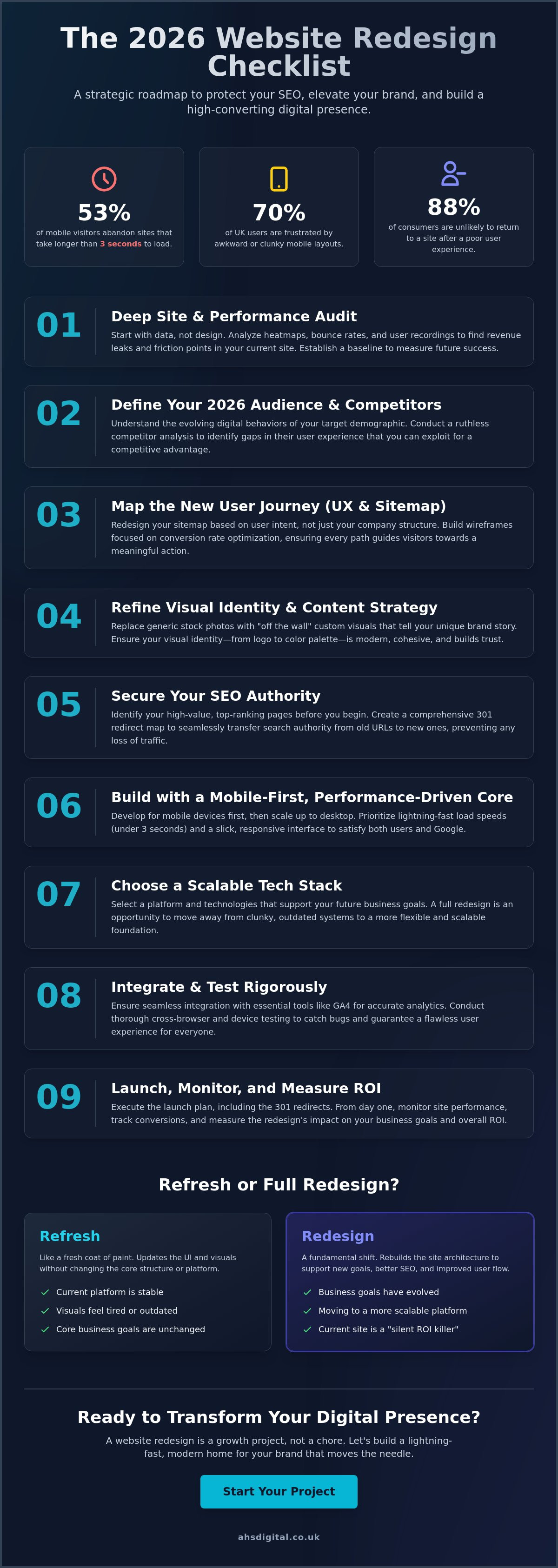
A staggering 53% of mobile visitors will abandon your site if it takes longer than three seconds to load. It’s a brutal reality in 2026, where falling behind competitors with slicker interfaces isn’t just a vanity issue, it’s a direct threat to your bottom line. We know the fear of losing your hard-earned Google rankings is real, and the confusion over technical jargon often makes a refresh feel like a gamble. This is why we have perfected our 9. website redesign checklist to help you navigate this transformation with absolute confidence.
We agree that your brand deserves a lightning-fast, modern home that doesn’t sacrifice organic visibility for style. We’re here to show you exactly how to protect your rankings while building a cohesive brand story that resonates across every digital touchpoint. In this article, you’ll discover the essential steps to boost your conversions and ensure your new site moves the needle for your business. We’re covering everything from UX architecture to the technical safeguards that keep Google happy during your launch.
Key Takeaways
- Elevate your digital presence by transforming your website into a strategic growth engine, starting with a deep audit of what drives results and an analysis of 2026 audience behaviours.
- Secure a distinct competitive advantage using our 9. website redesign checklist, ensuring your new site is lightning fast and mobile first to captivate users and satisfy Google.
- Protect your hard earned search authority and prevent brand erosion by mastering technical SEO essentials, including high value page identification and a seamless 301 redirect map.
- Move the needle on your business goals by replacing generic stock imagery with “off the wall” custom visuals that communicate your unique brand story with confidence.
- Ensure long term scalability with rigorous testing and GA4 integration, allowing you to track every lead and measure your ROI from day one.
What is a Website Redesign Checklist and Why Does Your Business Need One?
Think of your website as the digital front door to your business. If that door is creaky, outdated, or stuck, potential customers will simply walk away. A 9. website redesign checklist isn’t just a simple to-do list; it’s a strategic roadmap designed to move the needle for your brand. In the fast-paced UK market, standing still is the same as moving backwards. When you treat a redesign as a growth project rather than a chore, you position your business to outpace competitors who are clinging to 2022 aesthetics.
To see how a professional approach can transform a brand in record time, watch this Snickers redesign session:
Ignoring your digital presence comes with a heavy price tag. Brand erosion happens slowly, then all at once. If your site looks like a relic of the past, users assume your services are outdated too. Most ambitious brands hit the “3 year itch,” a point where technology and user expectations have moved so far ahead that the current site feels clunky. Instead of juggling five different freelancers who don’t talk to each other, smart businesses choose a cohesive creative suite to ensure every element works in harmony. This unified approach eliminates the friction that kills conversions.
The Difference Between a Refresh and a Full Redesign
A refresh is like a fresh coat of paint; it updates the UI without changing the plumbing. You might choose this if your current platform is stable but the visuals feel tired. However, if your business goals have shifted or you’re moving to a more scalable platform, a full redesign is essential. This process involves rethinking your entire site architecture to support better SEO and user flow. A redesign is a fundamental shift in the user journey that transforms your site from a static brochure into a high-performing sales tool.
Signs Your Current Site is Silently Killing Your ROI
Your site might be losing you money without you even realising it. Slow loading speeds are the primary culprit. If your pages take longer than 3 seconds to load, you’ve likely lost 40% of your audience before they’ve even seen your logo. Mobile experience is another critical factor, as awkward layouts frustrate 70% of UK users who browse on the go. When your old visuals no longer match your premium brand identity, you create a trust gap. By following web design principles that focus on both beauty and functionality, you can turn these losses into gains. A solid 9. website redesign checklist ensures you don’t miss these silent killers during your transformation.
Phase 1: Strategy, Audience, and the Evolution of Your Brand Story
A successful redesign doesn’t start with a blank canvas; it starts with a cold, hard look at the data. Before you change a single pixel, you must perform a deep audit of your current digital footprint. In 2024, data from Forrester suggested that 88% of online consumers are less likely to return to a site after a poor user experience. By 2026, this threshold for frustration will be even lower. You need to identify exactly where your current site is leaking revenue. Look at your heatmaps, track your bounce rates, and find the friction points that cause users to abandon their carts. This deep dive forms the bedrock of your 9. website redesign checklist.
Defining your 2026 target audience requires more than just basic demographics. You need to understand their evolving digital behaviours. Future-focused brands are already preparing for a landscape where Gen Alpha and younger Millennials dictate trends, demanding hyper-personalisation and instant gratification. Simultaneously, you must conduct a ruthless competitor analysis. Don’t just look at what they do well; find the gaps in their user experience. If your main competitor requires five clicks to reach a checkout, your goal is to make it two. Without these insights, the rest of your 9. website redesign checklist is just guesswork.
Mapping the New User Journey
Your sitemap is the blueprint for your digital growth. It shouldn’t be a list of pages you think you need, but a reflection of real search intent and user needs. We focus on conversion rate optimisation from the very first wireframe, ensuring that every path leads a visitor toward a meaningful action. We build sites that don’t just look pretty but actually move the needle for your business. Our digital marketing services ensure that every element of the user journey is geared towards a tangible ROI.
Refining Your Visual Identity
A logo refresh is often the spark that ignites a full website redesign. If your visual identity feels rooted in the past, your entire brand perception suffers. A professional colour palette and bespoke typography create an immediate sense of trust and authority. This isn’t just about aesthetics; it’s about scalability and consistency across every touchpoint. For a deeper look at how to align your visuals with your business goals, explore our branding agency pillar to see how we build brands from the ground up.
Ready to transform your digital presence into a high-performing asset? If you want to ensure your strategy is airtight for 2026, contact me today to discuss your project.
Phase 2: The Creative Suite – Visuals, UX, and Lightning Fast Performance
Phase 2 moves your project from the whiteboard to the screen. It’s where your brand identity takes a digital form. Every item on your 9. website redesign checklist must prioritise mobile first architecture. Since Google shifted to mobile-first indexing in 2019, a desktop-only focus is a recipe for invisibility. In 2026, mobile users represent over 60% of all web traffic. Your site needs to be responsive, lightning fast, and incredibly intuitive to move the needle for your business.
Speed isn’t just a luxury; it’s a core requirement for conversion. Research shows that a 1 second delay in page load time can lead to a 7% reduction in conversions. We build on technical architectures that strip away bloat and prioritise performance. We also ensure your CMS is manageable. You shouldn’t need a degree in computer science to update a blog post. Our 100% U.K. Based team empowers you to manage content yourself, keeping your site fresh and relevant without technical headaches.
The Power of Professional Photography and Video
High quality visuals are the heartbeat of a modern site. Ditch the generic stock photos of people in suits shaking hands. They’re forgettable and erode trust. Investing in custom photography builds immediate credibility. It shows the world you’re a real, established business rather than a faceless template. Use videography and drone footage to add a cinematic layer to your story. Imagine a dramatic, high contrast shot of a vintage camera lens reflecting a modern digital interface. It’s bold, memorable, and uniquely yours. These “off the wall” visuals separate leaders from followers.
UX and UI Design That Converts
UX and UI design are about more than just looking pretty; they’re about guiding the user journey. We use white space to let your content breathe and modern typography to ensure readability across all devices. Navigation must be intuitive. If a user can’t find your contact page within two clicks, you’ve lost them. We also adhere to WCAG 2.2 accessibility standards to ensure your site works for everyone. This is vital, considering there are over 16 million people in the UK living with a disability who require accessible digital interfaces.
- Intuitive Navigation: Leads users toward a clear call to action without confusion.
- White Space: Reduces cognitive load and keeps the focus on your core message.
- Accessibility: Ensures your 9. website redesign checklist includes compliance for all users.
- Modern Typography: Enhances brand personality while maintaining perfect legibility.
We love a challenge when it comes to complex layouts. By combining aesthetic flair with rigorous technical standards, we create a cohesive creative suite that represents your brand at its best. This holistic approach ensures your new site isn’t just a digital brochure, but a high-performing asset designed for scalability.
Phase 3: The Technical SEO Checklist – Protecting Your Rankings
Launching a stunning new site is a major milestone, but it’s a wasted effort if your organic traffic vanishes overnight. Too many brands treat SEO as an afterthought during a build, only to see their visibility drop by 40% or more post-launch. This phase of your 9. website redesign checklist focuses on safeguarding your digital equity. You’ve spent years building authority; don’t let a URL change or a missing tag wipe it out. We start with a comprehensive SEO audit to identify the 20% of pages that generate 80% of your conversions, ensuring these high-value assets receive the most attention during the transition.
Preserving Your Hard Earned Traffic
Changing your URL structure without a 301 redirect map is a digital disaster. It breaks every external link pointing to your site and frustrates users with 404 errors. You must remember that Google treats new URLs as entirely new pages. If you move a page without telling the search engine where it went, you lose the ranking power it accumulated over years. This isn’t just about technical housekeeping; it’s about revenue protection. For a deeper look at managing your site’s health, explore our SEO guide for technical best practices. Once your new site is live, submit a fresh sitemap to Google Search Console immediately to speed up the indexing process.
Content Refresh and Keyword Strategy
A redesign is the perfect moment to prune your content library. Audit your existing blog posts to decide which should be kept, merged, or deleted. Thin content that hasn’t seen a visitor in 12 months is likely weighing your site down. By 2026, search patterns have shifted toward AI-driven extraction. This means your content must be structured for clarity, using precise headers and concise summaries that AI models can easily parse. We integrate primary and secondary keywords naturally into the new design, ensuring they move the needle without feeling forced. Pay close attention to these elements:
- Meta Tags: Write unique titles and descriptions for every single page to maximise click-through rates.
- Image Alt Text: Optimise all visual assets to improve accessibility and rank in image search results.
- Internal Linking: Ensure all internal links are specific and direct to the correct pages, avoiding generic “click here” anchors.
- AI Readiness: Update content to answer direct questions, reflecting how 60% of users now interact with search engines.
Your technical foundation determines your ceiling for growth. By following this 9. website redesign checklist requirement, you ensure your new site is fast, crawlable, and ready to dominate the 2026 search landscape. Don’t leave your rankings to chance when you can build them into the architecture of your new site from day one.
Phase 4: Launch and Post Launch Growth Strategy
The final stage of your 9. website redesign checklist isn’t just about flipping a switch; it’s about a controlled, strategic explosion into the market. Before you announce your new digital home to the world, you must perform rigorous cross browser and cross device testing. Statistics from 2024 show that 55% of global website traffic comes from mobile devices, so your site must look flawless on everything from an iPhone 15 to a 27 inch iMac. We test every hover state, every button, and every animation to ensure the experience is seamless.
Data is your most valuable asset. We implement tracking and goal measurement from day one using GA4. You shouldn’t guess if your redesign is working; you should know. By setting up custom events and conversion paths immediately, you can track the 20% increase in engagement often seen after a successful UX overhaul. Once the technical foundation is solid, it’s time to create a “hype” campaign. Use your social media channels and email lists to drive initial traffic. A well timed teaser campaign can increase launch day traffic by up to 150% compared to a “soft” launch.
A website is never truly finished. We plan for continuous improvement based on real user data and heatmaps. Tools like Hotjar or Microsoft Clarity allow us to see exactly where users click and where they get frustrated. This allows for iterative updates that keep your brand ahead of the curve throughout 2026 and beyond.
The Launch Day Protocol
Launch day requires a military level of precision. We check all forms and contact points to ensure they’re functioning perfectly. There’s nothing worse than a beautiful site that can’t generate leads. You can see how we’ve structured a high converting, functional entry point on our contact page as a benchmark. We also verify site speed using Core Web Vitals. In 2026, a 0.1 second delay in load time can reduce conversion rates by 7%, so we aim for peak performance across the board.
Beyond the Launch – Moving the Needle
The launch is just the beginning of your growth journey. To truly move the needle, you need a robust digital marketing strategy that keeps the momentum going. A redesign provides the perfect “hook” for new PPC campaigns and refreshed SEO content. This is where the value of a results driven partner who loves a challenge really shines. We don’t just deliver a file and disappear; we stay in the trenches with you to ensure your ROI continues to climb month after month. Your digital transformation should be a catalyst for long term scalability.
Ready to Move the Needle in 2026?
A website redesign isn’t just a visual facelift; it’s a strategic pivot. By prioritising your brand story and audience evolution, you ensure your digital presence resonates with the 2026 market. Integrating lightning-fast performance and seamless UX into your creative suite prevents user drop-off, while a rigorous technical SEO audit protects the organic rankings you’ve worked years to build. This 9. website redesign checklist serves as your roadmap to ensuring no detail is overlooked, from the initial strategy phase to post-launch growth.
You don’t have to navigate this transformation alone. Our 100% U.K. Based team of creative experts acts as your strategic partner, offering a cohesive creative suite that covers everything from branding to complex technical migrations. We have a proven track record of increasing ROI through web transformation, helping ambitious brands turn their digital platforms into high-performing assets. We love a challenge and we’re ready to help you build something you’re proud of.
Take your marketing to the next level with a strategic redesign
The digital landscape moves fast, but with the right strategy, your brand will stay ahead of the curve. Let’s create something remarkable together.
Frequently Asked Questions
How long does a professional website redesign typically take?
A professional website redesign typically takes between 12 and 16 weeks from the initial strategy phase to the final launch. This timeline ensures we cover every step of your 9. website redesign checklist, including UX research, wireframing, and custom development. While smaller brochure sites might wrap up in 8 weeks, ambitious brands requiring complex integrations should plan for a 4 month window to ensure a polished, high performance result.
Will I lose my Google rankings if I redesign my website?
You won’t lose your Google rankings if you implement a robust 301 redirect strategy and maintain your URL structure where possible. Industry data suggests that failing to map old URLs to new ones can result in a 40% drop in organic traffic within the first 30 days. We focus on preserving your hard earned authority by auditing every page before the new site goes live, ensuring your SEO remains intact.
What is the average cost of a website redesign for a UK business?
UK businesses typically invest between £5,000 and £20,000 for a professional redesign, according to 2024 industry benchmarks for mid-sized enterprises. High end bespoke builds with advanced functionality or e-commerce integrations can exceed £50,000 depending on the project scope. We recommend reviewing our Web Design services to see how we balance high impact aesthetics with functional ROI for our clients.
Do I need to change my hosting provider during a redesign?
You don’t necessarily need to change hosting, but it’s often the best time to upgrade if your current provider fails to deliver sub-200ms server response times. Since Google’s Core Web Vitals prioritise speed, 40% of users will abandon a site that takes longer than 3 seconds to load. If your current host can’t scale with your new build, moving to a dedicated UK-based server is a smart move for your brand.
How often should a business redesign its website to stay competitive?
Most ambitious brands should refresh their digital presence every 2 to 3 years to keep pace with evolving technology and design trends. A study by Adobe found that 38% of people stop engaging with a website if the layout is unattractive or outdated. Regular updates ensure your site remains lightening-fast and fully responsive, preventing your conversion rates from stagnating as competitors innovate and move the needle.
Can I keep my current content or should I rewrite everything?
You can keep high performing content, but we find that 70% of legacy copy usually benefits from a refresh to align with modern search intent. If your current pages aren’t converting, it’s the perfect time to audit your messaging. Rewriting allows you to bake your 9. website redesign checklist requirements directly into your copy, ensuring every word serves a specific business goal and speaks to your target audience.
What is the most important thing to check before launching a new site?
Testing mobile responsiveness across at least 5 different device types is the most critical step before hitting the launch button. With over 55% of global web traffic coming from mobile devices, a layout that breaks on a smartphone will tank your ROI instantly. We also run a full crawl to identify 404 errors, ensuring your user journey is seamless from the very first click on the live server.
How do I know if I need a refresh or a full redesign?
You need a full redesign if your conversion rates have dropped by 15% or more over the last 12 months despite steady traffic. A simple refresh works for minor aesthetic tweaks, but a full overhaul is necessary when your underlying technology is outdated or no longer scalable. If you’re struggling to integrate new marketing tools or your bounce rate exceeds 70%, it’s time for a transformative approach to your digital presence.